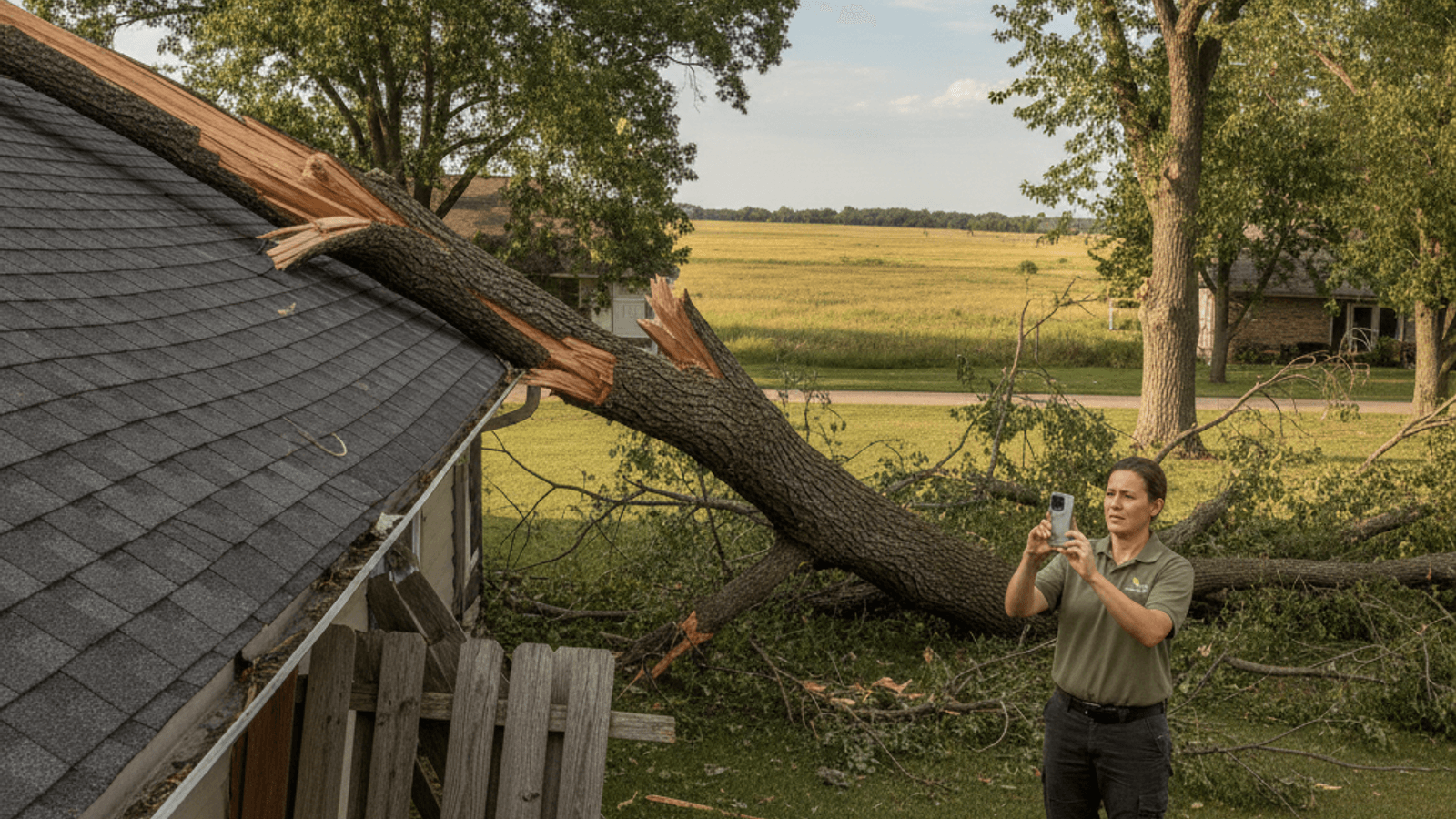
A fallen tree limb on a roof or fence requires distance, hazard checks, documentation, and professional assessment. Keep people away from the damaged area. Contact the utility for electrical hazards, then photograph the scene from a safe location before arranging tree removal and structural repair.
Safety first, before anything else
Before touching anything, look up and around. Stay clear if the tree or limb is touching or near a power line or service drop. Contact the utility so trained personnel can handle the electrical hazard. Call emergency services if someone faces immediate danger. Don’t move the tree, cut it, or clear a path around it yourself.
If the tree came down near a gas meter or gas line, check for signs of a gas hazard without approaching the damage. If you smell gas, move everyone away and contact the gas utility from a safe location.
Once you’ve confirmed there’s no line or gas hazard, stay off the roof. A limb resting on roof decking can be hiding structural damage underneath that isn’t obvious from a ladder, and climbing up to inspect it yourself before the tree is professionally removed is one of the more common ways people get hurt after storms that otherwise caused only property damage.
Document everything before anyone moves anything
Document the scene before cleanup when it is safe to do so. Take photos and video from the ground, including the tree’s resting position, the point of impact, visible debris, and wide views of the property. Photograph the base or break point only if you can do so without approaching hanging branches, unstable wood, or electrical hazards.
Write down the date and approximate time of the storm and when you discovered the damage, and if you can safely get it, a rough sense of the limb’s size and what section of roof or fence it’s resting on. None of this needs to be technical. It just needs to exist before the tree is moved, because once storm damage cleanup starts, the scene changes and photos taken afterward won’t carry the same weight with an adjuster.
Contact your insurance company or agent before cleanup when conditions allow. Ask what documentation, approvals, and records your policy requires. If work must begin to address an immediate hazard, prioritize safety and retain photos, written scopes, invoices, and messages. Coverage varies by policy and circumstances. Our guide to homeowners insurance and tree removal in Topeka explains the questions to raise with your carrier.
Getting the tree off is the first move, not the whole job
Once electrical and other immediate hazards are addressed, ask an independent provider to assess the tree and damaged structure. Emergency tree service may be appropriate when hanging branches, unstable wood, or structural damage create danger. The provider should evaluate access, obstacles, tree condition, and the intended result before removal begins.
But removing the tree is step one, not the finish line. Once the limb is off, you’re left with whatever damage it caused underneath: broken roof decking, torn shingles, a collapsed section of fence, sometimes gutter or siding damage from branches that scraped down the side of the house on the way down.
Don’t let the tree crew and the roofer treat it as someone else’s problem
This is where things go sideways for a lot of homeowners. A tree removal crew’s job is to get the tree off safely and clear the debris. A roofer’s or fence contractor’s job is to repair the structure. If nobody’s coordinating between those two jobs, you can end up with gaps: a tarp that wasn’t secured properly between the tree crew leaving and the roofer arriving, or a fence repair scheduled before the last of the root ball or heavy limb sections have actually been hauled off the property.
Ask each provider to define where its work ends and the next provider’s work begins. Confirm who will address exposed roofing, when debris will be cleared, and when a roofer or fence contractor can inspect the structure. Put those responsibilities and scheduling details in writing instead of assuming one provider will handle another trade’s work.
What to expect on cost before you’re stuck deciding under pressure
Storm-related estimates depend on the tree’s condition, its position against the structure, access, obstacles, and the requested cleanup. Ask the provider for a written quote describing removal, hauling, stump work, and any temporary protection it has agreed to provide. Confirm what isn’t included and ask your insurer what documentation it needs. Comparing written scopes helps reveal differences that a single total cannot explain.
Fence damage often gets treated as an afterthought, and it shouldn’t
A crushed or leaning fence needs its own assessment, especially around pets, children, or a pool. Keep people and animals away from unstable sections. Ask the tree provider and fence contractor to identify their separate scopes, including debris access and any sections that must remain undisturbed until the tree work is complete.
What this looks like differently depending on the storm type
Wind, ice, and other storm conditions can leave different damage patterns. Don’t assume an unchanged limb or tree is stable. Stay clear of hanging branches and damaged trees, and don’t cut wood under tension. A professional assessment should determine whether the damage can be pruned safely or requires removal.
Frequently asked questions
Should I call my insurance company before or after the tree is removed?
Call before removal when conditions allow, but don’t delay action needed to address an immediate hazard. Ask your carrier what documentation and approvals your policy requires, and keep photos, written scopes, and invoices.
Is it safe to remove a small limb from my roof myself?
If it’s touching or near a power line, no, never. Even for a smaller limb with no line involved, climbing onto storm-damaged roof decking carries real risk since the structure underneath may be compromised in ways that aren’t visible from above.
How do I know if a fallen limb caused structural damage versus just cosmetic damage?
You often can’t tell from the ground or from photos alone. Broken decking, cracked rafters, or displaced structural members aren’t always visible until the debris is cleared and a roofer inspects underneath, which is another reason not to climb up and check yourself.
If a limb or tree has fallen on your roof or fence, call Topeka Tree Pro at (785) 333-4052. We’ll connect you with an independent insured tree-service provider serving Greater Topeka. Confirm availability, qualifications, and the written scope directly with the provider.