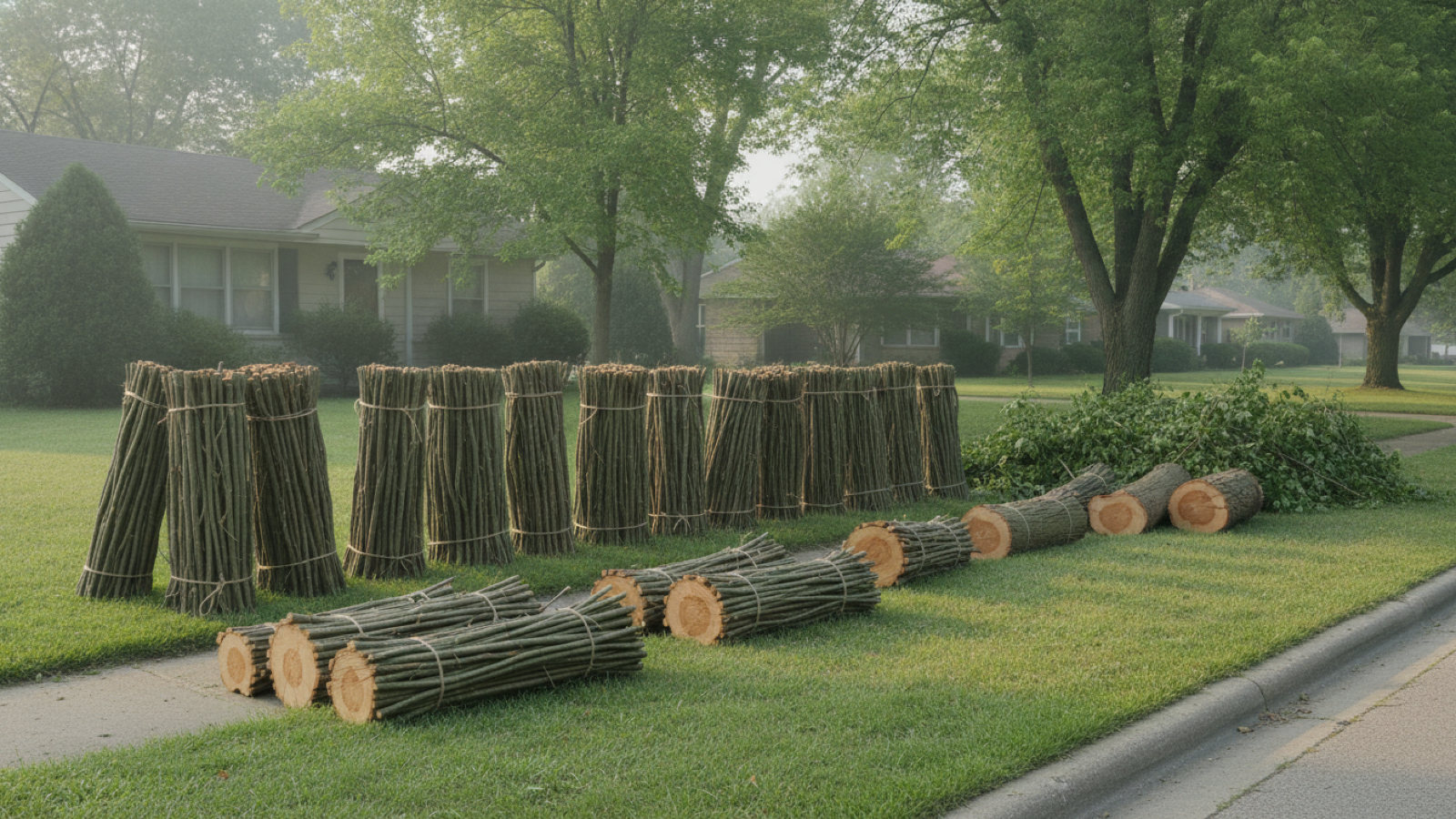
Tree debris disposal in Topeka may involve curbside collection, self-hauling, provider haul-off, or an approved burn plan. The right choice depends on current agency rules, debris type, load size, equipment, and the written service scope.
Check current requirements before cutting or loading material. Program limits, facility charges, operating hours, and burn restrictions can change. A provider’s estimate should state whether chipping, hauling, logs, stump debris, and disposal are included.
What are your options for tree debris disposal in Topeka?
The practical options depend on the material and current local requirements.
Curbside collection. Check whether the debris type, bundle, container, and collection week qualify under current Shawnee County rules.
Self-haul. Confirm the facility accepts the material, then compare vehicle requirements, current charges, and operating hours.
Burning. Verify current fire-department and environmental requirements before treating burning as a disposal option.
Provider haul-off. Ask whether chipping, logs, brush, stump debris, and disposal appear in the written estimate. Don’t assume every quote includes the same items.
What will Shawnee County pick up at the curb?
Shawnee County Solid Waste’s live rates page, snco.gov/sw/service.php, is the current collection rulebook. Under 95-gallon rate details it says: “Allows for up to 15 bags of yard waste (leaves, grass, etc.), which also includes bundled branches and trimmings.” That page does not publish a bundle length or diameter.
Bundle size is stated in a different document. The 2025 Lake Region Solid Waste Management Plan, revised October 17, 2025, section 7.7.4, says: “Bundled tree limbs are to be no longer than 4 feet in length and/or 18 inches in diameter.” That wording is diameter, not circumference. Do not treat those two pages as one measurement.
Keep tree debris separate from soil, rock, concrete, and other project waste. If the pile doesn’t clearly fit those published rules, call Shawnee County Solid Waste at 785.233.4774 before placing it at the curb.
What does it cost to haul brush to the Topeka yard waste facility?
The $22 and $23 figures on the county rates page are not a drop-off tip fee. That page dates them “Residential rates as of February 1, 2023” and lists a 95-gallon rate of $22.00 for City and $23.00 for County. The same page also says: “Refuse and recycling collection: Rates are $22.00 for City customers and $23.00 for Rural customers.” Those are monthly collection rates. Confirm them before you treat them as current.
For self-haul, two named Topeka drop-offs publish an address. Garick’s Topeka Biomass Facility lists 2200 NW Water Works Way, Topeka KS 66606. The 2025 Lake Region plan names that compost site as City of Topeka Forestry Department, “Operated as Garick Biomass & Yard Materials Recycling Center.” Garick’s own page lists hours and does not publish a current drop-off fee. Confirm the charge before you load.
Custom Tree Care’s Forestry Recycling Center at 3431 SE 21st Street, Topeka, publishes this drop-off table: small pickups/trailer 4’x8’ or smaller $15; full-size pickups/trailers 4’x8’ or greater $25; single axle dump truck/grapple $75; tandem axel dump truck/grapple $200. The page says “$25 plus a volume-dependent fee for logs.” It also says: “Prices and hours are subject to change.” Verify before you load, and unload the truck yourself.
Estimate the full self-haul scope before comparing options. Consider loading, vehicle or trailer access, unloading, repeat trips, and any material the facility won’t accept. Compare those tasks with a provider estimate that clearly identifies chipping and haul-off.
Can you burn brush in Topeka?
Don’t burn brush until the Topeka Fire Department confirms the current permit, material, site, weather, supervision, and notification requirements for your situation. A permit or approval for one type of fire doesn’t automatically authorize tree-debris disposal.
Describe the material accurately, including whether it is fresh, wet, treated, diseased, or mixed with leaves and other waste. Ask the department what is allowed and whether another agency’s rules also apply. Don’t rely on a backyard fire ring as a substitute for an approved disposal plan.
Does the City of Topeka pick up storm debris?
The city may announce special debris instructions after a storm, but availability and accepted material depend on the specific announcement. Check official city updates before placing storm debris at the curb.
Keep piles away from power lines and other hazards. Stay clear of downed lines, hanging branches, and unstable damaged trees. Contact the utility for electrical hazards. If a limb struck a structure, review our guide to storm damage to a roof or fence before arranging safe cleanup.
One exception worth knowing if you own ground out by the lake. When a tree comes down across a Corps of Engineers project boundary near Perry Lake, cutting it up is a federal permission question before it is a disposal question, and the narrow dead-wood allowance in that rulebook is not permission to haul the wood home. Our guide to Corps of Engineers tree removal near Perry Lake walks through it.
Is ash wood still quarantined in Shawnee County?
No, and this is where a lot of older advice is now wrong.
The federal emerald ash borer domestic quarantine was removed by USDA APHIS in a rule that took effect January 14, 2021. The Kansas Department of Agriculture followed, rescinding its county EAB quarantines by March 1, 2021. Shawnee County was one of the ten Kansas counties covered, along with Atchison, Doniphan, Douglas, Jackson, Jefferson, Johnson, Leavenworth, Miami, and Wyandotte. The state shifted its effort to education, outreach, survey, and biological control instead.
So moving ash wood out of Shawnee County is no longer a regulated act. That does not make it a good idea. Long-distance EAB spread has always been driven by people hauling infested firewood, not by beetles flying, and the reason the quarantine came off was that it wasn’t slowing the pest down, not that the risk disappeared. Burn ash locally or let the crew dispose of it. Don’t load it up for a lake cabin. Our fuller writeup on emerald ash borer in Shawnee County covers what an infested tree looks like and when treatment is still worth it.
What does a tree crew haul away, and what gets left?
Removal quotes don’t all include the same debris work. Ask whether the written scope includes cutting, chipping, logs, brush, hauling, disposal, and final cleanup.
Confirm whether stump grinding is included and where grindings will remain. Grinding a stump doesn’t establish that the entire connected root system is gone. Our guide to tree removal cost in Topeka explains how to compare scope, access, obstacles, and intended results.
There’s also a licensing angle worth knowing. Topeka requires tree companies working in the city to hold a city license, and under TMC 12.65.030(b) a permit for work on public property can be revoked if the person doing the work fails to remove leaves, trimmings, branches, stumps, or trash from the premises. A crew that abandons your parkway full of brush isn’t just being sloppy. The permit rules in our Topeka tree removal permit guide cover which jobs need city approval in the first place.
Topeka Tree Pro connects Greater Topeka homeowners with independent insured tree-service providers. Ask whether haul-off is included for a tree removal in Rossville or a storm cleanup.
Call (785) 333-4052 to request an estimate. Verify availability, qualifications, and every debris line item directly with the matched provider.
Frequently asked questions
How much yard waste will Shawnee County collect?
The live rates page allows “up to 15 bags of yard waste (leaves, grass, etc.), which also includes bundled branches and trimmings.” If a tree project exceeds that, compare self-haul with a written provider haul-off quote.
How should branches be prepared for curbside pickup?
The live rates page does not publish bundle dimensions. The 2025 Lake Region plan says bundled tree limbs are to be no longer than 4 feet in length and/or 18 inches in diameter. Confirm uncertain piles with Shawnee County Solid Waste at 785.233.4774 before collection day.
What does the Topeka yard waste site charge for brush?
County $22/$23 figures are monthly 95-gallon collection rates as of February 1, 2023, not a tip fee. Garick at 2200 NW Water Works Way does not publish a current drop-off fee on its own page. Custom Tree Care publishes a vehicle table, with prices subject to change. Verify before you load.
Do I need approval to burn brush in Topeka?
Confirm the current requirements directly with the Topeka Fire Department before burning. Describe the material and location, then ask about permits, daily approval, site conditions, and other applicable rules.
Can I burn leaves in Topeka?
Don’t assume leaves qualify for open burning. Check current fire-department and county rules for the location and material. Use an approved collection or disposal option when burning isn’t authorized.
Can I burn wood from a tree that was just removed?
Don’t assume freshly cut wood qualifies. Tell the fire department whether the material is fresh, wet, treated, diseased, or mixed with other debris. Follow its current direction instead of relying on a generic seasoning period.
Does the City of Topeka collect storm debris?
Check official city announcements after each storm. Any collection area, accepted material, placement instructions, schedule, and charge depend on the announced program. Never place or handle debris near a downed power line.
Can I still move ash firewood out of Shawnee County?
Legally, yes. Kansas rescinded its county emerald ash borer quarantines by March 1, 2021, after the federal quarantine was lifted on January 14, 2021. It’s still poor practice, because moving infested firewood is the main way the beetle travels long distances. Burn ash where it fell or have the crew dispose of it.
What happens to the wood chips from a tree job?
It depends on the written scope. Ask whether the provider will haul chips away, leave them on site, or exclude chipping. If you want chips retained, agree on the amount and placement before work begins. Check current city information separately if you plan to purchase processed mulch.