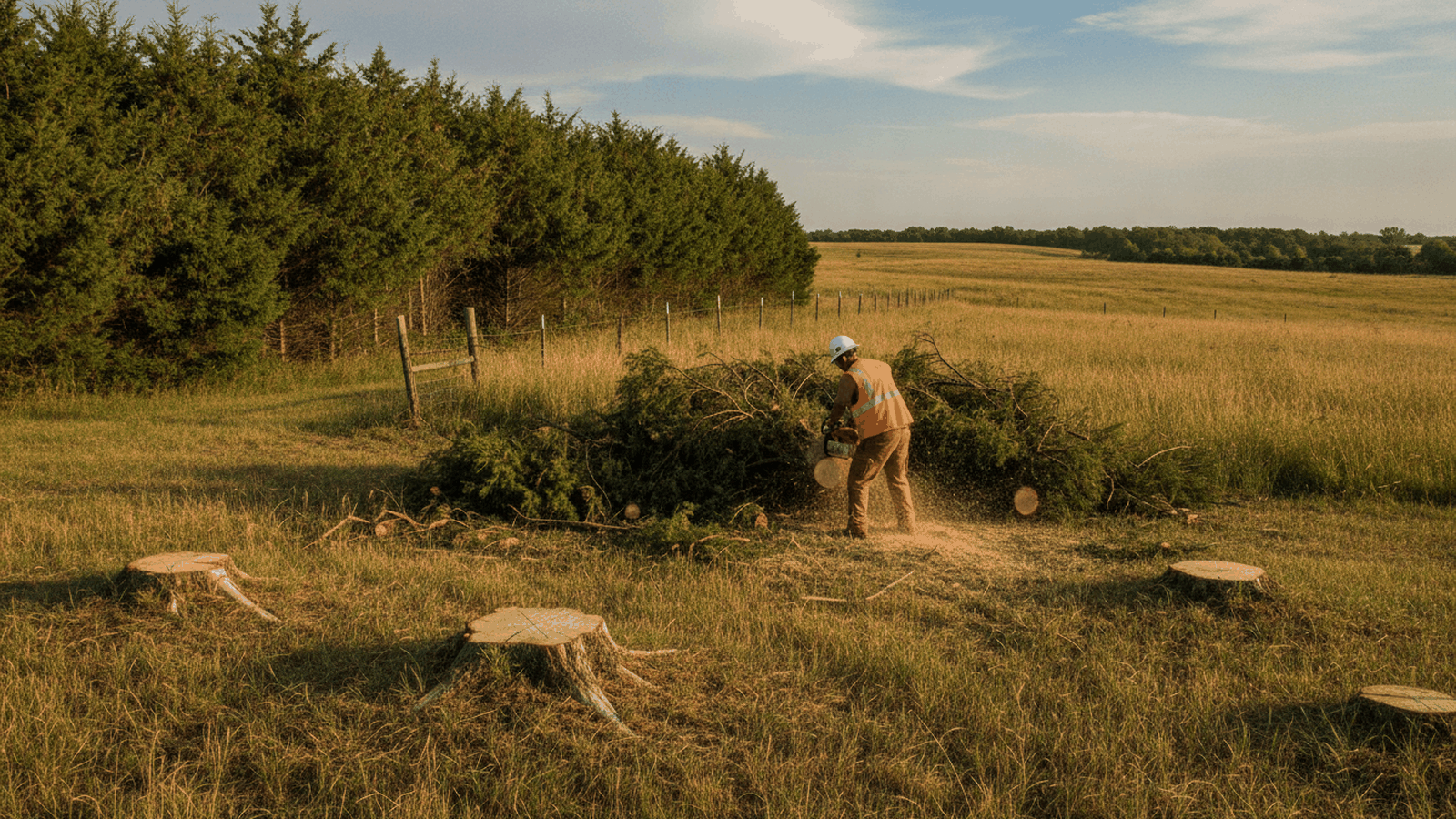
Land clearing cost in Topeka can’t be set reliably from acreage alone. Independent providers need the property’s actual density, access, obstacles, tree condition, and intended end result. Ask each provider for a written estimate that separates cutting or removal, hauling, stump work, and any permissions.
Why can eastern redcedar change a clearing scope?
Eastern redcedar can spread into places where it isn’t wanted. The Kansas Forest Service explains that birds and other animals carry its fruit. Where stems have become dense, a provider may need to evaluate the area as a lot-clearing project instead of isolated trimming.
Current height and density should be documented during the site visit. Those conditions help define the work, but they don’t establish a price without an actual provider estimate.
What does the five-foot redcedar guidance mean?
In K-State MF-1021, five feet is a condition attached to prescribed-burning guidance. It isn’t a land-clearing price threshold. The publication says a single burn may kill eastern redcedar below that height when adequate fuel is available.
That statement doesn’t make burning suitable for a specific property. It also doesn’t establish the cost of mechanical work. Actual density, access, obstacles, tree condition, and intended land use still need inspection. Ask the provider to explain how those conditions affect the written scope.
Can prescribed burning replace mechanical clearing?
That decision can’t be made from cost alone. K-State discusses prescribed burning as a brush-management tool, but suitability depends on the actual property, current conditions, and required permissions.
Don’t use general wind or fuel guidance as instructions for a do-it-yourself burn. Contact the relevant fire authority and a qualified prescribed-burning professional before planning one. The tree-debris disposal guide explains why disposal and burning must be scoped separately.
What options should you compare before mechanical clearing?
Options may include selective cutting, mowing where appropriate, mechanical clearing, or another land-management method. A provider should inspect density, terrain, access, obstacles, and the vegetation you want to preserve before recommending an approach.
K-State identifies eastern redcedar as a nonsprouting species. That fact doesn’t settle questions about safe access, remaining stumps, debris, erosion, or the property’s next use.
Herbicide recommendations and product labels can change. Ask K-State Research and Extension about current guidance, and follow the applicable product label. Don’t rely on an older publication for a treatment schedule.
For noncommercial guidance, contact the Kansas Forest Service or K-State’s Shawnee County office and ask what help is currently available. If heavy equipment is proposed, ask how the written scope handles desirable vegetation, soil disturbance, debris, and site restoration.
How should you compare land-clearing estimates?
Compare written estimates built around the same end result. Acreage alone doesn’t show density, access, obstacles, tree condition, debris handling, or stump work.
| Scope item | What to document | What the estimate should clarify |
|---|---|---|
| Trees and brush | Areas included, density, condition, and marked trees | What gets cut, removed, or preserved |
| Access and obstacles | Gates, fences, slopes, structures, and utility concerns | Proposed access and excluded obstacles |
| Intended result | Selective clearing, an open area, or protected trees | The finished condition the provider is pricing |
| Debris | Material to chip, stack, leave, or haul | What removal and cleanup include |
| Stumps | Stumps to leave, cut flush, or grind | Which stump work is included |
| Permissions and restoration | Questions for the provider and relevant authority | Who handles each item and what remains excluded |
If you’re preserving a shelterbelt, review the windbreak renewal guide before marking trees. For land and lot clearing, ask each provider to inspect the property and state every inclusion and exclusion. The final estimate depends on that provider’s assessment and written scope.
Does clearing redcedar require stump grinding?
Not automatically. The USDA’s Silvics of North America says eastern redcedar doesn’t reproduce naturally by sprouting or suckering. That answers the regrowth question, but it doesn’t decide whether a remaining stump interferes with the property’s intended use.
Stump grinding reduces the stump and nearby surface wood within the agreed scope. It doesn’t remove the entire root system. Ask whether the estimate calls for leaving the stump, cutting it flush, or grinding it. The written scope should also address depth, chips, soil, access, and nearby obstacles.
The stump-grinding guide explains what to compare in estimates. A cedar you’re keeping has different needs, covered in the cedar trimming guide.
How does acreage clearing differ from an in-town lot?
The scope changes with the property’s actual conditions and intended use. A single tree may fit a tree-removal scope, while a larger mixed area may require a clearing assessment. Don’t assume either job follows a standard billing unit.
Permissions may also differ by location and project. Review the Topeka tree-removal permit guide, then confirm current requirements with the relevant authority and provider.
On acreage near communities such as Auburn, ask the provider to inspect the full work area. Density, access, obstacles, tree condition, and the intended result can’t be confirmed from the road.
Frequently asked questions
How much does land clearing cost per acre in Topeka?
There isn’t a verified per-acre rate that applies to every property. Ask independent providers to inspect the actual density, access, obstacles, tree condition, debris plan, stump work, and intended result. Compare written estimates with the same inclusions and exclusions.
Why can cedar change a clearing scope?
Eastern redcedar can spread into unwanted areas when animals carry its fruit. Document the current density, tree condition, access, and intended result. A provider can then explain the proposed method and scope without assuming cedar follows one standard price.
Is burning a pasture to control cedar a do-it-yourself job?
Don’t treat it as one. Contact the relevant fire authority and a qualified prescribed-burning professional before planning any burn. They can address current conditions, required permissions, boundaries, and site-specific hazards.
Do I need to grind the stumps after a cedar clearing job?
Not automatically. Eastern redcedar doesn’t naturally reproduce by sprouting or suckering, but the remaining stump may still affect the intended land use. Ask the provider to compare leaving it, cutting it flush, or grinding it. Grinding doesn’t remove the entire root system.
Can cedar and brush be cleared while windbreak trees remain?
Ask whether a provider offers selective clearing for the actual site. Mark the trees and areas you want preserved before the estimate. The written scope should identify what remains, what gets removed, and how protected areas will be handled.
Request a site-specific land-clearing estimate
Topeka Tree Pro connects Greater Topeka landowners with independent licensed and insured tree-service providers. Call (785) 333-4052 to request an estimate. Ask the provider to inspect access, obstacles, density, tree condition, debris handling, stump work, and the intended result. Confirm estimate or visit fees, availability, qualifications, permissions, and the complete written scope.