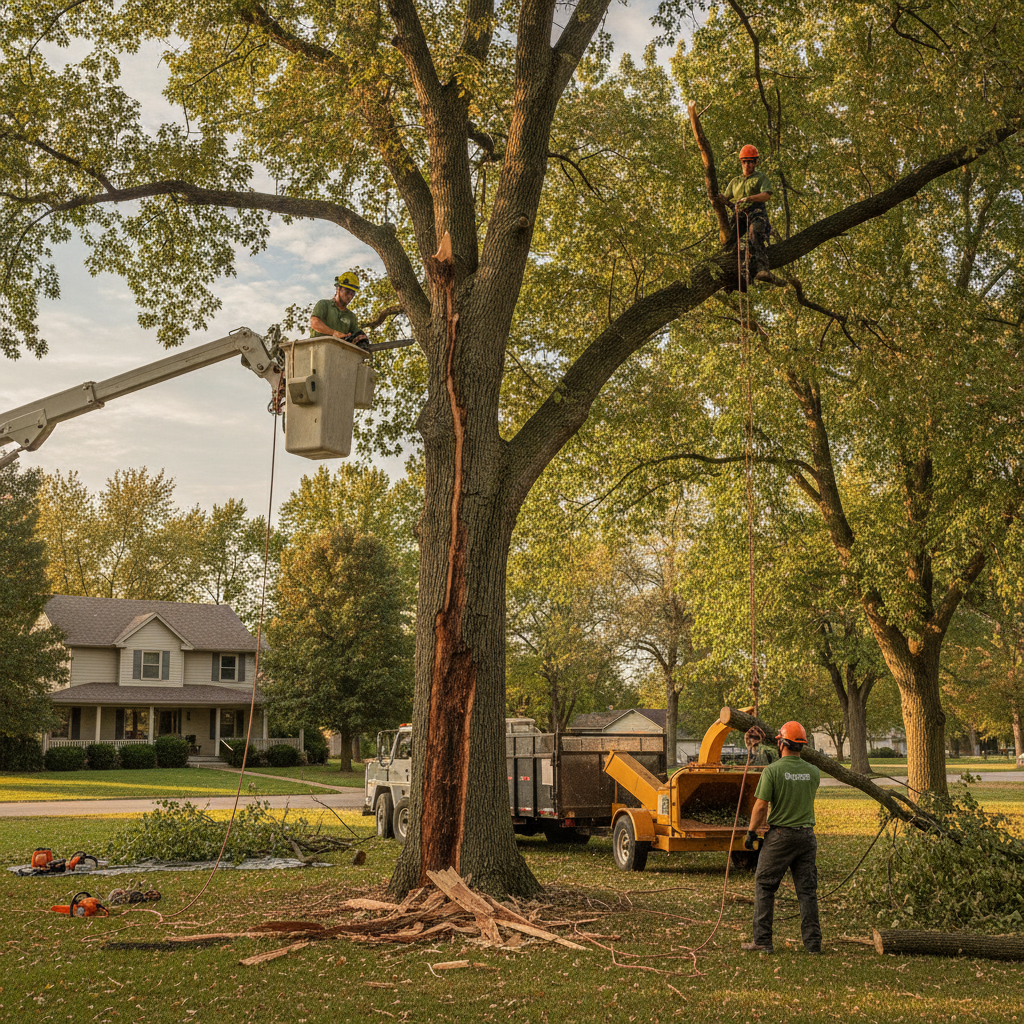
The storm cell has already drifted toward Perry Lake or out over the Flint Hills, and the tree is still standing. That’s the usual picture after lightning hits a tree in Greater Topeka: a long ribbon of bark on the grass, a pale wound running down an oak or silver maple, and a crown that still looks green. The tree isn’t automatically dead, and it isn’t automatically safe. The current superheated the moisture in the wood, blew bark off the living tissue underneath, and may have cooked roots you can’t see from the driveway.
What a lightning hit looks like on a Kansas tree
The classic mark is a long vertical strip of bark blown off the trunk, often in a spiral, with pale, splintered, or charred wood showing underneath. Lightning takes the tallest wet path to ground. In this metro that’s often the oldest stem on the lot: a bur oak over a Highland Park garage, a silver maple squeezed between two Potwin houses, a cottonwood on the Kansas River bank at NOTO, or a lone windbreak tree on a Wabaunsee pasture.
Water in the sapwood flashes to steam in a fraction of a second. Bark peels in a sheet. Splinters can land well out from the trunk. Grass at the base may look scorched. On a tight Oakland or North Topeka lot, that debris can hit a roof, a fence, or a car in the next driveway. On acreage south of Auburn or out toward Overbrook, the same blast mostly peppers the lawn.
A strike can also be almost invisible. Current runs under intact bark and still kills a band of cambium. The crown looks fine that evening. Weeks later a sector of leaves wilts, or one side of the tree leafs out late the following spring. Isolated trees on open lots along the Wanamaker corridor, and hedgerow trees in Osage County, take this quieter path as often as the old street trees downtown. Height and a clear shot at the sky matter more than the name on a nursery tag.
Oaks, silver maples, cottonwoods, elms, ashes, and pines show up after storms because they’re tall and hold a lot of moisture. The high tree on a hilltop lot in Holton or Oskaloosa, or the edge tree facing an approaching cell, is the one the charge is looking for. A silver maple that already carries a tight, bark-included union can split along that seam when the strike runs it, which is why a tree that only got tagged can still drop a leader onto a Potwin driveway.
If any of that wood is touching a line, or even close to one, stop. Don’t pull the branch. Evergy reviews vegetation on the pole-to-pole span, and the line from the pole to your meter is the customer’s responsibility. Call Evergy’s vegetation line at 888-471-5275 and wait for the utility. Don’t try to create clearance yourself.
A hollow or decaying stem can smolder after the flash. If you see smoke or glow in a cavity, stay back and call emergency services. Don’t open the trunk to look.
Why dieback shows up weeks later
The crown can look healthy because those leaves were finished before the strike. A bolt can kill the cambium, the thin living layer that moves water and sugars, while last week’s foliage still holds its color. Then a hot stretch in late spring raises the demand for water. The damaged path can’t keep up. A wedge of the crown browns from the tips inward, often on the same side as the scar.
Root damage runs on the same delay. Current that reaches the soil can cook fine roots on the strike side. The tree doesn’t lean that afternoon. It leans after the next saturating rain, when the clay under a Topeka lot is slick and the dead roots no longer hold. That’s a different story from ice loading, which drops limbs while you watch. Lightning hides the structural work.
Open sapwood is a door for decay and wood-boring insects over the next season. The strike didn’t summon them. It left a wound and a food source, and a tree that’s already carrying a weak union or a thin crown has less to spend on closing that wound.
Dead and hanging wood can come off any time. K-State Research and Extension puts routine pruning of many deciduous trees in late February through April, before bud break. A safety cut on a hanger doesn’t wait for that window. If the tree is an oak, oak wilt can move through fresh pruning wounds during the growing season, so a provider times extra oak work for when it’s safer this year and takes the immediate hazard first.
A tree that fails to leaf out, or leafs out and then collapses a section of crown, is telling you the vascular tissue didn’t recover. How to tell if a tree is dead is a separate look at scratch tests and bud behavior. None of that replaces an on-site assessment, and none of it certifies the rest of the tree as safe.
When the tree can stay
A one-sided bark scar isn’t an automatic removal. Trees wall off damaged wood. If a wide band of live bark still wraps the trunk, the remaining cambium can keep feeding a reduced crown. Woundwood may roll over the edges of the scar across later seasons. That’s a recovery path, not a promise. No living tree can be certified safe.
| What you see | Why the tree may stay | Why it may need to come down |
|---|---|---|
| Bark missing down one side of the trunk | Live bark still wraps most of the stem and can move water and sugars | The wound girdles the trunk, so the crown has no remaining path |
| The crown is still green the next morning | Those leaves were already built, so color that day doesn’t prove the plumbing survived | A large section wilts later, or one side fails to leaf out |
| The trunk hasn’t shifted | Roots may still be holding in the clay | The root flare has heaved, or the stem has started to drift after rain |
| A few small hangers over open lawn | Dead wood can come out with trimming if the stem is otherwise sound | Hangers sit over a roof, a driveway, or the street, or the main union is split |
A scar on a bur oak in an open southwest Topeka back yard is a different job from the same scar on a silver maple whose crown fills the gap between two Potwin roofs. On Osage County acreage the stem might come down in one piece. On a Highland Park lot it has to come down in sections over a garage. That access problem, not the species, is what makes removal heavier work. Photograph the scar, the debris, and anything that landed on a structure. If the stem sits in the city right-of-way, it isn’t yours to cut. The City of Topeka Forestry Division confirms where the property line actually is, and that line is often not where the sidewalk suggests.
When to call
Hanging wood, a new lean, a split trunk, or a branch near a line isn’t a Saturday project. Ground-level raking of bark strips and small twigs is the only part of this a homeowner should handle. Don’t climb. Don’t cut a limb that’s hanging or under tension. Don’t work from a ladder with a saw.
Stay out of the fall zone until someone who does this work has looked at the hangers. Storm damage cleanup is the job when debris and hung wood are the problem. A scarred tree that can stay still needs the dead wood taken off before the next ice event loads it.
Inside Topeka city limits, confirm the company’s city licence with the City of Topeka before work starts. Kansas has no statewide tree-service licence and no statewide general contractor licence. Most of the smaller towns and counties in this footprint, from Silver Lake to Overbrook and from Holton to Alma, license nothing at all. Ask for the name of the person who will inspect the tree, then check that name in the International Society of Arboriculture’s directory. The tree-service providers we connect you with are independent and insured. Confirm current proof of insurance with the matched provider before work begins.
A tree that looks only scarred still deserves a walk-around. Delayed dieback and a hidden lean are the reason to look twice, a few weeks apart, instead of declaring the tree fine on the morning after the cell. Storm work is arranged as providers have capacity. The line is answered. Topeka sits in the northeast Kansas severe-weather corridor, and NWS Topeka is the office that issues the watches and the storm reports for this footprint.
What happens if a tree gets struck by lightning?
The current follows moist sapwood toward the ground. Water in the cells flashes to steam, bark blows off, and a band of living tissue can die even while the tree is still standing. Limbs can shatter. Roots on the strike side can cook. Some trees fail during the storm. Many look almost normal until the crown starts to fail weeks later.
Which trees get hit most often around Topeka?
The tallest, most exposed stem on the property. Old oaks and silver maples on 1880s-to-1950s lots in Potwin, Oakland, and Highland Park. Cottonwoods along the Kansas River. Isolated pasture and windbreak trees in Jackson, Osage, and Wabaunsee counties. Height, moisture, and a clear shot at the sky matter more than a species ranking.
How rare is a lightning strike on a tree?
There’s no useful number for a single lot. A lone tall tree is a better target than a tree inside a closed canopy, which is why the old street tree on a small Topeka lot and the lone tree in a hayfield both show up after the same line of storms. Check watches and storm reports with NWS Topeka rather than guessing from a national figure.
When to call us
A lightning-scarred tree with hangers, a lean, or a split stem needs an insured tree-service provider, not a ladder and a saw. We match Greater Topeka property owners with independent insured providers and arrange the estimate with the person who will actually be on the property. Call us at (785) 333-4052.