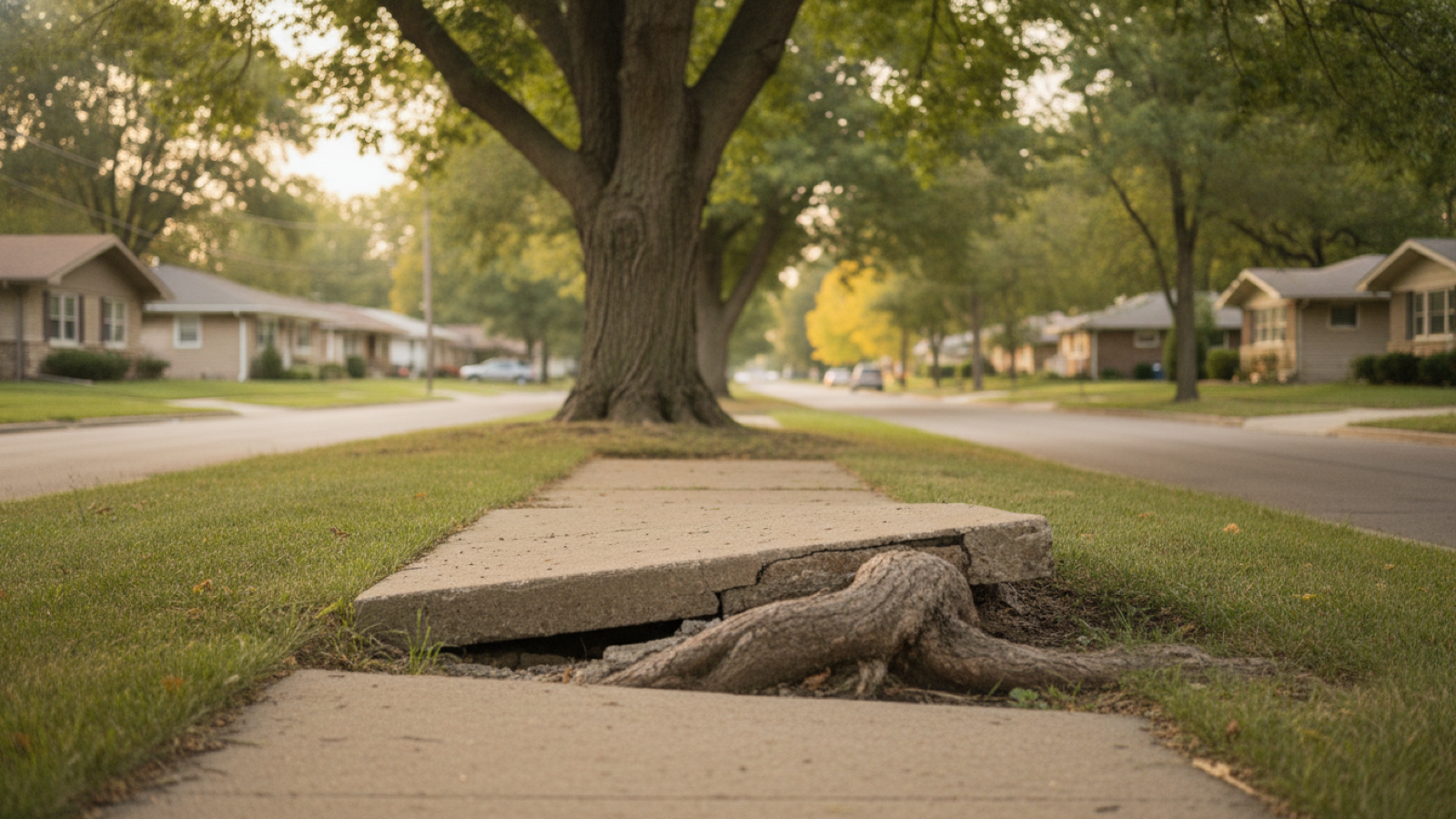
The abutting property owner is responsible for repairing a Topeka sidewalk lifted by tree roots, even though the walk sits in City right-of-way. Topeka Municipal Code 12.35.010 places sidewalk repair on the owner of the lot the walk fronts. The tree that caused the damage may still be on public property. Work on a tree in the parkway or City right-of-way requires a Division of Forestry permit.
Who pays for tree roots lifting a Topeka sidewalk?
You do, under TMC 12.35.010, which states plainly that sidewalks “out of repair” shall be repaired by “the owners of the lots or pieces of land abutting thereon.” Kansas state law backs the same rule. K.S.A. 12-1808 makes it “the duty of the owner of the abutting property to keep the sidewalk in repair.”
Neither statute cares who planted the tree or how old it is. The walk is public in the sense that anyone can use it, but the repair duty runs to the house it fronts. That surprises homeowners who assume anything stamped “public” is the City’s problem.
TMC 12.35.020 adds one more rule: any repair has to match the City’s own technical specifications for sidewalk construction. You can’t just pour a quick patch and call it done.
The walk is yours to fix, but the tree might not be yours to cut
This is the split that decides how the whole project goes, and it’s worth stating twice. Under TMC 12.35.010 the walk is the abutting owner’s to repair. Under TMC 12.65.030, a tree growing in that same strip is not the owner’s to trim or remove without a City permit, because the parkway counts as public right-of-way under TMC 12.65.010.
Our permit guide for Topeka tree removal covers that public-property rule in full, including how to check which side of the right-of-way line a tree sits on. The short version: if the tree that cracked your sidewalk is between the walk and the street, call the Division of Forestry before any cutting starts, even if the repair itself is entirely on you.
That means the two halves of this job can run on different clocks and different rulebooks. The walk repair is your call, your cost, your timeline (subject to the 30-day window below if the City condemns it). The tree work, if the tree is in the parkway, needs sign-off first. Sort out which side of the line the tree is on before you schedule anyone.
How bad does the lifting have to be before it counts as a defect?
One inch. That’s the line the City itself uses. Under the City of Topeka’s own 50/50 sidewalk program application, a sidewalk qualifies for repair when it’s “in violation of the city standards for sidewalk maintenance and or ADA standards,” and the application spells out what counts: “a 1-inch or more trip hazard, uneven brick surface, a severe cross slope that would be dangerous for pedestrians and those in wheelchairs, and concrete that has deteriorated into gravel.”
Measure the displacement and compare it with the current program application, but do not treat a smaller lift as automatically safe or cosmetic. Uneven brick, cross slope, surface deterioration, and current accessibility standards may also affect eligibility. Ask City Engineering to confirm whether the condition qualifies and which repair specifications apply.
What does Topeka’s 50/50 sidewalk program actually cover?
The City of Topeka splits the cost of qualifying sidewalk repairs 50/50 with the property owner, and in some cases covers the owner’s half entirely. The program’s own language: “The City of Topeka is accepting applications to remove and replace defective public sidewalks through a cost-sharing plan of 50% paid by the City, and 50% paid by the property owner.”
If your half of the estimate comes in at $1,000 or less, the City covers it as a grant, with “no cost to the homeowner.” Above that, the owner’s share gets recorded as a deferred mortgage loan against the property, meaning the City has a financial interest in it rather than a bill due immediately. That loan comes due if the property is “sold, traded, transferred or refinanced within 5 years.”
A few conditions matter before you apply. The property has to be residential, and it has to be owner-occupied if you’re seeking funding assistance rather than just the cost split. The program does not cover cleaning brick sidewalks or installing ADA ramps. You can’t have outstanding permit violations or unpaid city debts on file. Funding is limited and runs first-come, first-served, though the City gives priority to areas its Pedestrian Master Plan flags as high pedestrian demand, including school routes and transit connections.
There’s also additional funding assistance for households at or below HUD’s 80% income limit for the area. Those income figures get updated periodically, so don’t rely on a number you saw somewhere else. Confirm the current threshold with the City directly. For any of this, the contact is City of Topeka Engineering at 785-368-3842, or email [email protected].
What happens if you do nothing?
If the City formally condemns the sidewalk, the code starts a repair process. TMC 12.35.060 allows the City Council to pass a resolution condemning a sidewalk that has become “inadequate or unsafe for the travel thereon.” Once that resolution is published in the official City newspaper, the cited code provides 30 days to build or repair the walk at the owner’s expense.
Miss that window and “the City Engineer shall cause the work to be done by the City or by contract.” You don’t get to skip the bill by ignoring the notice. TMC 12.35.050 says the cost of that City-done work gets levied as a service assessment against your lot, calculated by front footage.
K.S.A. 12-1808 closes the loop at the state level. If the assessment goes unpaid within thirty days of notice, “the full amount shall be certified by the city clerk to the county clerk to be put on the tax rolls for collection like other taxes.” At that point it’s attached to your property taxes, not a contractor invoice.
None of that changes whether the tree needs a permit to touch. A parkway tree still can’t be cut without Forestry sign-off, condemnation resolution or not. The two processes run in parallel, not one instead of the other.
Can the tree survive the repair? Use trunk diameter as a screening check
Cut location and root size can affect stability, but trunk-diameter guidance is not a do-it-yourself clearance rule. Bartlett Tree Research Laboratories’ technical report states: “It is recommended that buttress roots not be cut closer to the trunk than a distance equal to three times the trunk diameter (DBH).” A qualified arborist should inspect the actual roots, defects, species, site, and nearby targets before any root is cut.
DBH means diameter at breast height, measured about 4.5 feet up the trunk. The easiest way to get it without a specialty tool: wrap a tape measure around the trunk to get the circumference, then divide by 3.14.
For example, an 18-inch DBH tree places the three-times-diameter screening distance at 54 inches. That figure helps identify when arborist review is especially important. It does not guarantee that cutting outside the line is safe.
Bartlett also says tree removal should be considered when buttress roots must be severed closer than one and a half times trunk diameter because stability may be affected. That is a prompt for professional assessment, not a fixed salvage threshold. Root layout, condition, number of cuts, soil, lean, exposure, and nearby targets can change the decision.
Root size matters too, separate from distance. Bartlett notes that “for mature trees, it is best not to cut roots greater than 2 inches in diameter,” and adds the honest catch: “it is usually roots that are larger than this that create sidewalk lifting problems” in the first place. A tree health assessment before any cutting gives you an actual measurement and a professional read on whether the tree is a good candidate for root work at all, and an arborist consultation can put that assessment in writing if you need documentation for the City or for a contractor bid. If the tree is big enough that failure would reach the house or the street, our guide to how a tree risk assessment gets its rating explains what that written report should actually contain before you pay for one.
Six ways to fix a root-lifted walk, from gentlest to hardest on the tree
Bartlett’s report describes repair alternatives with different impacts on trees. A qualified arborist and sidewalk professional can compare them against City specifications, accessibility, utilities, drainage, and the actual roots before choosing a method.
- Shave or grind the raised edge, or install a ramp or wedge over it. Concrete can be ground down to about half its original thickness. This touches no roots at all and is the least disruptive option on the list.
- Reroute the walk around the tree. Narrowing the sidewalk or curving it past the trunk increases the distance between walk and root without cutting anything.
- Bridge the pavement over the roots, essentially building a small structural span so the roots keep growing underneath undisturbed.
- Replace the poured walk with interlocking pavers. This won’t stop the lifting on its own, but unmortared paver joints make future re-leveling a much smaller job than breaking out a poured panel.
- Shave the top of the offending root, then re-pour the walk. Bartlett’s guidance: “it is better to remove the top surface of a root rather than the entire root,” and any root cut this way “should not be cut more than 1/3 of their diameter.”
- Cut roots and replace the sidewalk panel. This is an invasive option that can affect tree health and stability. A qualified arborist should evaluate the roots and tree before the sidewalk contractor uses this method.
Design details such as barrier depth, sidewalk width, slope, and concrete thickness must follow current City specifications and accessibility requirements. They also depend on grade, utilities, drainage, root location, and available space. Bartlett’s larger point is to favor the least damaging method that still produces a safe, compliant sidewalk and to have a qualified arborist involved in root cutting.
If the assessment supports tree removal, stump grinding may prepare the immediate work area. Grinding the stump does not remove the entire root system or guarantee that pavement movement will not recur. The sidewalk contractor and arborist should agree on what must be excavated and how remaining roots affect the design. Before below-grade work, confirm utility-locating responsibilities using our guide to Kansas 811 and stump grinding.
Which trees can lift sidewalks?
Any tree’s roots can conflict with pavement when growth habit, available soil space, moisture, planting distance, and site constraints put roots near the slab. A species name or neighborhood age does not establish the cause on a particular property.
Inspect the actual root location and tree condition before choosing a repair. If an existing stump is producing new growth, our guide to cottonwood stump sprouting in Topeka explains that separate issue.
For new plantings near public sidewalk, ask the City and a qualified tree professional about mature size, root space, placement, and applicable species guidance.
Frequently asked questions
Does the City of Topeka ever pay for sidewalk repair caused by tree roots?
Yes, through the 50/50 program. The City covers half the cost of qualifying repairs, and if the owner’s share is $1,000 or less, the City covers that too as a grant. Above $1,000, the owner’s portion becomes a deferred loan against the property, due if it’s sold within 5 years.
Can I remove the tree myself if it’s lifting my sidewalk?
Do not assume you can remove it based only on where the trunk appears to sit. Work on a tree in public right-of-way requires a Division of Forestry permit. If you believe the tree is private, verify the property and right-of-way boundary and ask the City whether any permission applies to the actual work before cutting.
How much does it cost to fix a sidewalk lifted by roots in Topeka?
The cost depends on the pavement area, repair design, accessibility requirements, root location, tree condition, access, and whether separate tree work is recommended. Start by asking City Engineering about current 50/50 eligibility and its estimate process. Then request written quotes that separate pavement work, root assessment or cutting, removal, hauling, and stump work.
What if the trip hazard is less than an inch?
A smaller displacement may not meet the program’s listed one-inch threshold, but that does not establish that the walk is safe, compliant, or ineligible under every listed condition. Ask City Engineering to evaluate current program eligibility and repair requirements. Monitor any unrepaired movement and avoid drawing conclusions about the roots without inspection.
Will cutting the roots kill my tree?
Root cutting can injure or destabilize a tree, and distance from the trunk is only one factor. Bartlett’s diameter-based distances are screening guidance, not guarantees. A qualified arborist should inspect root size, location, tree condition, soil, lean, exposure, and nearby targets before any root is cut.
How long do I have to fix a condemned sidewalk in Topeka?
Thirty days from the date the City’s condemnation resolution is published in the official City newspaper, under TMC 12.35.060. Miss that window and the City does the work itself, then assesses the cost against your property by front footage, with unpaid balances eventually moving to your county tax bill.
Getting the tree and the sidewalk sorted in the right order
The sidewalk repair may be the abutting owner’s responsibility, while tree work in public right-of-way requires City permission. Confirm both parts before scheduling work. Topeka Tree Pro connects homeowners in Topeka and across Shawnee County with independent insured tree-service providers. Ask the selected provider to inspect access, root location, tree condition, qualifications, insurance, and written scope. Call (785) 333-4052 to request an estimate, and confirm current program terms with City of Topeka Engineering at 785-368-3842 before budgeting the repair.