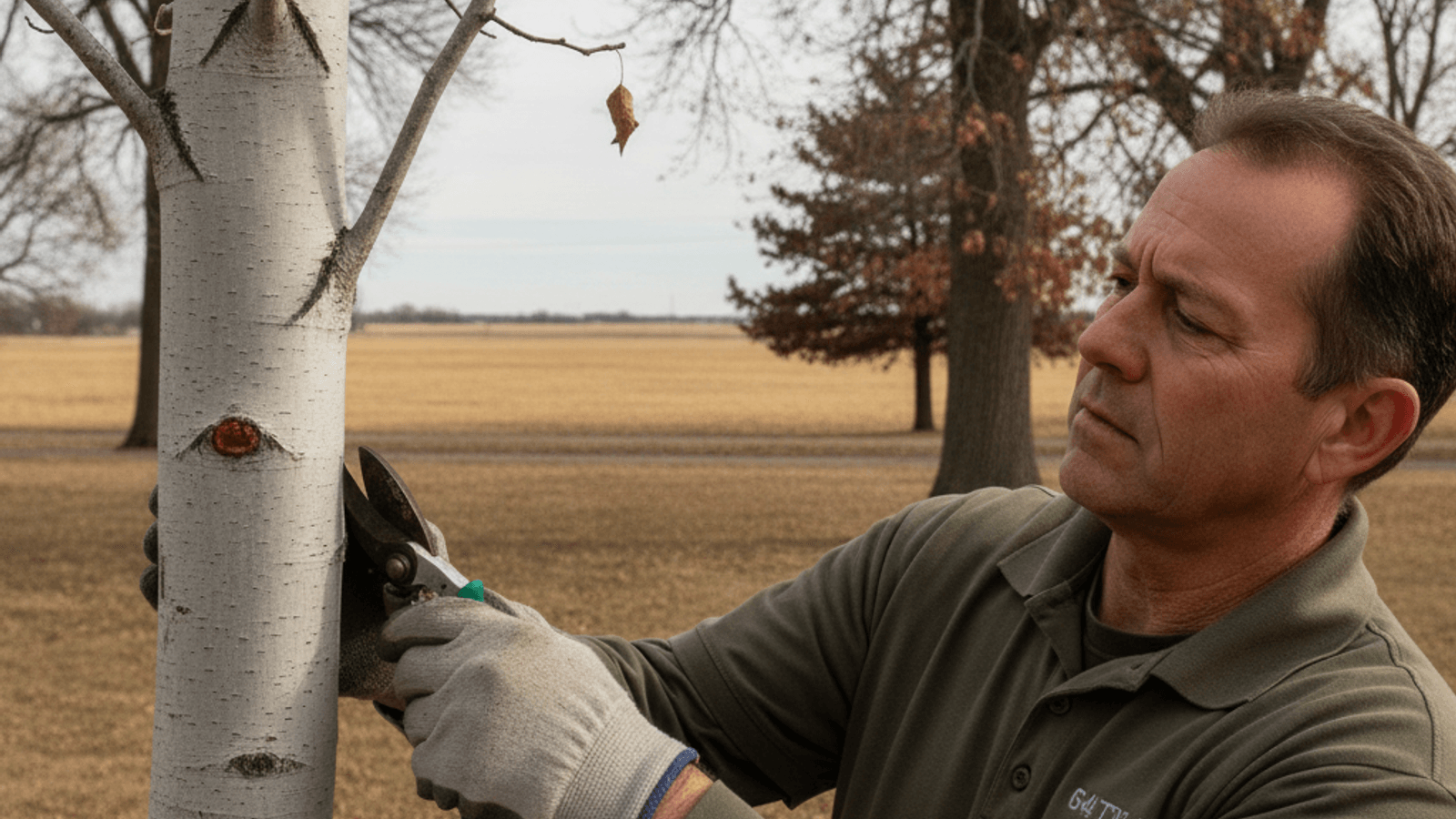
Quaking aspen isn’t native to Kansas. The USDA-NRCS plant guide for Populus tremuloides says the species grows “in all of the western North America US states (except Oklahoma and Kansas).” That is a native-range fact, not a planting ban. A Topeka aspen is a planted tree, and it can still be tried. The rest of this page covers the heat, drainage, and sucker costs of doing that.
An aspen tree in Topeka needs a site-specific decision, not a blanket recommendation. Quaking aspen grows quickly but reacts to heat, moisture, drainage, shade, and root disturbance. Before planting or removing one, consider the available space, site conditions, maintenance expectations, and what you want the property to look like later.
Is an aspen tree right for a Topeka yard?
Start with the planting site rather than the tree’s appearance. Soil drainage, available light, nearby pavement, buildings, utilities, and planting beds can all affect the decision.
The USDA Forest Service profile for quaking aspen describes the species as fast growing, with relatively short-lived stems. It also notes that moisture, drainage, and heat affect where aspen performs well. Those are general species traits, not proof that every Topeka yard is suitable or unsuitable.
Aspen also has poor shade tolerance. A planting location surrounded by larger trees may not provide the light the species needs. Open exposure presents a different concern because the site may become hot or dry.
Ask a provider to evaluate the actual planting area. A useful assessment should consider:
- How water moves through the soil after rain
- How much direct light reaches the location
- Whether nearby surfaces reflect or hold heat
- How much space exists for roots and new shoots
- What mature shape and screening effect you want
- Whether regular sucker management fits your plans
These details are more useful than choosing a tree from a regional list.
Plan for lateral roots and new shoots
Quaking aspen can spread through wide lateral roots. Those roots may produce suckers that become additional stems. Cutting one stem does not establish that the connected root system is gone.
That growth habit can be appealing when someone wants a natural grove. It may be inconvenient near lawns, planting beds, walkways, fences, or other areas where new shoots aren’t wanted.
Before planting, decide whether you want one visible trunk or a developing group. Then discuss how much room the root system has and how future shoots would be handled. This decision affects placement and ongoing maintenance.
The same issue matters during removal. Ask whether the written quote covers only the visible stem or also addresses stump work and future sucker management. The appropriate scope depends on the tree, its roots, nearby obstacles, and the desired end result.
For an existing tree, a provider can inspect the accessible area and explain the available tree removal options without assuming every connected root will disappear with the trunk.
How should an existing aspen be evaluated?
Changes in leaves, bark, branches, or overall growth can have several possible causes. Soil conditions, drainage, moisture, light, physical damage, and biological problems may produce similar symptoms.
Avoid diagnosing an aspen from one photograph or a single visible symptom. A useful tree health assessment should consider the whole site along with the affected trunk, branches, and surrounding roots.
Before the visit, note what has changed and where it appears. Helpful observations include:
- Whether decline affects one branch or much of the canopy
- Whether the ground has stayed unusually wet or dry
- Whether construction or digging occurred near the roots
- Whether new suckers appeared after cutting or disturbance
- Whether broken or hanging branches create an immediate hazard
These observations help define the problem. They don’t establish a diagnosis by themselves.
When should an aspen tree be trimmed?
K-State’s general pruning guidance says deciduous trees are generally pruned before bud break, commonly from late February through April. Dead, broken, or hazardous limbs may require different timing.
That general calendar isn’t a substitute for inspecting the tree. The reason for pruning matters. Routine shaping, clearance work, storm damage, and removal of failed branches are different jobs.
Good questions to ask before scheduling tree trimming include:
- Which branches need attention, and why?
- Is the goal clearance, structure, or removal of damaged wood?
- Could nearby branches or trunks be unstable?
- What will the written quote include?
- Will cut material be hauled away?
- Are stump or sucker concerns outside the trimming scope?
Stay clear of hanging branches, unstable damaged trees, and downed power lines. Electrical hazards should be handled by the utility. Branches under tension and seriously damaged trees need professional assessment.
Should a declining aspen be kept or removed?
The answer depends on the tree’s condition, its location, the surrounding targets, and the homeowner’s goals. Fast growth doesn’t mean every declining stem should be removed. A relatively short-lived stem also doesn’t prove that removal is currently necessary.
Ask the provider to explain what can be observed, what remains uncertain, and what each option would accomplish. The comparison might include limited pruning, monitoring, removal of one stem, or broader work involving the stump and surrounding shoots.
Get the proposed scope in writing. Confirm whether it includes removal, hauling, stump work, site cleanup, and any follow-up related to suckering. Also verify the provider’s qualifications, insurance, scheduling, and any permissions that may apply.
Topeka Tree Pro connects Greater Topeka homeowners with independent insured tree-service providers. Call (785) 333-4052 to request an estimate and confirm availability, estimate or visit fees, the written scope, and your aspen tree concerns directly with the matched provider.