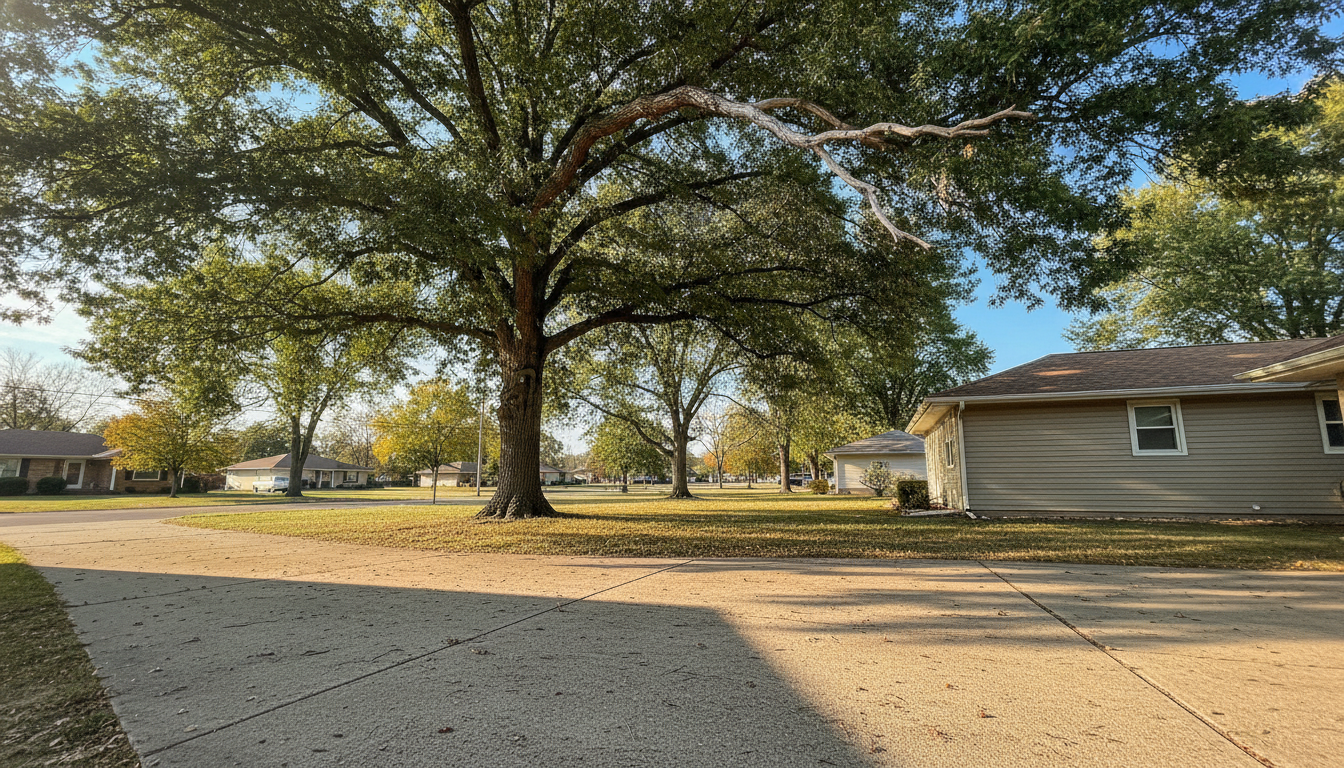
Wait. Dennis Patton, the horticulture agent for K-State Research and Extension in Johnson County, puts deciduous-tree pruning from late February through April, before bud break. Oaks skip April, May, and June. A dead, dying, broken, or hazardous limb can come down today.
You’re in a Topeka yard in September. The Johnson County extension office defines fall as September through November. Fall is not the month for a full prune. A hanging limb is a different job.
When is the best time to trim trees in Kansas?
Patton’s article “Pruning Trees and Shrubs: It’s all in the timing” is the calendar most Kansas homeowners actually need. He writes: “Trees are pruned slightly earlier in the season, from late February through April.” He also writes: “The ideal time to prune trees is prior to bud break.”
Bud break is the tree, not a date on your phone. In a warm spring it arrives earlier. Patton’s reason is simple: “The lack of foliage allows the structure to be exposed, making it easier to see what pruning issues need to be corrected.”
Walk the tree before that window. The spring tree health checklist for Topeka is the ground-level look: broken wood, cracks, lean, and uneven canopy, from a safe distance.
The Johnson County extension office’s unsigned article “Fall Pruning: Think Twice” calls late winter and early spring “the most desirable time to prune.” Most desirable, not the only time. That office also says taking “dead, dying, broken or hazardous limbs” can be done “anytime of the year, as safety of property and people is always the first concern.” Patton says follow-up pruning for “dead, broken or hazardous limbs” can run throughout the season. A hanging limb does not wait for February.
Oaks are the exception, and the two Kansas windows overlap awkwardly.
Patton’s deciduous window runs through April. K-State publication MF3132, Tree and Shrub Problems in Kansas (November 2023), says: “Avoid wounding or pruning of oak trees during April, May, and June.” April sits in both sentences. For an oak, drop April from the general window. Late February through March, still before bud break, is the overlap both sources leave standing. After June, wait for the next late-winter window unless the limb is dead, dying, broken, or hazardous. The oak wilt guide is where those three months live in their disease context.
Can I prune in the fall?
Not a full prune. The Johnson County extension office defines fall as September through November. That is this month, and the next two.
That office writes: “Pruning, although a recommended practice, creates an injury.” One of the keys is to cut “at the time of year when the plant can seal the wound as rapidly as possible.” Then: “Unfortunately, fall is not that time, as the plant is going into dormancy and not focused on producing new tissue, which protects the injury created by the cut.”
What fall is for sits in the next line: “Fall pruning is best focused on the removal of dead, dying, broken or hazardous limbs.” Ice and wind are how those limbs show up around Topeka. See ice-storm tree damage and a limb on a roof or fence. If you’re not sure the wood is actually dead, read how to tell if a Topeka tree is dead before you cut.
Major corrective pruning “to help maintain the overall health of the tree is best done during the dormant winter season or in early spring.” Leave sound living wood until then. Broken or hazardous wood does not wait.
Why does the timing matter at all?
Because a pruning cut is an injury. The Johnson County article is blunt: “Unlike people, trees really don’t heal. Instead, they seal, which is a completely different process.” The tree “just surrounds the damaged wood with a layer of cells which function is to stop the injury from spreading.” That office calls the process CODIT, compartmentalization of decay in trees.
Correct timing improves the odds. It does not close the wound. The same article says: “Unfortunately many trees cannot stop the wound from spreading.”
MF3132 puts a practical limit on the cut itself: “Wood decay can be prevented by avoiding wounding. Pruning cuts should be made when branches are small to minimize wound size.” That is prevention language, not a promise the tree will seal.
Winter has one more bonus in that Johnson County article: “During winter all potential damaging pests of the tree are dormant.” That still does not park a hazardous limb until January.
If the real question is whether the tree is a risk, not which month to thin it, that is a tree risk assessment, not a calendar.
Which trees break the general rule?
Oaks first. MF3132’s sentence is the whole rule: “Avoid wounding or pruning of oak trees during April, May, and June.” Wounding, not only a planned prune. Those months matter because “Oak wilt is spread by sap beetles (aka picnic beetles) and from tree to tree through root grafts of infected oak trees.” Skipping cuts in April, May, and June addresses the beetle route. It does not stop root-graft spread.
MF3132 also scopes the disease: “Oak wilt, caused by Bretziella fagacearum (syn. Ceratocystis fagacearum), is an occasional problem on red oak in northeast Kansas and along the Kansas/Missouri border.” Topeka sits in northeast Kansas, so the geography applies here. An occasional problem is not a common one, and nothing about those three months says your oak is sick. A hanging oak limb still comes down now.
Elm is not in that oak sentence. No Kansas month rule is confirmed for elm. Have a matched provider look at that tree before you pick a date.
Evergreens split into two classes in Patton’s article. Juniper, yews, and boxwood “are best pruned either just before the new growth emerges or just after.” His time frame is late March through mid-May. Spruce and pine “are pruned after the new growth is produced.” “The pruning should be finished by the end of June.” And only “about halfway into the new growth,” not halfway down the tree. Dead or hazardous evergreen wood does not wait on those windows.
Flowering shrubs: Patton writes, “Shrubs produce flowers two ways.” Then: “Spring flowering shrubs are best pruned within about four to six weeks after bloom time.” His examples are forsythia, lilac, and azaleas. Hazardous wood on a shrub is still an anytime cut.
Roses have their own line in the unsigned Johnson County article: “Rose canes can be subject to winter injury during a cold season. For this reason it is recommended to prune roses in late March to mid-April, just before the period of rapid growth.” Both halves travel. A broken rose cane can come off now.
What can be cut at any time of year?
Dead, dying, broken, or hazardous limbs. Both Johnson County pieces say so. Safety of people and property comes first.
That is emergency tree service when the wood is over a house, a drive, or a play area. It is ordinary tree trimming when the wood is dead and stable enough to schedule. Nobody should rule on your tree from this page. The provider who comes out has to see it.
As we already note in the oak wilt guide, topping is not an appropriate repair. Taking a hazard limb is not a license to cut the tree back to stubs.
Does Topeka require a permit to trim a tree?
The right month does not settle it.
The existing Topeka tree permit guide quotes TMC 12.65.030(a). No person shall “plant, set out, maintain, protect, spray, fertilize, treat, trim, prune or remove any tree, hedge, bush, shrub or vine upon public property” without first getting a permit from the Division of Forestry.
Read trim and prune in that list. A parkway oak between the sidewalk and the curb can sit in two rules at once. Skip April, May, and June for the oak. Still ask the Division of Forestry about the permit, because public property is not your back yard. Confirm the right-of-way before anyone sets a ladder in that strip.
Private-yard timing follows the calendars above. Public-property work follows the city, even in late February.
What should I ask the provider before they cut?
Ask what they think the tree is. Oak versus maple changes the month.
Ask whether the proposed cuts are dead, dying, broken, or hazardous wood, or major corrective pruning that should wait for late winter.
Ask whether any of the work sits on public property, including the strip between the sidewalk and the street.
Ask for a written scope: which limbs, how far back, and who hauls the brush. Price questions belong on tree trimming cost in Topeka. This page does not quote a number.
Ask what they will not do. If the pitch is a full canopy cut in September on a sound tree, that is the calendar talking, not the Johnson County guidance.
Topeka Tree Pro connects you with independent insured providers. The pros we send inspect. We match. Verify insurance, the written scope, and the date with the person who comes out.
Frequently asked questions
When should you trim trees in Kansas?
Late February through April, before bud break, for most deciduous trees, per Dennis Patton at K-State’s Johnson County office. Oaks skip April, May, and June. Dead, dying, broken, or hazardous limbs can come down any day of the year.
Can I prune trees in September in Topeka?
Not for major corrective work. The Johnson County extension office defines fall as September through November, and says fall is not when a tree can seal a wound rapidly. Fall is for dead, dying, broken, or hazardous limbs.
When should I prune an oak in Kansas?
Avoid wounding or pruning oak trees during April, May, and June, which is what K-State publication MF3132 states. The overlap with the general deciduous window is late February through March, still before bud break. A hazardous oak limb can come down now. Details sit in the oak wilt guide.
Is there a Kansas month window for elm?
No Kansas month rule is confirmed for elm. Have a matched provider assess the tree and pick the date from what they see.
Do I need a permit to trim a Topeka tree?
If the tree is on public property, yes, under TMC 12.65.030(a), because the verb list names trim and prune. The permit guide is the full walk-through. A back-yard tree is a different question. Confirm the line with the Division of Forestry when the trunk sits near the curb.
What if a limb is hanging over the house right now?
Take the hazard seriously and stay clear. Dead, dying, broken, or hazardous wood can come down any day of the year. Call (785) 333-4052. We’ll connect you with a matched independent provider. Emergency tree service is the path when the wood is over people or a roof.
How do you get this tree trimmed on the right month?
Name the tree. Name the wood: live correction, or a hazard. Name the ground: back yard, or the parkway. Then have someone walk it.
Call (785) 333-4052. We’ll connect you with insured local crews. They inspect. We match. Shawnee, Jefferson, Jackson, Osage, and Wabaunsee.