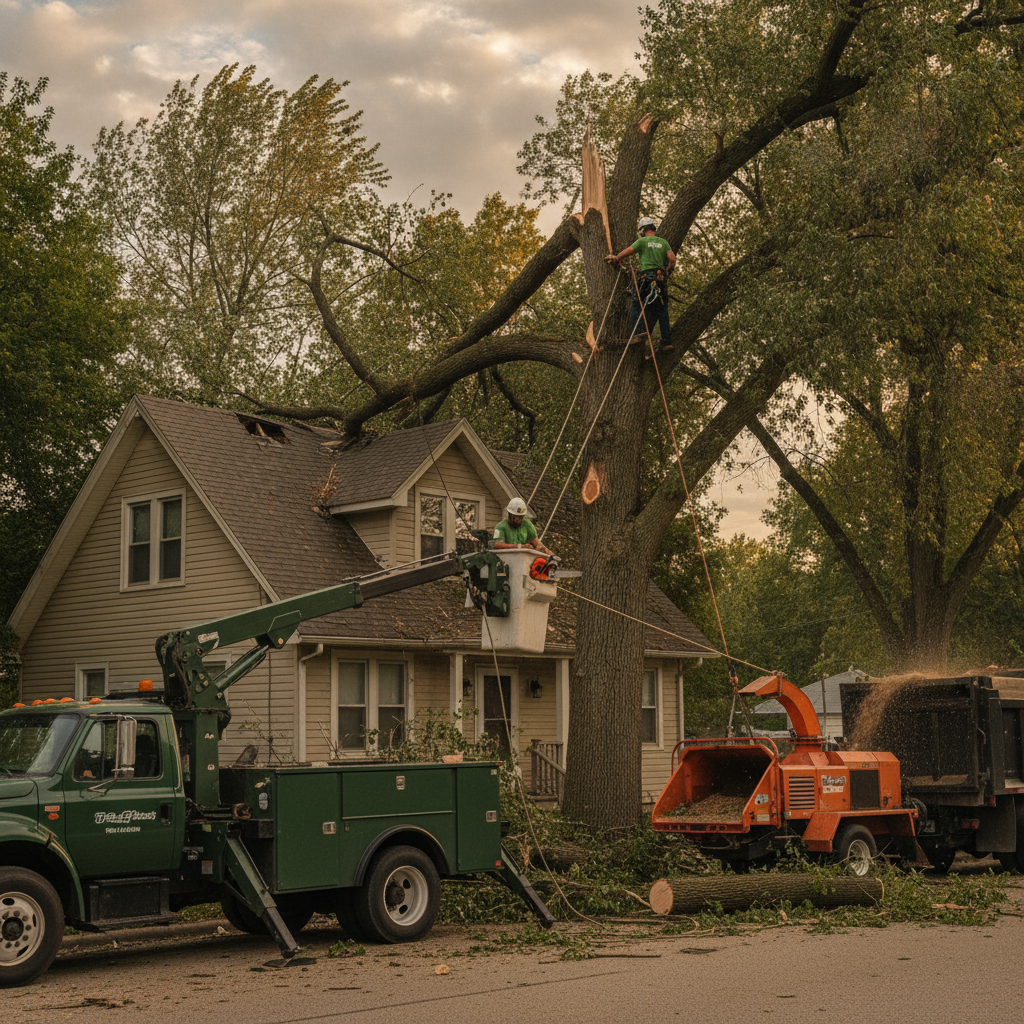
Ice does more damage to Topeka trees than a heavy snow. Freezing rain loads a silver maple until a union fails, and the limb that looked fine at dusk is on the shingles by morning. Emergency tree service is the work that takes weight off a house, opens a blocked drive, or makes hanging wood stop being a threat. The chips and the stump can wait. The hazard cannot.
What counts as an emergency versus a scheduled take-down
Emergency tree work is about what the tree can still do to people and property in the next hours, not about how ugly the yard looks. A hanging limb over a Highland Park sidewalk, a stem on a Potwin roof, a split trunk over a garage, or a tree that has lifted its root plate and is leaning toward the house: those are emergency jobs. A dead ash in a back corner with a clear place to drop, a hedge that needs a cut, or a bur oak that wants a winter prune is scheduled work.
Spring in this corridor brings damaging straight-line wind and hail as routine weather, not rare events. Peak severe season runs roughly March into June, and the National Weather Service office in Topeka is where watches and warnings actually come from. Winter is ice, not snow. A tree that shrugs off a blizzard can lose half its crown when freezing rain coats every twig. That is why a quiet Tuesday after an ice night produces more urgent calls than a snow day. The same pattern shows up in ice-storm tree damage across Greater Topeka: the load sits on the wood until a union lets go.
On a tight lot in Potwin, Oakland, or North Topeka, the same failed limb is a different job than it is on a Wanamaker-corridor acre. The houses sit close. The sidewalk and the city strip sit closer. Whose tree it is can be a real question before anyone cuts. A tree in the city right-of-way or on other city property is not the homeowner’s to take down. Confirm the location with the City of Topeka Forestry Division before a provider schedules a saw. The line between a private yard tree and a right-of-way tree is often not where the sidewalk suggests.
| What you are looking at | Treat it as emergency work | This part can wait |
|---|---|---|
| Limb or stem on a house or garage | Get the weight off the structure in controlled pieces | Hauling the last of the chips and grinding the stump |
| Only driveway blocked by a fallen stem | Open access so you can leave the property | Cosmetic pruning on undamaged trees |
| Hanging wood over a sidewalk or play area | Reduce the hung-up wood so the tear cannot finish | Replanting or a full crown restore |
| Tree touching or near an Evergy line | Utility first, then tree work | Anything a saw would do before the line is cleared |
Out in Auburn, Berryton, Carbondale, or Overbrook, the emergency is often a volunteer stem or an Osage orange that has come down across a long drive, with no municipal forestry desk to call. In Holton or Oskaloosa the old canopy over the square behaves more like central Topeka. Around Alma and Harveyville the problem is more likely a windbreak or a cedar the wind has laid into a fence line. Same storm, different work.
Not every broken tree has to come out. Emergency trimming can take a split limb and leave a tree that still has a live crown and a sound stem. A stem that has split to the ground, a root plate that has stood up, or a tree that is already sitting on a roof is usually a removal. A photo does not settle that. An on-site look at the unions, the lean, and what sits underneath does.
If the wood is on the ground, off the house, and not hanging over a walk, you can rake and stack brush. Leave hanging wood, wood under tension, and anything overhead to a provider. Do not climb. Do not run a chainsaw from a ladder. Do not cut a limb that is bent and waiting to spring.
Roof, wires, and a tree sitting on the house
A tree on a house is two problems stacked: the wood, and whatever the wood is touching. If that includes an Evergy line, the wood is second.
The span that runs pole to pole is Evergy’s to review. The line from the pole to your meter is the customer’s responsibility. Call Evergy’s vegetation line at 888-471-5275 if vegetation is on the pole-to-pole span, and stay away from anything that is touching a conductor. Never move a branch that is on a line to get a better look. Never walk up to a downed wire for a photo. Ask Evergy what has to happen before anyone works near your service drop. Tree work starts after the electrical hazard is under the utility’s control, not before. Evergy’s own page on who trims what is the split.
After an outage, Evergy may ask you to clean up the debris so crews can keep restoring power. That leftover wood is still yours to handle, and it may still be hung up, under tension, or against a structure. Storm damage cleanup is the follow-through once the line is safe to work around.
A limb on a roof keeps loading the deck until someone takes the weight off in a controlled way. Cutting the limb at the fence line so it drops the rest of the way through the shingles is how a bad night becomes a hole in the house. The provider pieces the wood off the structure, then decides whether the tree can stay. Some can. A co-dominant union with included bark is a known failure point, and ice finds it. That does not mean every silver maple on the block is coming down. It means the person on site looks at that union, the remaining crown, and what sits under it.
A fallen limb on a roof or fence is the usual Topeka picture after ice: not a whole tree walked over, but one big piece that unzipped from a mature crown and stopped on the house. On a 1920s Oakland bungalow the drop zone is the porch, the neighbor’s eaves, and the city strip. On a newer lot west of Wanamaker there is often lawn to work from. The physics are the same. The room to work is not.
If the tree is on the city strip, stop and confirm ownership. On a Perry Lake lot, who owns the tree can be a different answer again. Corps of Engineers land is not a backyard. Confirm that before anyone cuts.
What a crew does first on a Topeka street
The first move is not a saw. It is keeping people out of the drop zone, checking for lines, and finding wood that is hung up and still holding tension. A hanging limb looks still. It is not. The fibers that have not finished tearing are a spring.
On a Potwin street the access is the job. Equipment sits in the lane. The drop zone is a garage roof, a neighbor’s fence, and a sidewalk. The provider pieces the tree down in short sections because there is no room to fell anything. On a West Topeka lot along Wanamaker there is often room for a chipper and a clear fall, so the same diameter stem is a shorter day. In Wabaunsee County the drive itself may be the obstacle: mud after a soaker, a gate, cattle, and a cedar that has come down across the only lane in.
Kansas has no statewide tree-service licence and no statewide general contractor licence. Licensing here is local. The City of Topeka licenses contractors who work inside city limits. Most of the smaller towns and counties in this footprint license nothing at all. “Hire a licensed tree service” is the wrong sentence in Holton. Inside Topeka, confirm a company’s city licence with the City of Topeka. Everywhere, ask for the name of the person who will actually be on the property, then check that name in the International Society of Arboriculture’s directory. The ISA Certified Arborist credential belongs to a person, not to a company and not to this brand. Confirm current proof of insurance with the matched provider before work begins.
The tree-service providers we connect you with are independent and insured. Storm work is arranged as those providers have capacity. The line is answered. What happens next depends on whether Evergy has to move first, whether the wood is still in a live drop zone, and whether daylight and the weather make the site workable.
A photo from the porch helps a provider see the scene. It does not replace an on-site look. A picture misses a root plate that has cracked the lawn, a second split higher in the crown, and the back-side lean toward the neighbor’s garage.
Once the immediate hazard is reduced, the rest is a plan: remaining removal if the stem cannot stay, trimming if it can, debris off the lot, and stump work as a separate scope if you want the grind. Leaving the stump is common after a storm night. Grinding it is a later, quieter visit.
What emergency tree work costs
A limb on a Topeka roof does not have a menu price. What you pay follows the same physics as any other take-down, with more of it, because the tree is already on something you care about.
Trunk diameter moves the number. So does lean. So does what sits under the tree. A stem that has to come down in short pieces over a garage roof takes more rigging and more time than the same tree with a clear drop zone in a Silver Lake side yard. Whether a crane or a bucket can even reach the tree is a different day than climbers on a lot where the wires and the houses eat the airspace. How much wood has to leave the property matters. Stump grinding and root chasing are usually not in the same scope as the night’s hazard work. Confirm every one of those pieces, and any visit or estimate fee, with the provider who will do the job.
Height alone, including a “40-foot tree” someone measured from the sidewalk, does not set a price. A tall, skinny volunteer on an Osage County fence line with a pasture to drop into is not the same job as a shorter, heavier silver maple wedged between two Highland Park roofs.
Common questions
What is considered emergency tree removal?
Emergency tree removal is taking down a tree, or the part of it, that is already failing onto people, a house, a drive, or a walk, or that is hanging in a way that the next gust or the next thaw will finish. A scheduled removal is a tree you can live under until a crew can plan the drop. Fallen trees on structures, blocked only-exits, split stems, uprooted plates, and hanging storm limbs are the usual emergency set. A dead tree in an open back lot is not, even if you would rather it were gone.
How much does emergency tree removal cost?
Emergency work costs what the access, the diameter, the targets, and the wood volume require, plus the fact that the tree is already on the house or in the drive. Ask the matched provider to spell out the tree, the method, the debris, whether the stump is included, and what is excluded. Then confirm that number with the provider who will be on the property, not with a neighbor’s job from the last ice storm.
Who do I call if a tree is down in my yard?
If the tree is on or near a power line, call Evergy first at 888-471-5275 and stay back. If people are hurt or trapped, call emergency services. For the wood itself, call us and we will connect you with an independent insured tree-service provider who can work Greater Topeka, from Silver Lake to Overbrook and from Holton to Alma. Confirm insurance with that provider, and if the work is inside Topeka city limits, confirm the city licence with the City of Topeka.
How much does it cost to cut down a 40 ft tree?
A 40-foot measurement from the sidewalk does not set a price. Diameter, lean, what the tree would hit, and whether a crew can get equipment to it do. The same height on an open Osage County lot and between two Oakland houses are different jobs. Confirm the figure with the provider for that tree, on that lot.
Will every storm-damaged tree need to come down?
No. Canopy damage, a lost limb, even a spectacular split in one large branch, can still leave a tree that is reasonable to keep after the hazard wood is off. A stem split into the flare where the trunk meets the ground, a plate that has hinged out of the soil, or a tree that has already come to rest on a roof is a different conversation. Species, remaining structure, and what the tree would fall on next all feed that call. Nobody can certify a living tree as safe. An assessment names the visible concerns and the reasonable ways to reduce them.
When to call us
A limb on the roof, a stem on the only driveway, wood hanging over a walk, or a tree that has started to lean after ice or wind is not weekend chainsaw work. We’ll get an insured provider out to take the weight off and make the site walkable, then sort removal, trimming, and cleanup as the tree actually needs. Call us at (785) 333-4052.