After a spring squall or a glaze of freezing rain, a silver maple that stood straight over a Potwin driveway can sit at a new angle by morning. That’s the leaning tree people mean when they search the phrase: a stem that moved, often with the ground moving under it. A bur oak that has swept toward the street for decades, with extra wood on the low side of the trunk, grew into that angle. It’s a different structure, and it usually fails in a different way.
Fresh lean vs the tree that grew that way
A tree that grew at an angle built wood to live there. A tree that leaned last night did not.
Walk around the stem. An old lean, sometimes called a sweep, starts near the ground and curves back toward vertical as the tree added growth rings. The trunk looks oval or buttressed on the downhill side because the tree laid down extra wood against gravity and wind. You see that shape on oaks in Highland Park, on honey locusts along older streets, and on pasture trees that spent their lives reaching for a gap in a shelterbelt out toward Alma and Harveyville. The lean is part of how the tree stands.
A fresh lean is a straight stem that changed direction in one event. The trunk still looks round. The bark on the pull side may show new cracks. The crown still has last week’s outline, only the whole outline has rotated. Ice is the winter version of this in northeast Kansas. Freezing rain loads every limb at once, and a tree that shrugged off snow can rotate at the roots when that load meets wind. That’s the pattern behind most ice storm tree damage here. Spring is the other season: saturating rain, then a straight-line wind. NWS Topeka is the forecast office that names those watches and reports the storms.
Young trees on the Wanamaker corridor, in Westboro, and out through Silver Lake and Rossville tell a third story. A recently planted tree can tip in wet clay because the root ball never left the nursery shape, or because a stake stayed on so long the trunk never thickened. That’s a planting problem. It’s not the same as a fifty-year-old silver maple whose plate lifted in Oakland. Pushing a mature tree back toward vertical tears more roots. Leave that off the weekend list.
These are the ground-level signs that the lean is new and that the roots moved with it:
- Soil that has cracked, ridged, or lifted on the side opposite the lean is the root plate rotating, not the trunk bending in place.
- A gap under the root flare, or roots pulled into the air, is that same rotation seen from below the trunk.
- A stem you know was straighter before the storm, even at a modest new angle, is a storm lean because the change itself is the signal.
None of those signs prove a particular tree will fall. They tell you the failure mode to have inspected: anchorage, not a tree that grew toward the light. No living tree can be certified safe, and a photo from the sidewalk does not settle it.
Root plate lift after saturated Kansas soil
Trees stand because roots and soil act as a plate. When that plate rotates, the tree leans as a unit.
Northeast Kansas sits on expansive clay that loses strength when it’s wet. A long rain, a thaw, or river flooding along the Kansas River at NOTO turns the upper soil into something roots cannot brace against. Wind or ice then has a hinge. The plate lifts on the side away from the lean, the soil compresses on the side toward the lean, and the whole stem takes a new set. Cottonwoods on the river bank do this readily because they’re tall, heavy in leaf, and rooted in floodplain ground. So do big maples on small lots in North Topeka, Oakland, and Potwin, where there’s no room for the crown to unload and nowhere for the tree to fall except toward a porch or a parked car.
On the square in Holton the old canopy trees take the same ice and wind, only the things under them are storefronts and parked trucks instead of porches. Out in south Shawnee and Osage County the same rain works on a different landscape. Hedge rows of Osage orange, volunteer timber along a long drive, and trees at the edge of a pond sit in soil that stays wet after the streets in Topeka have already dried. A lean there may not threaten a house. It can still block a lane, a fence, or a barn. Around Perry Lake, shoreline trees add another wrinkle: if the stem is on Corps of Engineers land, it’s not the cabin owner’s to cut, even when it leans toward the dock.
A decayed root system makes the same motion easier. Mushrooms at the base, a hollow flare, or a cavity on the pull side mean the plate was already missing wood when the storm arrived. Emerald ash borer has been confirmed in Shawnee County since 2017, and in Jefferson, Jackson, and Osage as well, but a lean on an ash does not by itself prove the insect is in that tree. It only means the anchorage and the stem deserve an on-site look.
If the lean is toward a power line, or close enough that a failure would take the line with it, stop. Don’t cut, don’t pull, and don’t try to free a branch that’s on a conductor. The pole-to-pole span is Evergy’s to review. The line from the pole to the meter is the customer’s responsibility, which still does not mean you work it yourself. Call Evergy’s vegetation line at 888-471-5275 and read who is responsible for trimming trees before anyone schedules a crew. Never touch a branch that’s contacting a line.
Stay on the ground. Look at the soil, photograph the flare from several sides, and keep people and cars out from under the lean. Don’t climb, don’t run a chainsaw above shoulder height, don’t work from a ladder, and don’t cut a limb that’s hanging or under tension. After ice or a severe-weather watch, storm damage cleanup is how the providers we connect you with take hung-up wood and shifted stems, as they have capacity.
Cabling, reduction, or removal
Cabling does not glue a lifted root plate back into the earth. Reduction does not stand a trunk back up. Removal is what is left when the plate has failed or the lean sits over something you cannot move.
| Option | What it does | When it fits |
|---|---|---|
| Cabling and bracing | Holds a weak union or a stem whose roots still grip, so the crown cannot split farther in the next ice load. It does not re-anchor a plate that has already heaved. | The lean is old or modest, the soil at the base is quiet, and the person inspecting the tree finds a union that can take hardware. |
| Reduction pruning | Shortens the crown so wind and ice have less to push. The trunk stays at its new angle. | The plate has not lifted, the remaining wood still holds, and the goal is less sail rather than a vertical trunk. |
| Removal | Takes the tree down in sections when anchorage is gone or the lean is aimed at a house, a playset, a drive, or a line Evergy has already cleared you to work near. | Soil is heaved, roots are in the air, the stem has a fresh crack, or there is no clear place for the tree to fail without hitting something. |
A cable is steel in the crown. It shares load at a union. On a Potwin lot the useful version of this is a co-dominant bur oak that has always leaned over a garage roof, with an intact plate and a tight crotch. Hardware there is a load-sharing tool, not a way to rewind the storm. Ask about cabling and bracing only after someone has looked at the roots, not instead of looking at the roots.
Reduction is tree trimming with a structural purpose. Cutting the high, heavy side without walking around the tree first can make the lean worse by leaving the crown one-sided. Topping is not reduction. Topping forces weakly attached water sprouts and a larger, weaker crown a few seasons later. K-State Research and Extension puts routine pruning of deciduous trees from late February through April, before bud break. Dead or storm-broken wood can come out any time. On oaks, ask a provider when it’s safe to prune on your property this year, because oak wilt moves through fresh wounds during the growing season.
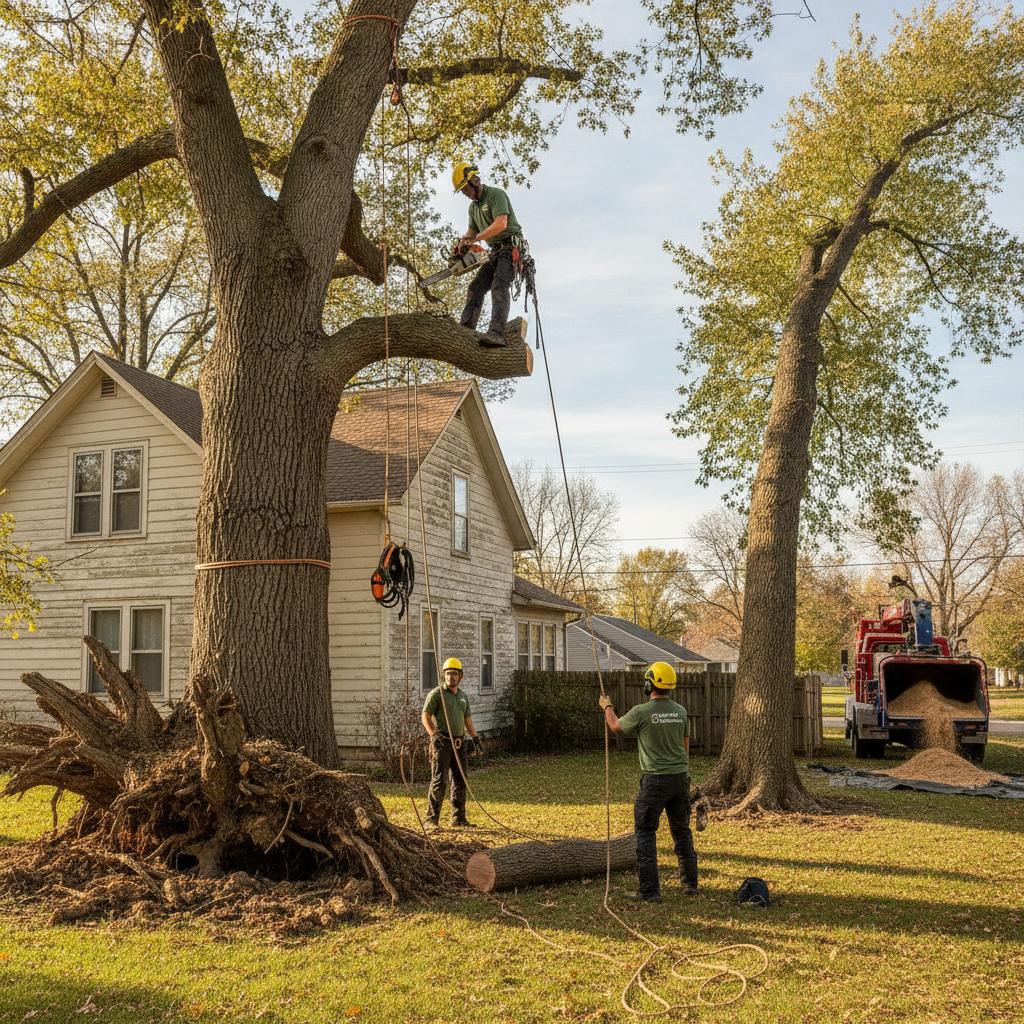
Tree removal on a lean is a taking-apart job more than a dropping job. A stem that has to come down in short pieces over a Highland Park roof takes more time and more gear than the same tree with a clear backyard on a Wanamaker lot. Access between houses, a fence line, parked cars, and how much wood has to leave the property all move the number. Stump grinding, if you want the flare gone, is a separate scope. Confirm the estimate and any visit fee with the matched provider. There’s no Topeka Tree Pro price for this work.
Kansas has no statewide tree-service licence and no statewide general contractor licence. Licensing is local. The City of Topeka licenses contractors who work inside city limits. Most of the smaller towns and counties in this footprint license nothing at all. Ask who will actually stand on the property. Ask whether that person holds the ISA Certified Arborist credential, then check the name in the International Society of Arboriculture directory. Confirm current proof of insurance with the provider before work begins, and if the job is inside Topeka, confirm the company’s city licence with the City of Topeka. If the stem is in the city right-of-way, it’s not yours to cut. The City of Topeka Forestry Division is who confirms the tree’s location and what permission the work needs. On the older streets, the boundary between a yard tree and the city strip is often not where a porch view makes it look.
What is a leaning tree?
A leaning tree is a stem whose main trunk is off vertical. That includes a slow sweep toward light, a bow from ice that the tree later grew into, and a straight lean from a single storm that shifted the root plate. The useful split is not how dramatic the angle looks from the kitchen window. It’s whether the tree grew that way and braced it with wood, or whether the ground moved this week.
Should I be concerned about a leaning tree?
Concern tracks the change and what’s underneath the crown, not the existence of an angle. A new lean after wind or ice, heaved soil, roots in the air, a crack in the trunk, or a crown aimed at a house, a playset, a drive, or a line is worth an on-site assessment. A long-standing sweep with a buttressed trunk and quiet soil is a different conversation. No inspection makes a living tree safe. It identifies visible concerns and reasonable ways to reduce risk.
Can a leaning tree be corrected?
A newly planted tree whose root ball tipped in wet clay can sometimes be reset by a provider while the roots are still small. A mature Topeka tree that leaned in a storm is not straightened back to plumb. The tree adds wood that locks the new angle in, and torn roots do not re-knit because someone guyed the trunk. Correction, when it’s real, means reducing the crown, sharing load at a union with hardware, or taking the tree down so it cannot finish the fall on its own.
When to call us
A fresh lean, a heaved root plate, a hung-up limb, or a stem over a roof is insured tree-service work, not a weekend with a chainsaw and a rope. Topeka Tree Pro matches Greater Topeka property owners with independent insured providers who can inspect the plate, reduce the crown, or take the tree down in pieces. Call us at (785) 333-4052.