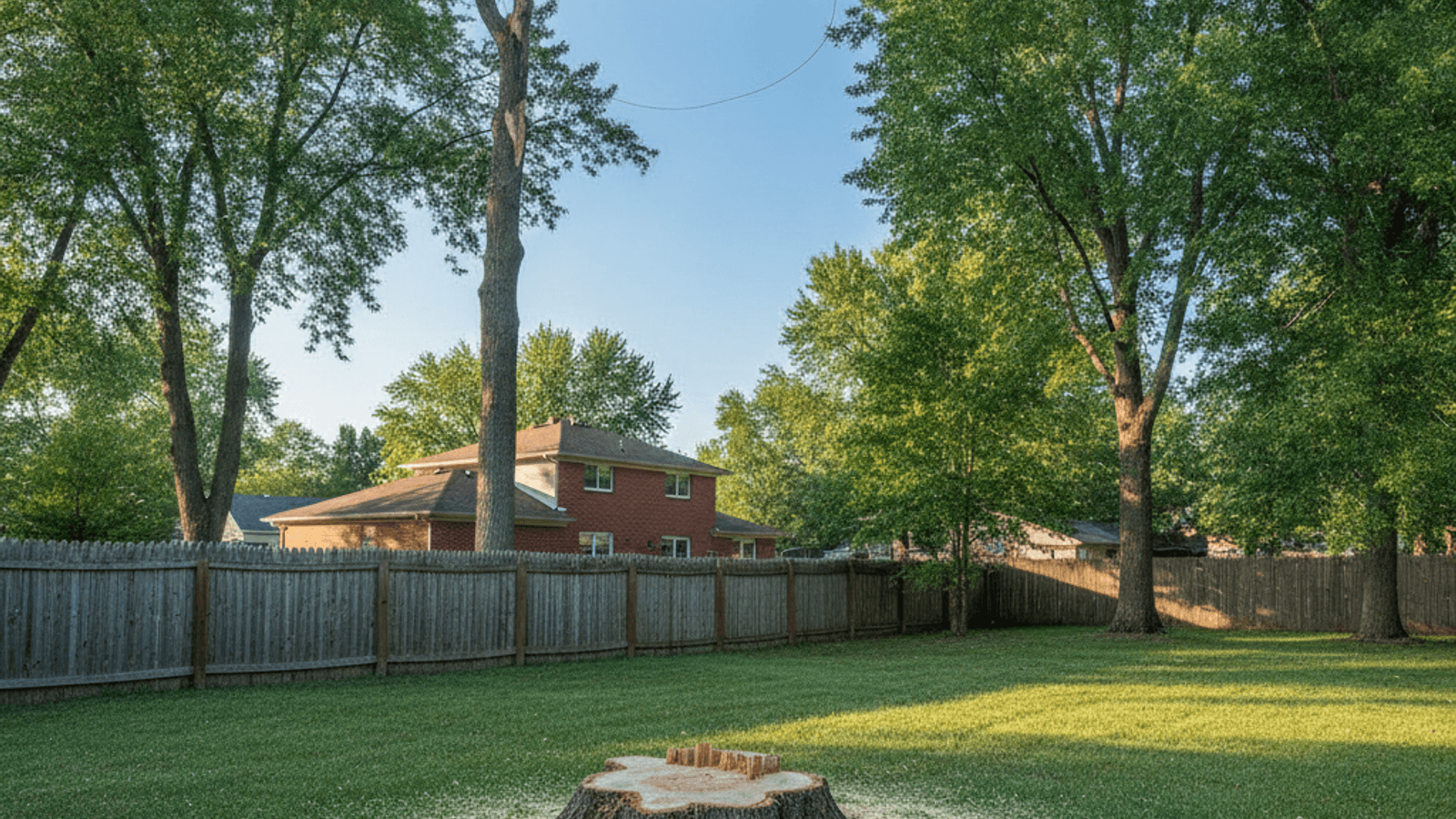
Most people who lose a tree this way go straight to a nursery for a replacement quote. In Kansas that quote usually isn’t the number that matters. The civil starting point is what the whole property lost in value, and replacement cost only comes into it when the owner can show the tree had a specific, unique value of its own. These are published sources, not advice about your situation, and a Kansas attorney is the one who applies them to your facts.
A neighbor cut down my tree in Topeka. What is it worth?
Not what it costs to replace, at least not by default. The first question a Kansas court asks is how much value the property lost when the tree disappeared.
That comes from Evenson v. Lilley, 295 Kan. 43, 282 P.3d 610 (2012), decided by the Kansas Supreme Court:
“It was not, however, error for the district court to base damages on the diminution of the value of the real property.”
The court went on:
“Such a measure is explicitly supported by Kansas caselaw and is the most widely applied rule in other jurisdictions.”
So the valuation question is bigger than the stump. It’s about the property before and the property after.
Replacement cost can still be the measure. It just sits behind an exception, and the owner is the one who has to open it.
Can a neighbor legally cut a tree hanging over their yard?
They can trim what hangs over their side. They can’t come onto your ground and take the tree.
Kansas settled that in Pierce v. Casady, 11 Kan. App. 2d 23, 711 P.2d 766 (1985):
“A landowner has a right to trim branches that overhang the landowner’s property even though the trunk of the tree is on a neighbor’s land.”
Then the court drew the property line in plain terms:
“Defendants have no right to go on plaintiffs’ property to do that work for the same reasons plaintiffs have no right to go on defendants’ property to trim or cut down the tree.”
The same opinion handles the tree that’s genuinely dangerous:
“We choose to follow the jurisdictions holding that trees constitute a nuisance if the overhanging branches do substantial harm or the overhanging branches create an imminent danger.”
And the remedy that goes with it:
“If the tree is a nuisance, the landowner may compel the neighbor to abate the nuisance or, if an injury occurs, look to the neighbor to pay any damages allowable by law.”
Read those together and the route is clear. A worried neighbor can push the owner to deal with a hazardous tree. That’s not the same thing as permission to cut it. Our Topeka tree removal permit guide walks through the trimming and nuisance side in more detail.
What did the Kansas Supreme Court decide in Evenson?
It threw out the test the lower court had used:
“We conclude that the dichotomy of “temporary” versus “permanent” injury on which the district court relied is inappropriate for measuring the value of trees.”
And it put a more useful question in its place:
“The question of “permanent” versus “temporary” damage is ultimately less helpful than the question of how the trees were used and their intrinsic value to the property.”
The facts are worth knowing, because they show the size of the gap people don’t expect. A controlled burn got away and “spread to the Evensons’ property, destroying the outbuildings and around 200 trees.” The owners sought damages in excess of $75,000. A certified general real estate appraiser “provided an appraisal of total damages to the property of $4,687”.
Those numbers belong to that case and nowhere else. They aren’t a valuation range for a Topeka tree, and nobody should read them as one. What carries over is the court’s focus: how the trees were used, and what they were actually doing for the property.
When does replacement cost become the measure instead?
When the tree had value of its own, and the owner proves it:
“If a tree has a specific, unique value, then the replacement cost of the tree may be the proper measure of damages.”
The opinion describes trees that might need replacing “when they screen out wind and noise, produce income, or have ornamental value.”
Two sentences in that opinion do most of the work here, and they belong together:
“If the Evensons had introduced evidence that their trees had any value independent of their value to the land, such as loss of income from fruit trees or the sentimental value of particular trees, then it might have been error for the district court to refuse to consider any other measures of damages.”
“The Evensons made little showing that the trees had any value independent of their value to the land.”
The burden sits with the owner. A tree doesn’t earn replacement cost by being big, old, or expensive to put back. It earns it by being shown to have done something for that property on its own.
Once that showing exists, more opens up:
“In addition to the loss of value to the land, the court might then have considered other measures of damages, such as aesthetic loss, loss of income production, or even replacement costs.”
Notice the “may” and the “might.” The court is naming measures that become available, not promising anyone a result.
Why does the criminal statute count the same tree differently?
Because it’s answering a different question. K.S.A. 21-5813(a)(1) defines criminal damage to property as:
“Knowingly damaging, destroying, defacing or substantially impairing the use of any property in which another has an interest without the consent of such other person”
Subsection (f) then says how the damage amount gets counted:
“In determining the amount of damage to property, damages may include the cost of repair or replacement of the property that was damaged”
Subsection (c) sets the classifications by amount:
- “Is damaged to the extent of $25,000 or more is a severity level 7, nonperson felony”
- “is damaged to the extent of at least $1,000 but less than $25,000 is a severity level 9, nonperson felony”
- “damaged is of the value of less than $1,000 or is of the value of $1,000 or more and is damaged to the extent of less than $1,000 is a class B nonperson misdemeanor”
Put the two texts side by side and they measure the same tree on different scales.
| Source | What it’s deciding | The measure it describes |
|---|---|---|
| Evenson v. Lilley | Civil damages for destroyed trees | Lost value of the real property, by default |
| Evenson, the exception | Trees with proven independent value | Other measures, replacement cost among them |
| K.S.A. 21-5813(f) | Criminal damage classification | Damage may include repair or replacement cost |
That’s a comparison of what two texts say, nothing more. Subsection (c) is criminal classification language, not a civil valuation table, and neither text predicts how a particular dispute turns out.
What should you document before the evidence is gone?
Everything about what the tree was doing, before cleanup changes the site. Evenson put the burden of showing independent value on the owner, and that evidence gets harder to assemble every day the yard changes.
Worth capturing:
- Wide photographs showing the stump, the gap in the canopy, nearby buildings, and the visible property line.
- Older dated photos that show the tree screening wind, framing the house, or bearing fruit.
- Measurements of the stump and its distance from fixed features like a fence, a corner, or a driveway.
- Messages, estimates, invoices, and anything else tied to who cut it and when.
- Notes on the date, the sequence, and what was left behind.
- A written assessment of species, condition, damage, and the risk left in the trees still standing.
That last one is the piece homeowners usually skip. A written arborist consultation puts a professional’s observations on paper while the site still shows what happened, and a tree health assessment covers the neighboring trees that took collateral damage.
Cleanup is a separate decision, and it can wait until the documentation is done. Topeka Tree Pro can connect you with independent insured providers for tree removal and stump grinding once you’re ready.
If a storm brought the tree down rather than a neighbor, that’s a different question. Our homeowners insurance and tree removal guide covers storm claims.
Frequently asked questions
How does Kansas usually value a tree someone cut down?
Kansas civil cases generally start with what the property lost in value. Evenson v. Lilley allows other measures when the owner shows the tree had value independent of the land it stood on.
Can my neighbor trim branches that hang over their yard?
Yes. Pierce v. Casady recognizes a landowner’s right to trim branches overhanging their property. The same opinion says they have no right to enter the neighbor’s property to do that work.
Can a neighbor cut down a tree they think is dangerous?
Not by walking over and cutting it. Pierce says substantial harm or imminent danger can support compelling the tree’s owner to abate a nuisance, which is a different route entirely.
Is replacement cost automatic when someone destroys a tree?
No. Evenson says replacement cost may be the proper measure when a tree has a specific, unique value. The owner has to introduce evidence of that independent value first.
Does the criminal damage statute use replacement cost?
K.S.A. 21-5813(f) says the damage amount may include the cost of repair or replacement. Evenson separately makes lost real-property value the civil starting point, so the two texts count differently.
What evidence matters most after a tree is cut down?
Photographs, measurements, older images of the tree in place, communications about the cutting, and a written record of what the tree did for the property. Document before anything gets hauled off.
Can Topeka Tree Pro tell me what my claim is worth?
No. Legal valuation and recovery questions belong with a Kansas attorney. We connect you with local arborists for written tree assessments and for the cleanup work itself.
Need a written tree assessment in Topeka?
Topeka Tree Pro connects Greater Topeka homeowners with independent insured tree-service providers. You can also review service information for Potwin before requesting an assessment.
Call (785) 333-4052 to request an estimate. Confirm fees, scheduling, and whether a provider serves your property in Shawnee, Jefferson, Jackson, Osage, and Wabaunsee counties.