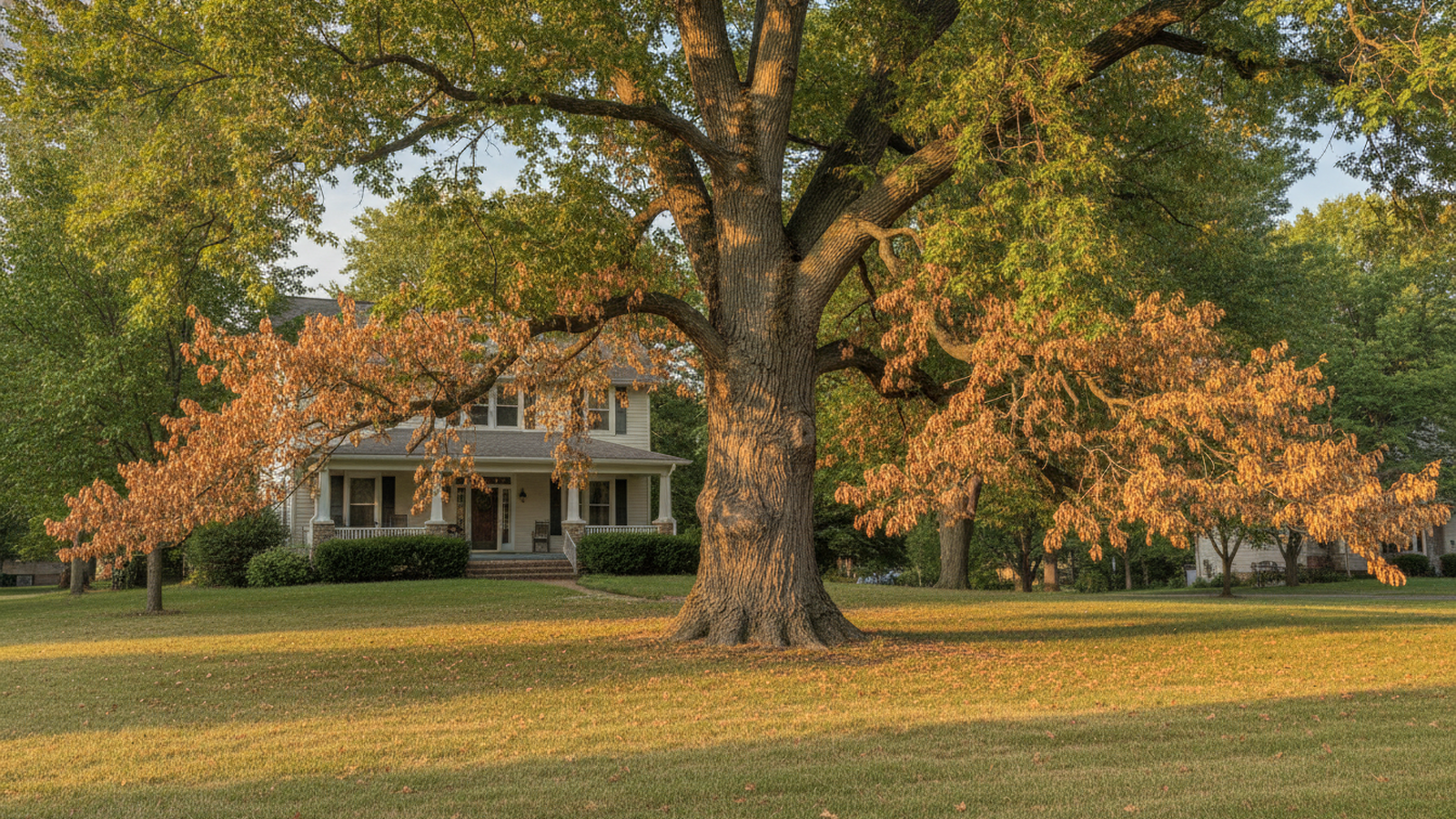
Bur oak blight can cause brown leaves on a Topeka bur oak, but that symptom does not confirm the disease. Similar signs can have different causes, including problems that need prompt attention. Start with a professional assessment, then discuss treatment timing only after the cause and tree condition are understood.
What is bur oak blight, and is it in Kansas?
Bur oak blight is a fungal leaf disease caused by a pathogen called Tubakia iowensis. The USDA Forest Service report on the disease says it “is most common in Iowa and Minnesota, but the disease has been noted in western and southern Wisconsin, northern Illinois, northeast Kansas, eastern Nebraska, and eastern South Dakota”.
Topeka sits in northeast Kansas, which puts local trees at the edge of that range, not its center. The fungus is highly specific to its host. The report confirms that “Substantial necrosis of leaf veins and petioles by T. iowensis occurs only on bur oak.” If you own a different oak species, that signature heavy vein and leaf-stem damage points somewhere else.
What bur oak blight looks like in August
The disease builds quietly through early summer before it gets obvious. Per the USDA report, “The first symptoms usually appear in June in the form of elongated, purple-brown lesions on veins of the leaf undersurface”. You probably won’t notice those early spots from the ground.
By late summer, the damage is hard to miss. The report says “necrosis on the base of the petiole and death of whole leaves appear in late July and into August”. You’ll generally see it low on the tree first, since “Dead leaves and leaves with veinal necrosis are typically most evident in the lower crown”.
The most distinct visual tell arrives as the weather cools. The report explains that “Healthy bur oak branches typically shed all of their leaves heading into winter.” On an infected tree, “Such leaves may remain hanging on the tree, and black pustules begin to form in late summer on the necrotic petiole tissue.”
The report adds that “Only T. iowensis forms black, crustose fruiting structures on the lower 0.4 inch of overwintering petioles of bur oak”. However, this isn’t a homeowner-proof diagnosis. The report itself limits the test: a different group of fungi can leave similar black structures on leaf stems and twigs, and a separate twig blight also leaves dead leaves hanging, clustered on dead branch tips rather than scattered. You’ll need a professional tree health assessment to confirm what you’re seeing.
Is it bur oak blight or oak wilt?
A bur oak turning brown in late summer makes most people think oak wilt. The confusion is common enough that the USDA report addresses it directly: “It is likely that some trees with bur oak blight have been misdiagnosed as oak wilt, which may also result in dead foliage and branch dieback.”
Speed, species, and symptom pattern can help frame the assessment, but they cannot confirm either disease from the ground. Review the warning signs in oak wilt in Topeka, then have a qualified provider distinguish disease from water stress, site problems, and other possible causes.
The two Tubakia problem: why the Kansas advice you’ll find is for a different fungus
Search for Kansas advice on this disease and you’ll likely land on a K-State page titled “Problem: Tubakia Leaf Spot (Tubakia dryina)”. That’s a different fungus. The advice a Topeka homeowner finds under the Kansas name is written for the other Tubakia, and the two diseases carry opposite management rules. For Tubakia dryina, the K-State fact sheet says “Practicing sanitation by removing leaves from diseases trees in the fall can reduce inoculum for the next year.” It also clearly states “No fungicide sprays are recommended.”
For bur oak blight (Tubakia iowensis), raking doesn’t help at all. The USDA report states that “Because the initial inoculum is produced in the tree crown, sanitation of leaves on the ground is not believed to be an effective control.” You can’t rake your way out of bur oak blight.
K-State also notes that “Iron chlorosis appears to make trees especially susceptible to Tubakia.” They add that “Trees under stress such as that caused by drought, a high pH or especially those suffering from iron chlorosis tend to be more likely to show symptoms.” If you suspect iron chlorosis in your trees, ask for an assessment that considers soil, drainage, moisture, light, and competing explanations for the symptoms.
Can wet weather contribute to bur oak blight symptoms?
Yes. The USDA report says severe late-summer symptoms can follow high spring rainfall. It also notes that summer drought after normal spring rain may leave more dead leaves hanging on the tree. Those patterns describe conditions associated with the disease, not a diagnosis for an individual oak.
Weather records may provide context, but they cannot identify the cause of browning leaves. A provider should also consider the tree’s species, symptom pattern, soil, drainage, moisture, light, and overall condition.
Can bur oak blight be treated?
Not in August. The USDA report’s instruction is to “Inject trees as soon as the leaves are fully formed in late May or early June, before symptoms appear.” An August diagnosis is a next-spring decision.
The treatment itself has strict limits. Per the report, “Experimental injections of fungicide have been found to be effective in controlling the disease in some high-value trees, but only trees showing moderate to severe levels of disease should be treated.” It adds that “individual trees need not be treated more than once every three years”.
The report also records that some treated trees may show leaf damage from the chemical itself, and not all treated trees improve. Schedule an arborist consultation to discuss those limits, confirm the diagnosis, and verify the provider’s qualifications before authorizing treatment.
Will my bur oak die?
Bur oak blight alone is not automatically a removal verdict. The USDA report says relatively few affected trees appear to die from the disease aside from associated borer damage. Your tree still needs individual assessment because similar symptoms, additional pests, site stress, and structural defects can change the outlook.
Your tree’s genetics also shape its risk. The USDA notes that “This disease distribution roughly coincides with the limited distribution of a small-acorned, fire-adapted variety of bur oak”. Acorn size is a risk indicator, not a test: “Ornamental plantings of bur oak trees with large acorns are not seriously affected, but planted bur oak with small acorns may have severe symptoms”. The report’s planting advice is to “grow bur oak trees produced from large acorns as these seem to be mostly free of the disease”.
What a Topeka homeowner should actually do this fall
This fall, document where symptoms appear and request an assessment before choosing treatment, tree trimming, or removal. Keep clear of hanging branches and unstable damage. Do not use one neighborhood, one symptom, or unchanged appearance as proof that the tree is stable.
If the provider finds a structural defect, compare cabling or bracing with removal. Ask how the tree’s condition, access, obstacles, and intended result affect the recommendation. The guide on how to tell if a tree is dead can help you identify concerns, but a brittle branch alone does not diagnose the whole tree. Tree removal should follow an assessment of the actual condition and risk.
Frequently asked questions
Does raking leaves prevent bur oak blight?
No. The USDA report says “Because the initial inoculum is produced in the tree crown, sanitation of leaves on the ground is not believed to be an effective control.” The fungus overwinters up in the canopy, not on your lawn.
When is the best time to treat bur oak blight?
The USDA report describes treatment after leaves are fully formed in late May or early June and before symptoms appear. Use spring tree care to plan a timely assessment, then let the confirmed diagnosis and provider’s written recommendation guide treatment.
Will bur oak blight spread to my other oak trees?
The USDA report says the substantial vein and petiole damage associated with T. iowensis occurs only on bur oak. Symptoms on another oak need their own assessment because appearance alone cannot identify the cause. K-State notes that members of the red oak group are more likely to be affected by the other Tubakia than members of the white oak group.
How do I know if my tree has bur oak blight or oak wilt?
You cannot confirm the difference from browning leaves alone. The USDA report notes that some trees with bur oak blight have likely been misdiagnosed as oak wilt. A professional assessment can compare species, symptom pattern, site conditions, and other possible causes.
Should I cut down a bur oak with blight?
Not based on a suspected blight symptom alone. The USDA report says relatively few affected trees appear to die from the disease aside from associated borer damage. Removal depends on the individual tree’s confirmed condition, structure, surroundings, and available management options.
Get a professional tree assessment in Topeka
Do not guess at a fungal diagnosis from late-summer browning. Topeka Tree Pro connects Greater Topeka homeowners with independent insured tree-service providers. Call (785) 333-4052 to request an estimate, then verify availability, qualifications, diagnosis, and written scope directly with the matched provider. For assessment or trimming options, review tree service in Topeka.