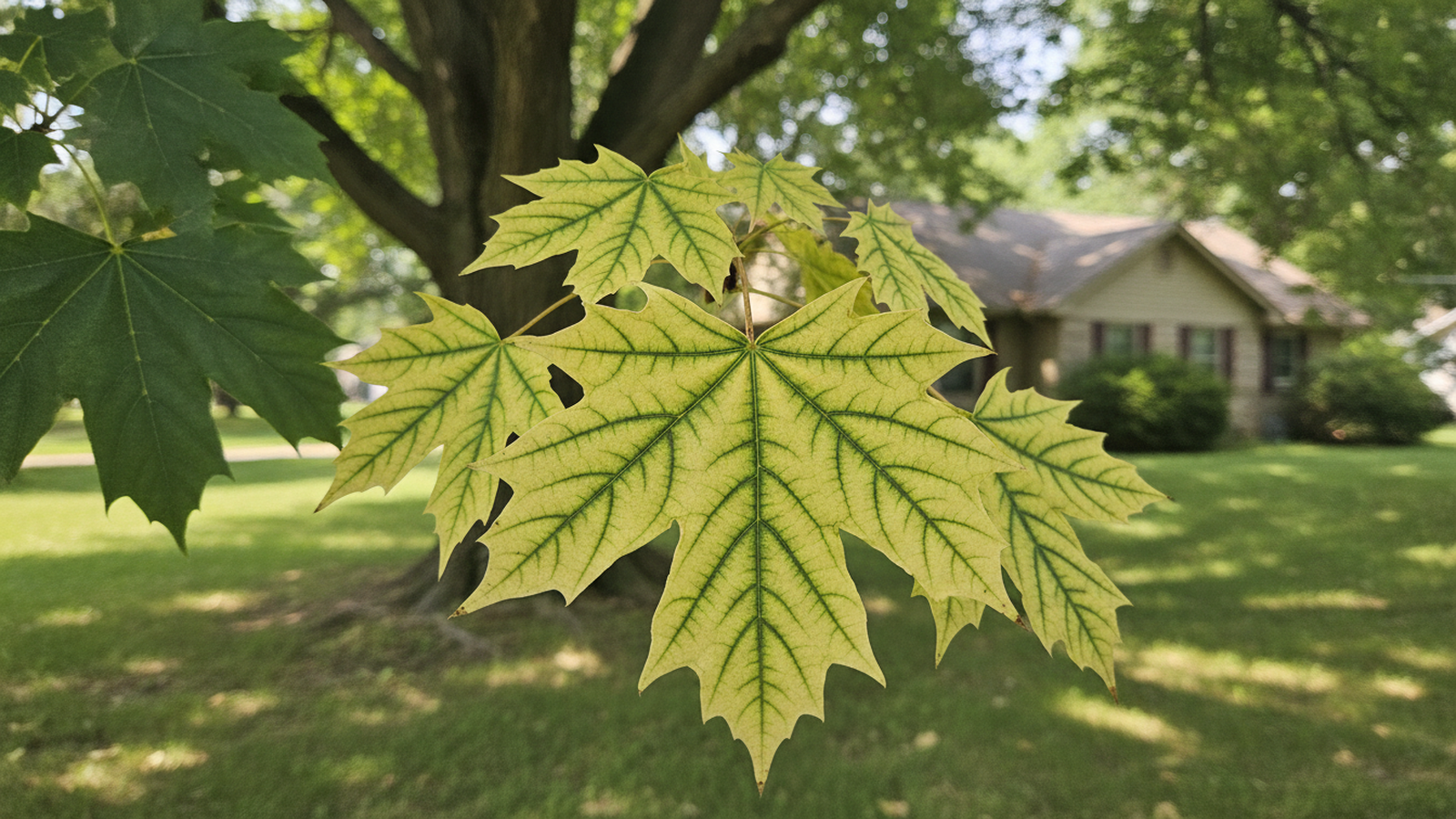
Iron chlorosis causes a distinct pattern: deciduous leaf veins stay green while the tissue between them turns yellow. In most Kansas soils, iron is plentiful but unavailable to trees. Soil pH controls that availability. At pH 7.0 and above, iron changes into an insoluble form that trees can’t readily use.
Diagnosis matters before anyone promises a quick green-up. A trunk treatment applied in late summer may not show results until next year.
What is iron chlorosis in trees?
Iron chlorosis develops when a tree can’t access available iron. It doesn’t necessarily mean the soil contains too little iron.
The Kansas Forest Service and K-State Research and Extension explain this condition in Iron Chlorosis in Trees. Their publication states that iron is plentiful but unavailable in most Kansas soils.
Iron remains readily available between pH 5.0 and 6.5. At pH 7.0 and above, it changes into an insoluble form. Tree roots then have difficulty accessing the iron already present.
Iron supports normal leaf color. When availability falls, the leaf tissue changes first. Veins remain green while the areas between them become yellow-green or yellow.
That pattern applies specifically to deciduous trees. Soil and leaf sampling should confirm the cause before treatment, especially for species other than pin oak.
What does iron chlorosis look like?
Iron chlorosis first appears as yellow tissue between green leaf veins. The contrast can make each vein look like a narrow green line.
Leaves emerging during early spring are frequently normal-sized. Leaves appearing later may become smaller and more yellow.
Symptoms don’t always cover the entire canopy evenly. Urban soil variations can produce yellowing along one side. Individual branches may also show stronger symptoms than nearby growth.
Severe cases can progress from yellow leaves to white leaves. Those leaves may eventually turn brown. Advanced cases can include twig dieback near the crown and branch ends.
After several untreated years, the tree may die. Twig dieback or advanced decline calls for a closer tree risk assessment, not treatment based only on leaf color.
Which trees can develop iron chlorosis?
Pin oak, silver maple, baldcypress, and sweetgum are the most susceptible species named in MF718.
A second group may develop iron chlorosis:
- White pine
- River birch
- Walnut
- Sugar maple
- Red maple
- Eastern redcedar
- Sycamore
- Ornamental pear
- Some crabapple species
These groups shouldn’t be treated as equal. Pin oak and silver maple belong to the most susceptible tier. River birch and red maple belong to the group that may develop symptoms.
So the first question on a yellowing tree is which species it is. A silver maple or pin oak belongs to the most susceptible group identified by MF718. A river birch or red maple only puts the condition on the list. Either way, the tree still needs a diagnosis. A matched independent provider can inspect it onsite and explain whether species identification, soil sampling, or leaf sampling is needed.
A yellowing red maple in Topeka still needs a proper diagnosis. Leaf color alone doesn’t establish the underlying cause.
Is it iron chlorosis or another problem?
Start with the pattern, not the tree’s overall color. Narrow green veins surrounded by yellow tissue support an iron chlorosis diagnosis on deciduous trees.
Manganese deficiency produces a different pattern. Broad bands of normal green remain beside the major veins. Leaves at branch ends generally remain unaffected until late summer, after growth stops.
Excess moisture and poor drainage can also make trees look chlorotic. Herbicide damage and deficiencies involving nitrogen, manganese, boron, or zinc may produce similar symptoms.
| Possible cause | What the leaves or site may show | Best next step |
|---|---|---|
| Iron chlorosis | Narrow green veins with yellow tissue between them | Confirm with soil and leaf sampling |
| Manganese deficiency | Broad green bands beside the major veins | Compare the band width and sample before treatment |
| Excess moisture or poor drainage | A tree that looks chlorotic without confirming iron trouble | Inspect site moisture and drainage separately |
| Herbicide or another mineral deficiency | Chlorosis symptoms without the defining iron pattern | Use soil and leaf samples to narrow the cause |
| Pine, oak, or elm disease concern | The green-vein pattern alone doesn’t identify these diseases | Use a disease-specific guide and professional assessment |
A county soil test measures pH and available nutrients. It can’t identify diseases, insects, pesticide residue, drainage, compaction, or chemical pollutants.
If a pine is turning brown, use the pine troubleshooting guide. An oak with other concerning symptoms needs the separate oak wilt guide. These concerns require different diagnostic paths.
What iron chlorosis treatment works?
The right iron chlorosis treatment depends on the confirmed cause. MF718 describes foliar sprays, soil treatments, trunk injections, and implants.
Each option offers a different tradeoff:
| Treatment | What it provides | Important limitation |
|---|---|---|
| Foliar spray | Quick improvement on treated leaves | Results are temporary and limited to sprayed leaves |
| Soil treatment | Treatment beneath the canopy lasting two to three years | Placement and trunk measurements affect the method |
| Trunk injection or implant | In most cases, another treatment may not be needed for three to five years | Drilled holes damage living tissue |
| Tree selection | Avoids repeated treatment for chronically unsuitable soil | Applies when choosing replacement or new trees |
Foliar treatment
A foliar spray can produce quick results. However, the improvement is temporary.
Only the leaves receiving spray benefit from that application. New growth emerging afterward may still appear chlorotic.
Soil treatment
MF718’s soil-treatment rate is one pound per inch of tree diameter. Diameter is measured four feet above the ground.
The publication describes holes or injection sites spaced two feet apart. Those sites are six to ten inches deep.
The grid begins two to three feet from the trunk. It then extends beyond the branch ends, or drip line. This treatment remains effective for two to three years.
Those measurements are treatment specifications, not soil-sampling directions. The Shawnee County sampling depth is different and appears below.
Trunk injection or implants
Trunk treatment can provide a longer interval between applications. In most cases, another treatment may not be needed for three to five years.
That duration comes with a real tradeoff. Every drilled hole damages living tissue and can provide an entry point for disease organisms.
Small wounds usually close with callus tissue within one year. Larger wounds take longer. MF718 advises investigating other treatment options before repeatedly wounding the trunk.
An arborist consultation can help compare those tradeoffs after diagnosis. Product or treatment selection shouldn’t come before soil and leaf sampling.
When will an iron injection turn leaves green?
Spring and late-summer treatments follow different timelines. That distinction matters during August in Topeka.
A spring treatment applied after leaves fully develop normally shows a response within two to three weeks. Trees treated later in summer may not respond until the following year.
That means an injection ordered in mid-August may not produce greener leaves this month. The visible response may arrive next spring.
Use a spring tree health checklist to plan follow-up timing. New spring growth provides a clearer point for comparing the canopy’s response.
How do I test soil for iron chlorosis in Topeka?
For a Topeka submission, follow Shawnee County’s tree-and-shrub sampling directions. The county office instructs residents to sample 10 to 12 inches deep.
MF718 gives a general statewide depth of about six to eight inches. The Shawnee County soil-testing office receives local samples and specifies 10 to 12 inches for trees and shrubs. Use the county office’s depth for a Topeka submission.
Follow these local steps:
- Collect at least four to five samples from the area.
- Mix those samples together thoroughly.
- Place two cups of mixed soil in a resealable quart-sized bag.
- Select the basic fertility package when pH testing is needed.
The basic fertility package includes soil pH and costs $14.00.
Submit the sample to:
K-State Research and Extension, Shawnee County
1740 SW Western Avenue
Topeka, Kansas 66604
785-232-0062
The office is open Monday through Friday, from 8:00 a.m. to 5:00 p.m.
A soil test doesn’t replace leaf sampling or site inspection. MF718 recommends both soil testing and leaf sampling before treatment, especially for species other than pin oak.
Can iron chlorosis be prevented?
Choosing trees that tolerate high-pH soil is the best preventative approach described in MF718.
Repeated treatment may manage symptoms, but it doesn’t permanently change a chronic soil condition. K-State Research and Extension’s Johnson County office puts it plainly: “It will take a lifetime of treatments as there is no one-time fix to the high pH soils that create the problem.”
That makes species selection important when replacing a declining tree. It also supports testing before adding another susceptible species nearby.
Frequently asked questions
Does iron chlorosis mean my soil lacks iron?
No, iron chlorosis doesn’t necessarily mean the soil lacks iron. In most Kansas soils, iron is plentiful but unavailable to trees. At pH 7.0 and above, it changes into a less available, insoluble form.
Why are my pin oak leaves turning yellow?
Yellow tissue between green veins may indicate pin oak chlorosis. Pin oak is among the four species MF718 names as most susceptible. Soil and leaf sampling should confirm the diagnosis before treatment.
Can silver maple or river birch develop iron chlorosis?
Yes, but the two species belong to different susceptibility tiers. Silver maple is among the most susceptible species. River birch belongs to the group that may develop iron chlorosis.
Should I use chelated iron for trees?
Don’t choose chelated iron before confirming the cause. MF718 recommends soil testing and leaf sampling before treatment, especially for species other than pin oak. A confirmed diagnosis should guide the treatment method.
Will an iron injection work during August?
A late-summer injection may not show a response until the following year. Spring applications after full leaf development normally show results within two to three weeks. August treatment shouldn’t be expected to green the canopy immediately.
How deep should I take a tree soil sample?
Use a depth of 10 to 12 inches for Shawnee County tree and shrub samples. MF718 provides a general statewide depth of six to eight inches. Topeka residents should follow the receiving county office’s local instructions.
Get a local diagnosis before treating
Confirm the cause before choosing an iron treatment. Start with a tree health assessment or an arborist consultation.
Topeka Tree Pro connects property owners across Shawnee, Jefferson, Jackson, Osage, and Wabaunsee counties with independent insured tree-service providers. After the tree is evaluated, ask the matched provider whether tree trimming belongs in the written scope.
Call (785) 333-4052 for help finding the right local service. Visit the Topeka tree service page for coverage details.