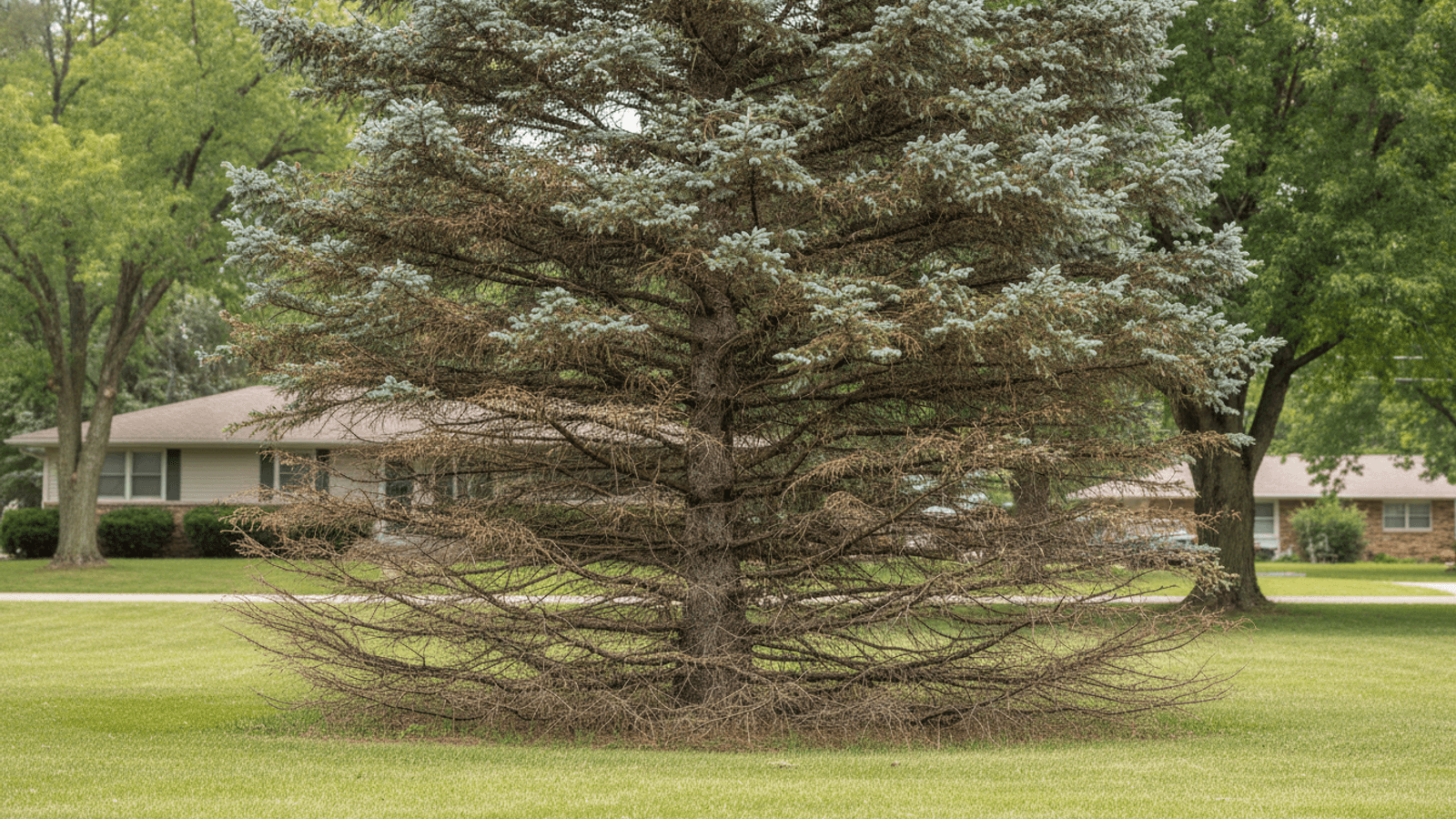
A blue spruce dying in Topeka may be affected by disease, site stress, herbicide exposure, physical damage, or more than one cause. K-State Research and Extension notes that poor growing conditions can resemble Cytospora canker and Rhizosphaera needlecast. Visible symptoms can guide an inspection, but they cannot confirm a diagnosis by themselves.
Why is my blue spruce dying in Topeka?
K-State documents several possible contributors to blue spruce decline, including Cytospora canker, Rhizosphaera needlecast, herbicide exposure, and unsuitable growing conditions. Other damage may produce similar symptoms, so the list is not a diagnosis.
Rhizosphaera symptoms can become visible after the useful treatment window has passed. Treatment timing should be based on a confirmed problem and current growth stage, not the month alone. Existing needle loss cannot be reversed by spraying.
Site conditions still belong in the assessment. Soil, drainage, moisture, light, nearby applications, and the distribution of damage can help a qualified provider narrow the possibilities.
What do the four field signs actually mean?
Four things brown a blue spruce in Topeka, and each one leaves a different mark you can check for yourself.
| Field sign | Possible explanation | Useful next step |
|---|---|---|
| Pitch-covered bark patches or dark structures in damaged tissue | Canker or another bark injury | Have the branch and surrounding tissue assessed before pruning |
| Dark dots arranged along needles | Needlecast or another needle problem | Confirm the cause before planning treatment |
| Dieback that appears uneven or spirals upward | Root-zone exposure, injury, or another uneven stress | Review nearby applications and request an inspection |
| Inner needles changing color without a clear pattern | Moisture, drainage, light, or another site condition | Assess the site and tree together |
Dark structures can be useful inspection clues, but appearance alone doesn’t establish the cause. Their location, pattern, surrounding tissue, and the tree’s growing conditions all matter.
None of these four signs involve chewed or stripped foliage. A spruce that looks stripped bare or has spindle-shaped bags hanging in its branches is more likely dealing with bagworms, not a fungus or site stress.
If the cause is unclear, request a tree health assessment through Topeka Tree Pro. Compare written estimates by the inspection scope, any testing or reporting included, and the provider’s qualifications. Actual pricing depends on the tree, site, access, and requested deliverables.
Can a spiral pattern prove herbicide damage?
No. A spiral or one-sided pattern may be a useful clue, but it doesn’t prove what caused the damage. K-State explains that water-conducting tissue can follow a twisting path through the trunk, which may influence where symptoms appear.
K-State also warns that blue spruce can be damaged by phenoxy-type lawn herbicides absorbed through roots or foliage. Review what was applied nearby and share that information with the provider inspecting the tree. Disease, physical injury, moisture problems, and other site conditions still need consideration.
Is it too late to treat Rhizosphaera needlecast this month?
Yes, for this year. K-State’s timing is specific: fungicide applications need to happen when new shoot growth is a half inch to an inch long, with a second application three weeks later. That window falls in spring, not August.
The disease itself works on a slow clock. Symptoms first show up in late summer or fall, when the mature needles on the lower crown start to yellow. Those needles stay attached through winter, then turn purple and drop the following spring, with most defoliation arriving the second summer after infection.
Fungicides K-State names as effective include Bordeaux mixture, thiophanate methyl, and chlorothalonil, applied on that spring schedule. Improving air circulation helps in the meantime: K-State notes the disease favors poor air circulation and high humidity, and clearing weeds and shrubs crowding the tree increases airflow.
What is Cytospora canker, and is it treatable?
Cytospora canker is a fungal disease that shows up as white, pitch-covered patches on the bark, sometimes with small black fruiting bodies in the diseased wood underneath. K-State’s Kansas problem guide notes it’s occasionally found on drought-stressed or winter-injured trees, which ties it to the same stress pattern behind site decline.
If Cytospora canker is confirmed, K-State guidance includes removing affected branches and avoiding pruning during wet weather. A provider should first distinguish the suspected canker from other bark injury and determine which branches can be removed safely.
Does a browning blue spruce carry the same deadline as a browning pine?
Not necessarily. Guidance for pine wilt should not be applied automatically to a blue spruce. The species, cause, condition, and surrounding hazards need to be established first.
A lack of rapid visible change does not prove that a damaged tree is stable. Hanging branches, a compromised trunk, root movement, or contact with electrical lines calls for prompt professional or utility help. For other decline, ask a provider to assess the tree and explain whether monitoring, pruning, treatment, or removal is appropriate.
What is actually stressing blue spruces in Topeka?
Site conditions may contribute as much as disease. K-State notes that blue spruce can struggle outside its preferred growing conditions, so the assessment should include soil, drainage, moisture, light, and nearby activity.
Blue spruce is shallow rooted, and K-State lists infertile soil, poor drainage, shade, drought, and winter drying outside its native range as things it’s very sensitive to. Extended stretches of hot, dry weather can damage it outright. Any combination of these factors can lead to the same gradual decline: purpling inner needles, needle drop, branch dieback, and in some cases tree mortality.
Real management helps. K-State recommends mulching young trees with shredded bark or another organic mulch, never plastic, 3 to 4 inches deep in a radius of at least 3 to 4 feet. Water at least twice a month through the growing season, and occasionally during dry winter months. Fertilization generally isn’t required. Keep herbicides, especially phenoxy types, away from the root zone, which extends well beyond the tree’s crown.
Because similar symptoms can have different causes, evidence about another species or disease should not be treated as a diagnosis for a blue spruce. The provider should evaluate the tree’s own moisture history, drainage, light, damage pattern, and surrounding conditions.
Does Tecumseh’s windbreak country make needlecast worse?
Closely planted trees may have less air movement, which K-State identifies as a condition associated with needlecast. That does not confirm disease in a particular windbreak or establish its planting history.
For tree work around Tecumseh, ask the provider to inspect spacing, airflow, drainage, access, and the pattern of symptoms. Our guide to windbreak trees and row renewal explains the broader decisions involved when a row needs attention.
Frequently asked questions
Can a blue spruce recover once its lower branches have turned brown?
Not on the branches that are already bare. A branch that’s lost its needles doesn’t grow new ones, and K-State describes affected branches as eventually defoliated and killed by the disease that caused it. The real question is whether the rest of the tree still has enough healthy growth to be worth keeping.
Does fertilizing help a stressed blue spruce?
Generally, no. K-State’s management guidance for established blue spruce states plainly that fertilization generally is not required. Watering and mulching matter far more than feeding for this species in Kansas.
Should I mulch or use a plastic weed barrier around the base?
Organic mulch, never plastic. K-State recommends shredded bark or another organic mulch, 3 to 4 inches deep, in a radius of at least 3 to 4 feet, and specifically warns against any type of plastic mulch.
How often should an established blue spruce be watered in Topeka?
At least twice a month during the growing season. K-State also recommends watering occasionally during dry winter months, since blue spruce is sensitive to both drought and winter drying outside its native range.
Can lawn weed killer really damage a tree from that far away?
Yes, through the roots. Blue spruce is shallow rooted, and K-State warns that phenoxy-type lawn herbicides can be absorbed by those roots or the foliage and cause considerable damage, sometimes spiraling up the trunk.
Are there better trees to plant instead of blue spruce here?
Yes. K-State names baldcypress, Austrian and ponderosa pines, and junipers as better-adapted conifer choices for Kansas landscape and ornamental plantings.
Can I confirm Cytospora canker or needlecast by looking?
Not reliably from one sign. Pitch-covered bark and dark structures along needles can help guide an inspection, but similar symptoms may have other causes. Confirm the diagnosis before choosing pruning or treatment.
Do I need a professional opinion before deciding to remove the tree?
A written report can document the observed condition, possible causes, and available options. When requesting an arborist consultation, ask what the quote includes, whether testing or written recommendations are part of the scope, and which qualifications the provider holds.
Getting a straight answer on a browning Topeka spruce
On a tree that’s native to the Rocky Mountains and planted in Kansas clay, the real question usually isn’t which fungicide to buy. It’s whether this particular tree, in this particular yard, is still worth keeping.
Topeka Tree Pro connects Greater Topeka homeowners with independent insured tree-service providers. A provider can inspect the tree, discuss possible causes, and explain whether monitoring, pruning, treatment, or tree removal belongs in the written scope.
Removal estimates depend on the tree’s condition, access, nearby obstacles, hauling, stump work, and the intended end result. Ask each provider what the quote includes and verify qualifications, insurance, permissions, scheduling, and availability directly. Call (785) 333-4052 to request an estimate.