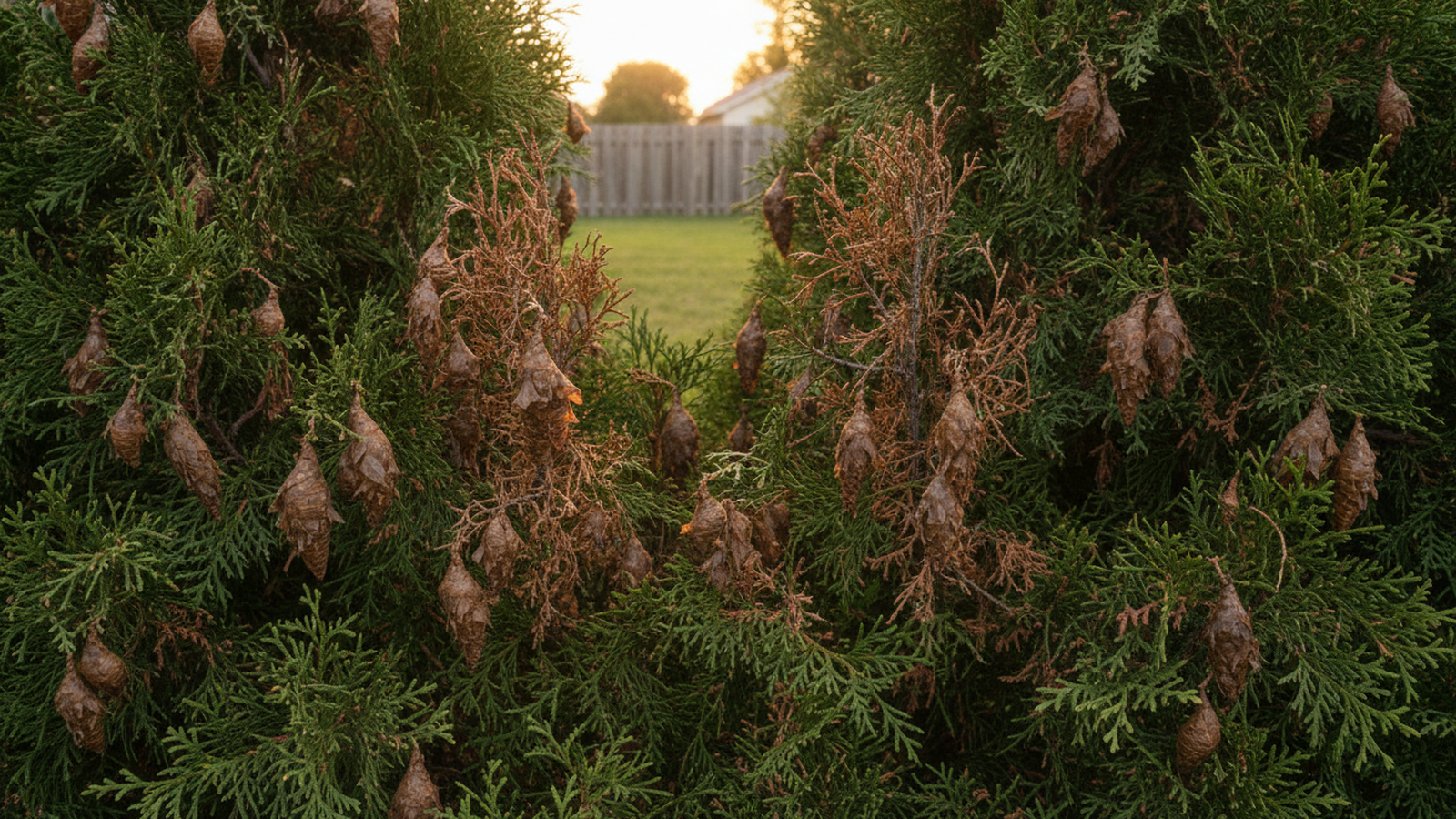
Bagworm control depends on the insect’s current stage. Sprays work best while larvae are small and actively feeding. Once they have stopped feeding and sealed their bags, hand-picking reachable bags is the practical option. Check the bags and the calendar before choosing a control method.
What are bagworms doing on my trees right now?
K-State Research and Extension’s MF3474 describes one bagworm generation each year. Eggs generally hatch from mid-May through early June, and the larvae feed as their bags grow. From mid-August into early September, mature larvae stop feeding, seal their bags, and pupate inside. Inspect the bags closely because calendar timing alone doesn’t confirm the stage on an individual plant.
Is it too late to spray for bagworms?
Spraying is unlikely to help after larvae stop feeding and seal their bags. K-State explains that insecticides work best while larvae are small and actively eating treated foliage. Bacillus thuringiensis subsp. kurstaki and spinosad act through ingestion, so effectiveness declines as feeding slows. Confirm the insect’s stage and follow the product label before applying anything.
When should I spray bagworms in Kansas?
Start in late May, once larvae are 1/8 to 1/4 inch long, and reapply weekly for four weeks. K-State recommends this repeat schedule specifically because eggs don’t all hatch at the same time. Cooler spring temperatures can delay hatch and push the whole window later, so watching your own trees in early May matters more than circling a date on the calendar. Spray in the morning or evening, when larvae are most active, and follow the product label. K-State notes that full coverage can be difficult on the upper and inner branches of mature trees. If a tree or hedge cannot be reached safely, ask an independent provider to assess the available options. Homeowners seeking tree and shrub care in Rossville can also discuss access, plant condition, and the intended result before requesting a written quote.
What do bagworms on evergreens actually look like?
Look for spindle-shaped bags, roughly 1 to 2 inches long by this point in the season, hanging off branches like small Christmas tree ornaments. They’re often mistaken for pine cones or bits of dead plant material, especially against cedar or juniper foliage. Conifers take the worst of it. K-State notes that conifers are particularly susceptible to bagworm damage because they don’t regenerate new growth once it’s been eaten, unlike deciduous trees, which can push out new leaves the following season. Arborvitae, bald cypress, cedar, fir, juniper, pine, and spruce are the conifer hosts. Bagworms also feed on black locust, crabapple, elm, hackberry, honey locust, linden, maple, oak, poplar, rose, sycamore, and willow. In a Topeka yard, they’ll sometimes attach to the siding, a garbage can, or a deck rail near an infested plant, not just the plant itself. On a blue spruce, check for bags before assuming the browning is one of the other things that brown that species here, since the damage patterns look different up close.
Why does the same hedge get bagworms every single year?
Because the female moth never leaves. Male bagworms become small black moths with clear wings, about 1/2 inch long, and fly off using pheromone scent to find females. Females never get that chance. K-State’s publication is specific: female bagworms don’t have wings, legs, antennae, or functional mouthparts, and they never become moths at all. A female lays between 500 and 1,000 eggs, which stay inside her pupal case, inside the bag, all winter. That means an infestation doesn’t spread out and thin over time on its own. It sits on the same windbreak or hedge row and compounds year after year, because the next generation hatches out of bags that never went anywhere. Missing even one female bag when you’re checking a hedge can mean 500 to 1,000 new larvae the following spring. This is also the mechanism behind the ballooning you may have noticed in June: newly hatched larvae, 1/8 to 1/4 inch long, spin a strand of silk and drift on the wind to nearby plants, which is how a bagworm problem spreads from one shrub to the next row over.
What should I do after the spray window closes?
Hand-pick every bag you can reach, on evergreens and any other host plant, and don’t stop at the obvious ones. K-State’s guidance for minor infestations is straightforward: regular hand-picking during the growing season and through winter reduces bagworm populations the following year. Check the whole canopy, not just eye level, since female bags tend to sit at the tops of trees and shrubs while male bags cluster lower down. For bags you have already picked, K-State MF3474 says to drop them into a bucket with a soapy water solution, 1 fluid ounce of soap per gallon of water, and soak them for 15 minutes. Then empty the bucket and pile the bags in full sun. Don’t toss them in the trash, the compost pile, or leave them on the ground, since eggs inside an intact bag can still be viable. If the infestation is heavy or the trees are too tall to reach safely, K-State’s own guidance acknowledges hand-picking stops being practical at that point, which is where a tree health assessment is worth the call, to get eyes on how bad it actually is and whether next spring’s spray window is worth planning around.
Kansas bagworm calendar
| Timeframe | What the insect is doing | What to do |
|---|---|---|
| Mid-May to early June | Eggs hatch, tiny larvae (1/8 to 1/4 in) emerge and balloon on silk to nearby plants | Start scouting; this is the window to prepare for spraying |
| Late May through late June | Larvae still small; peak feeding begins | Spray weekly for 4 weeks with Btk or spinosad, morning or evening |
| July into early August | Larvae growing, bags lengthening toward 1 to 2 inches | Spraying loses effectiveness as feeding declines; hand-picking still works |
| Mid-August to early September | Larvae stop feeding, seal the tops of their bags, begin to pupate | Spraying is no longer useful; hand-pick and soak bags in soapy water |
| Fall through winter | Bags remain on branches; females’ eggs overwinter inside | Best window for thorough hand-picking, since every bag is finished and each one you pull is eggs removed |
| Following mid-May | New generation hatches | Scouting starts again |
How do bagworms compare to other pests we cover in Topeka?
Bagworms damage the plant they feed on. K-State’s MF3474 notes that conifer defoliation can be damaging, because those trees do not replace eaten foliage the way deciduous trees can the following season. That plant-by-plant feeding differs from emerald ash borer in Shawnee County, which the state tracks as a regional threat to ash trees. The condition of the affected plant should guide the response.
One thing worth ruling out while you’re checking conifers: bagworms strip foliage, but they don’t turn a whole pine brown in a matter of weeks. If a pine specifically is browning fast rather than looking chewed, that’s a different problem, and a pine tree turning brown in Topeka covers what pine wilt looks like and why the removal deadline falls before May 1.
Bagworms aren’t the only pest that gets missed on a walk past the yard. Our spring tree health checklist is built around catching early hatch and other seasonal issues before they compound, and if cedar is part of what you’re managing, cedar trimming timing in Topeka covers when to prune those same trees without adding stress on top of a bagworm year.
Frequently asked questions
Can I still spray for bagworms in August?
No. By mid-August, larvae have stopped feeding and sealed the tops of their bags to pupate, and both effective insecticides, Btk and spinosad, only work if the larva eats treated foliage. A larva that’s no longer feeding won’t ingest the residue, so spraying now won’t reduce the population.
What controls bagworms while larvae are small?
K-State identifies products containing Bacillus thuringiensis subsp. kurstaki or spinosad for small, actively feeding larvae. Timing varies with hatch and development, so inspect the plant and follow the product label. Once larvae stop feeding and seal their bags, spraying is unlikely to help.
Why do I get bagworms on the same trees every year?
Female bagworms never grow wings, legs, or the ability to fly, so they never leave the plant they hatched on. Each female lays 500 to 1,000 eggs that overwinter inside her bag, right on that same branch, which is why an untreated infestation compounds on the same hedge row or windbreak year after year instead of spreading out and fading.
Do bagworms kill trees, or just damage them?
They can kill a tree, particularly conifers. K-State notes that conifers can’t regenerate foliage once it’s eaten, so extensive bagworm feeding over several years in a row can fully defoliate and kill a well-established tree or shrub. Deciduous trees generally tolerate bagworm feeding better because they push new leaves the following season.
Should I just leave bagworm bags alone and let birds handle it?
Not if you want the population to actually drop. Birds and parasitic wasps do prey on bagworms, but K-State is clear that these natural enemies don’t kill enough of them to affect the population or prevent plant damage on their own. Hand-picking and proper disposal is the control that actually moves the needle for a minor to moderate infestation.
Get a second opinion on your trees before next spring
Fall and winter provide time to inspect plants and remove reachable bags before the next hatch. If a windbreak, hedge, or tall conifer cannot be handled safely, Topeka Tree Pro can connect you with an independent insured provider for hedge and shrub care or an arborist consultation. A provider can also assess whether tree trimming belongs in the written scope. Call (785) 333-4052 to request an estimate and verify availability directly with the provider.