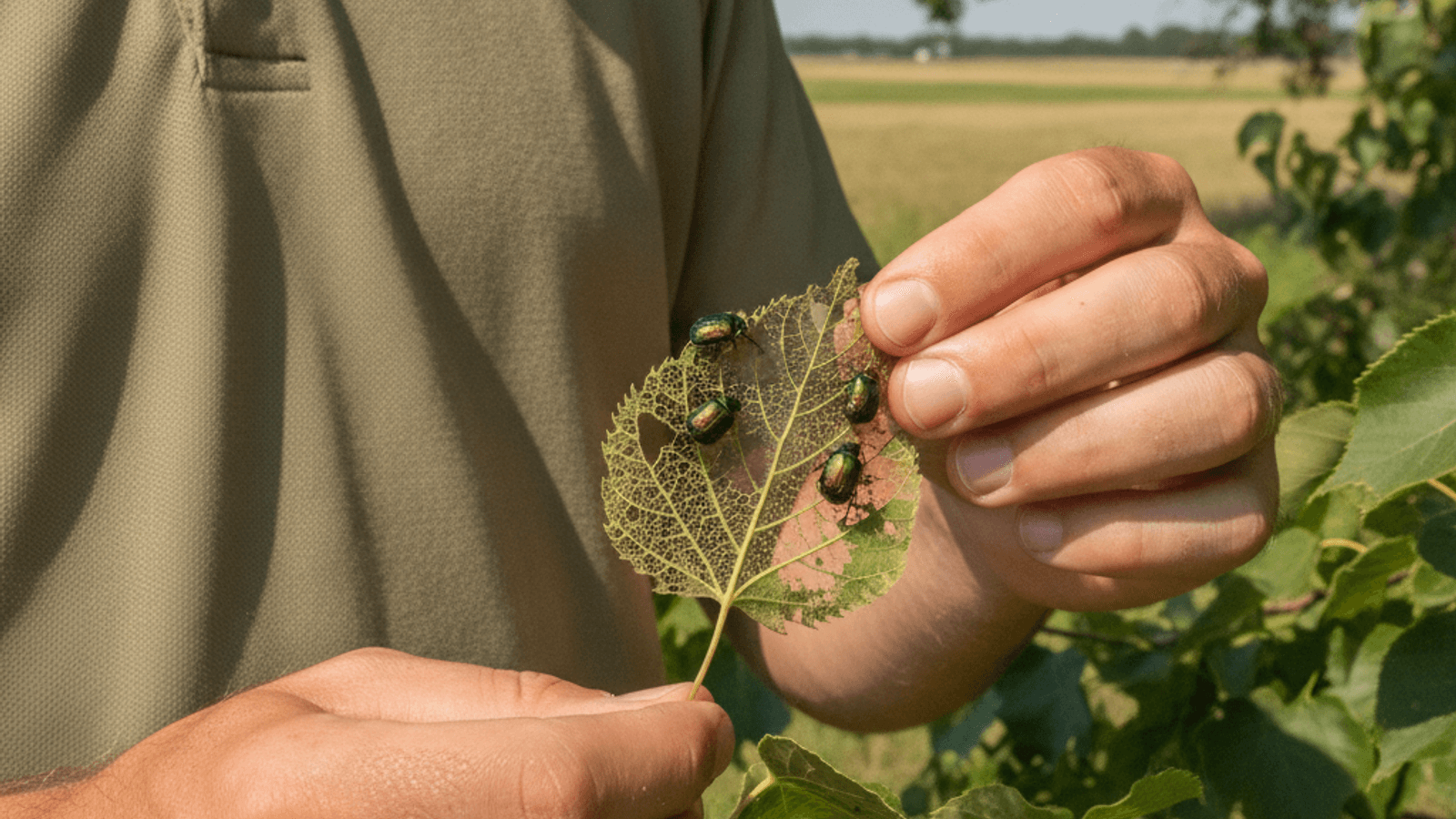
Check the beetle’s size before anything else. K-State Research and Extension puts Japanese beetle adults at 3/8 to 1/2 inch long. They’re metallic green with coppery-brown wing covers and darkened green legs. There’s a second metallic-looking beetle flying in Kansas in August, and it’s roughly twice that size. That one is the green June beetle. K-State’s own entomologist says the two get confused but “really do not look alike.” Size sorts them out in a second. Getting that right matters, because the two call for different responses.
How do I know these are Japanese beetles?
Start with length, then color. K-State describes the Japanese beetle adult as 3/8 to 1/2 inch long, metallic green, with coppery-brown wing covers and darkened green legs. Hold that against the green June beetle. K-State puts that one at 3/4 to a full inch, velvety green, with yellow-orange margins running lengthwise on the front wings. Its underside is shiny green or gold. One is half an inch with coppery-brown wing covers. The other is nearly an inch and velvety.
If you can get close, there’s a second check. Japanese beetle adults carry four to five white tufts of hair along each side of the abdomen. Two more sit at the tip. K-State names those tufts as the feature that separates Japanese beetle from the green June beetle and the false Japanese beetle. They’re small, so treat them as confirmation rather than your first test.
An adult lives 30 to 45 days and feeds over a four-to-six-week stretch. K-State places adult activity from June through September, depending on environmental conditions and geographic location. There’s one generation a year. The rest of the year happens underground as egg, grub, and pupa. The grub overwinters about 2 to 8 inches below the surface, depending on soil type.
What does Japanese beetle damage on a tree look like?
Irregular holes are the main sign, not lace. K-State says adults “mainly feed on the upper leaf surface, creating irregularly shaped holes.” The lacelike, skeletonized look is a different presentation, and K-State scopes it to highly susceptible plants. On those, the beetles eat the tissue between the veins and leave the veins standing, and K-State says those leaves eventually turn brown before falling off.
Two feeding habits help confirm it. Adults work in groups, and they start at the top of a plant and move down as food runs out. K-State also notes they prefer plants sitting in full sun all day.
That group behavior isn’t an accident. Once a few beetles start feeding, they release an aggregation pheromone. It pulls in more beetles of both sexes to the same spot. K-State says adults are especially drawn to plants other adults have already visited. That’s why one tree gets stripped while the one beside it barely gets touched.
Littleleaf linden, crabapple, black walnut, and American elm all sit on K-State’s list of susceptible ornamentals. So do rose-of-sharon, Virginia creeper, and both Japanese and Norway maple. K-State counts more than 300 host plants in total. Roses and shrubs on that host list can draw beetles at the same time as the tree. When that happens, hedge and shrub care is worth asking about too.
Japanese beetle vs green June beetle: how do I tell them apart?
Three insects get mixed up here, and one of them isn’t a beetle. K-State describes the first two. The third is on this table because its late-summer window overlaps the beetles’ season.
| Insect | What K-State says it looks like | When it’s out in Kansas |
|---|---|---|
| Japanese beetle | 3/8 to 1/2 inch, metallic green, coppery-brown wing covers, darkened green legs, four to five white hair tufts along each side of the abdomen | Adults may be present June through September, depending on environmental conditions and geographic location |
| Green June beetle | 3/4 to 1 inch, velvety green, yellow-orange margins lengthwise on the front wings, shiny green or gold underside | Adults fly for several weeks, July through August |
| Fall webworm (not a beetle) | A caterpillar inside a silk web wrapped around branch tips, covered in our fall webworm post | The noticeable generation runs late July into late September |
Size is the fastest call. K-State’s green June beetle is roughly twice the length of a Japanese beetle, and K-State says outright that the two “really do not look alike.” Green June beetle adults feed mostly on ripening fruit and corn tassels, though K-State notes they may feed on oak and maple leaves. And if what you’re looking at is silk wrapped around a branch tip rather than chewed leaves, that’s a different pest entirely.
Are Japanese beetles established around Topeka?
Yes, and K-State has named the region directly. K-State’s Dr. Raymond Cloyd has written that Japanese beetles “are established in eastern and central portions of Kansas, and are slowly moving westward.” Topeka sits in eastern Kansas. By 2021, Cloyd described adults as “present throughout Kansas.”
The local record goes back further. K-State’s Dr. Bob Bauernfeind wrote in 2015 that Japanese beetles “have become a firmly established pest species in portions of Kansas.” His first capture reports that season read: “Desoto June 9; Manhattan June 15; Topeka June 16.” Those figures are pheromone-trap captures, not an official confirmation log. Mid-June is when Topeka’s beetles showed up that year.
Shawnee County’s own extension office has dealt with this directly. Katherine Miller worked for the K-State Research and Extension office there at the time. She told WIBW in July 2022 that beetles had been emerging for about a month. She described the damage as a “skeletonized, lacey-looking leaf.” Her office was fielding a run of calls about it. Those reports document activity during those specific seasons. They don’t predict when beetles will appear in another year.
Checking leaves and upper branches periodically can reveal fresh feeding and groups of adult beetles. A spring tree health checklist covers what else to look for. A tree already carrying stress deserves a closer look through a tree health assessment.
Will Japanese beetles kill my tree?
Not usually, if the tree is healthy and well established. Wisconsin Extension says well-established trees and shrubs generally tolerate Japanese beetle damage. It notes little impact on next season’s leaf-out. One rough August looks worse than it actually is.
The exception is damage that repeats. Wisconsin Extension says regular, severe defoliation can leave some plants more open to other problems. Birch and linden get flagged by name. Wisconsin Extension says repeated severe foliage damage on those two can attract borers, and that those borers can kill the tree. That’s a pattern built over years, not a single bad season.
Not sure which beetle or tree problem you’re seeing? Ask an independent provider to inspect the tree, site conditions, and damage pattern. A tree health assessment can help distinguish beetle feeding from other possible causes. For broader concerns, ask what an arborist consultation would include in its written scope. The estimate depends on the actual tree, access, and requested work.
Why do Japanese beetle traps make the problem worse?
Because the lure works too well. K-State doesn’t recommend Japanese beetle traps. The food and sex pheromone bait can pull in more adults, male and female, than would normally be in that spot.
Traps also fail to catch much of what they attract. Beetles feed on the way in, so you get damage from beetles the trap never caught. In an irrigated yard K-State flags a second problem. Females lay eggs in the turf before capture, which raises grub density and the odds of lawn damage later.
Shawnee County’s extension office says the same thing in plainer words. Miller told WIBW the traps attract beetles from your yard, your neighbor’s yard, and the general area. As she put it, “It’s bringing in all of ‘em.”
What gets Japanese beetles off my trees?
Handpicking avoids spraying the plant and can be practical on reachable leaves. Work small trees and shrubs by hand, ideally early in the season before numbers build. Early morning or late evening is best, since adults move less then. Hold a wide-mouthed jar or bucket of soapy water or rubbing alcohol under the beetles, then touch them. K-State specifies 70% isopropyl alcohol. Disturbed beetles fold their legs and drop straight in. Repeat daily or every other day. K-State caps the useful run at about four weeks from emergence.
Don’t use one year’s capture date to predict another season. K-State says adult activity varies with environmental conditions and location. Handpicking may still remove reachable beetles, but the calendar alone can’t show the tree’s condition or identify every cause of leaf damage.
Cultural care is what actually protects the tree. K-State lists proper irrigation, fertilization, mulching, and pruning as the practices that keep a plant healthy enough to tolerate minor adult feeding. A tree trimming crew handling routine pruning is already doing part of that. K-State also names smartweed as a weed worth removing near the tree.
One watering point is easy to get backwards, so keep the two targets separate. Water the tree. Wisconsin Extension is direct about it: “make sure trees are watered and mulched properly” to reduce the stress of defoliation. Ease off the lawn instead. K-State’s advice to limit watering during adult flight is about discouraging females from laying eggs into turfgrass. K-State then says to resume regular irrigation in late summer so the turf recovers. That’s turf guidance, not tree guidance.
Contact insecticides exist, and K-State is candid that spraying has long been the primary strategy against adults. K-State’s 2021 guidance names pyrethroid-based products containing permethrin, bifenthrin, or cyfluthrin. Its 2017 guidance also named carbaryl. Read the product label in full and follow it, and ask the K-State Research and Extension office in Shawnee County for the current registered list. Two warnings come attached. K-State says these products may harm many natural enemies, and that continual use can trigger twospotted spider mite outbreaks. K-State is also explicit about pollinators: “these insecticides are directly harmful to pollinators including honey bees and bumble bees. Therefore, apply insecticides in the early morning or late evening when bees are less active.” That matters most on roses and anything else in bloom.
Milky spore disease targets the grub stage in soil, not the adults on your leaves. K-State describes it as slow, taking up to 10 years to establish, especially in cooler regions. It only affects Japanese beetle larvae. It’s a long soil play, not a fix for this week.
Frequently asked questions
Do Japanese beetles kill trees?
Not directly, and not from one season. Wisconsin Extension says well-established trees generally tolerate the damage. The risk is repeated, severe defoliation. Wisconsin Extension says that pattern can leave birch and linden open to borers that can kill the tree. An independent provider can inspect the tree’s condition and discuss whether the damage appears isolated or repeated.
What’s the difference between a Japanese beetle and a June bug?
Depends which June bug you mean. If it’s the big brown one that thumps into porch lights, that’s a May or June beetle, and it isn’t metallic green at all. If it’s the green one, that’s the green June beetle. K-State puts it at 3/4 to 1 inch, velvety, with yellow-orange margins running lengthwise on the wings. A Japanese beetle is 3/8 to 1/2 inch with coppery-brown wing covers. Roughly half the size.
Should I put up a Japanese beetle trap?
No. K-State recommends against them. The lure draws in more beetles than would show up naturally, and many feed on your plants before reaching the trap. Shawnee County’s extension office gives Topeka homeowners the same advice.
Will Japanese beetle grubs damage my lawn?
They can, especially a lawn already stressed by heat. K-State says 10 to 12 grubs per square foot can cause real turfgrass damage during summer. Wildlife digging for grubs adds a second layer. K-State names birds, skunks, raccoons, and armadillos among them.
When will Japanese beetles be gone for the season?
Adults live 30 to 45 days each and feed over four to six weeks. K-State places the active period from June through September, depending on environmental conditions and geographic location. Populations taper as beetles die off rather than stopping at once. An August infestation can still have weeks left in it.
Why are Japanese beetles all over my roses?
Roses give off eugenol and geraniol, two chemicals K-State identifies as attracting Japanese beetle adults. Once a few settle in, their aggregation pheromone brings more of both sexes to the same bush. That’s why a rose bed can look far worse than a tree ten feet away.
Get help assessing what’s happening in your trees
Leaf damage can have more than one cause. Topeka Tree Pro connects Greater Topeka homeowners with independent licensed and insured tree-service providers. Service includes communities such as Topeka and Silver Lake. A provider can inspect the canopy, site conditions, and damage pattern before discussing possible next steps. Call (785) 333-4052 to request an estimate, then confirm the provider’s estimate or visit fees, availability, qualifications, and the written scope.