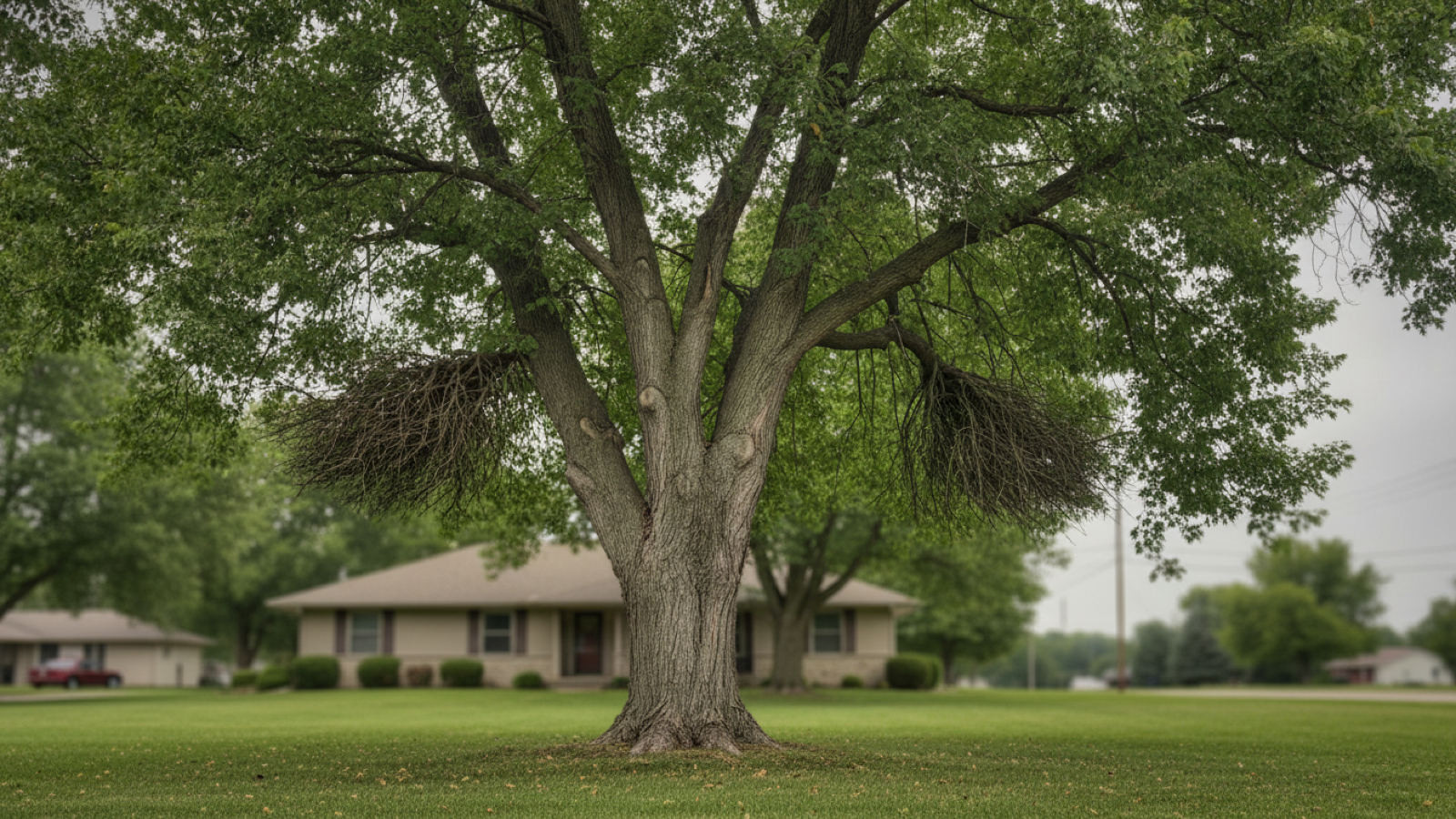
A hackberry tree in Topeka can carry dramatic leaf and branch symptoms. Witches’ brooms, nipple galls, and blocky yellow blotches don’t damage its health. Wood decay is different. When decay makes a tree a structural risk, K-State says it should be removed. The right response starts by separating cosmetic signs from structural danger.
What are the hackberry tree pros and cons in Kansas?
The Kansas Forest Service hackberry profile says hackberry grows throughout Kansas. It prefers deep, moist soil but resists drought on upland sites.
Growth is slow at first. After a few years, growth should average 12 to 18 inches annually. On favorable soils, a hackberry may reach 60 to 70 feet.
Its drought tolerance also makes hackberry useful in windbreak plantings. The fruit provides winter food for quail, pheasant, turkey, and other birds.
The tradeoffs are easy to notice. Branches may develop dense brooms, while leaves may carry raised galls. Fall psyllids can also enter nearby homes through mesh screens.
These appearances don’t automatically signal declining health. The Kansas Forest Service says insect attacks can cause some disfiguration of the leaves and branches, but they are of minor importance.
A hackberry’s location or the age of the surrounding property doesn’t diagnose its condition. An assessment should consider the individual tree, soil, drainage, moisture, light, nearby obstacles, and the symptoms that are actually present.
Which hackberry problems are cosmetic?
Several visible hackberry problems don’t damage the tree’s health. Witches’ broom and nipple galls are the clearest examples.
What causes witches’ broom on hackberry?
Witches’ broom creates swollen branch sections and clusters of lateral shoots. These brooms become easiest to see during winter.
K-State describes the cause as an interaction between two organisms. They are the powdery mildew Podosphaera phytoptophila and eriophyid mite Aceria celtis.
The precise broom-forming mechanism hasn’t been established. University of Illinois Extension says neither organism has been tested for inducing brooms. Observations suggest mites may initiate them before mildew enters deformed buds.
Large common hackberries may carry a few to hundreds of brooms without obvious loss of vigor. K-State’s problem table states that witches’ broom doesn’t damage tree health.
Many twigs inside a broom die during the dormant season. Cutting affected branches removes those twigs and improves the canopy’s appearance.
However, pruning has limited value as disease control. It clears existing brooms but doesn’t stop new ones from forming. A hackberry tree trimming service should focus on affected branches, deadwood, and canopy condition.
Do hackberry nipple galls require treatment?
No management strategy exists for hackberry nipple gall maker. K-State also states that these galls don’t affect plant health.
The small galls form on leaf undersides during summer. Each measures approximately one-quarter inch across and one-quarter inch high.
Heavily galled leaves may fall before the normal leaf-drop period. New foliage replaces prematurely shed leaves during spring.
The psyllids become household nuisances when temperatures fall. Adults seek protected winter sites and can pass through mesh screens.
Removing one hackberry won’t necessarily stop that nuisance. K-State says migrating psyllids remain when a neighborhood contains many hackberries. Removal shouldn’t be presented as the solution for psyllids alone.
What do yellow hackberry leaves mean?
Yellow hackberry leaves require a closer look at the pattern. Island chlorosis, iron chlorosis, and hackberry decline produce different signs.
| Visible pattern | What it points toward | K-State guidance |
|---|---|---|
| Blocky or angular bright-yellow blotches bordered by veins | Island chlorosis | Not damaging, primarily cosmetic, and no management is needed. It is thought to involve a virus, but the cause remains undetermined. |
| Yellow tissue between veins while veins remain green | Iron chlorosis | Hackberry can develop iron chlorosis, although it isn’t among the four most susceptible species. Test before treating. |
| Pale foliage, a thin crown, poor growth, and overall decline | Hackberry decline | The condition is thought to involve poor site conditions and environmental stress. Support appropriate watering, fertilizing, and pruning. |
These patterns aren’t interchangeable, but one visible symptom doesn’t confirm a diagnosis. Blocky areas bordered by veins can resemble island chlorosis. Yellow tissue between green veins can resemble iron chlorosis. Site conditions and other possible causes still need consideration.
K-State lists hackberry as a tree that can develop iron chlorosis. However, it isn’t among the four most susceptible species. Those are pin oak, silver maple, baldcypress, and sweetgum.
Soil testing and leaf sampling should happen before treatment. That step is especially important for species other than pin oak.
For local samples, Shawnee County’s soil-testing instructions specify a 10-to-12-inch depth for trees and shrubs. State publication MF718 gives a 6-to-8-inch depth. Topeka residents should follow the county office’s depth because it receives their samples.
Collect at least four to five samples from the area. Mix them, then submit two cups in a resealable quart-size bag. Our guide to iron chlorosis in Topeka trees explains the complete diagnostic path.
A tree health assessment can separate these leaf patterns from broader decline. That distinction prevents cosmetic symptoms from driving an unnecessary removal decision.
Which hackberry symptoms require closer attention?
Twig blight causes dieback among small twigs and medium-sized branches. K-State associates it with stress but classifies the damage as minor. Its table recommends no management for the blight itself.
Squirrels may strip bark and cause twig or branch dieback. The damage can become severe during occasional years. K-State still lists no management response for that problem.
Wood decay belongs in a different category. Signs include crumbly, spongy, or discolored wood. Mushrooms or conks may also appear around affected wood.
K-State says wood decay causes tree decline and death. Its problem table also states that no control is available after infection. Trees that are a structural risk should be removed.
Decay alone doesn’t establish structural risk from a photograph or neighborhood location. A detailed assessment should examine the affected wood, surrounding structure, site conditions, obstacles, and possible targets.
When removal is recommended, review the site’s tree removal service and Topeka tree removal cost guide. Hackberry-specific pricing isn’t listed, so project details determine the estimate.
Storm damage needs its own evaluation. The Topeka ice-storm tree damage guide explains what to check after broken limbs appear. Routine planning can begin with the spring tree health checklist.
Frequently asked questions
Is witches’ broom killing my hackberry tree?
No. K-State states that witches’ broom doesn’t damage tree health. Cutting affected branches removes dead twigs and tidies the canopy, but pruning doesn’t prevent new brooms.
Are nipple galls harmful to a hackberry tree?
No. K-State says nipple galls don’t affect plant health. There is also no management strategy for the gall maker.
Why are my hackberry leaves turning yellow?
The leaf pattern separates three possible problems. Blocky yellow areas suggest island chlorosis, while yellow tissue between green veins suggests iron chlorosis. Pale foliage with crown thinning and poor growth points toward hackberry decline.
Should I cut down a hackberry with witches’ broom?
No, witches’ broom alone isn’t a removal reason. It doesn’t damage tree health, although affected branches may be cut for cleanup. Wood decay warrants removal when it makes the tree a structural risk.
Will removing my hackberry stop psyllids entering the house?
Not when nearby properties contain many hackberries. K-State says removing one property’s trees won’t prevent invasions by migrating psyllids. Removal shouldn’t be sold as a reliable neighborhood-scale psyllid solution.
Is hackberry a suitable tree for Kansas?
Yes, hackberry grows throughout Kansas and resists drought on upland sites. On favorable soils, it may reach 60 to 70 feet. Its fruit also supplies winter food for several bird species.
Get help identifying your hackberry problem
Topeka Tree Pro connects Greater Topeka homeowners with independent insured tree-service providers. Start with an assessment when yellowing, decay, or branch symptoms overlap.
Review tree service options in Topeka or call (785) 333-4052. Confirm availability, the written scope, and qualifications directly with the provider.