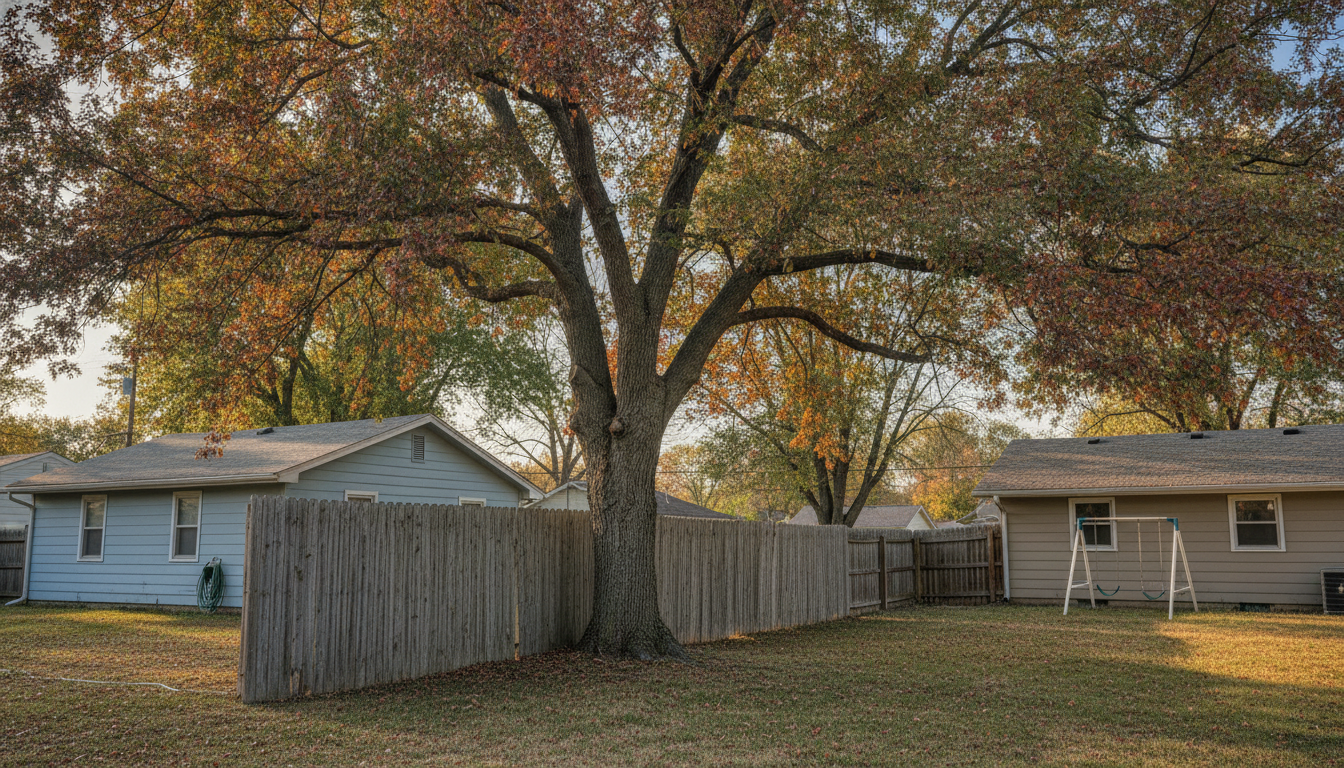
A big tree near the fence raises three different questions, and Kansas answers them with three different levels of confidence. Who may trim the branches over your yard: settled, by a published Kansas opinion. What it costs to damage a tree that isn’t yours: settled, by statute and caselaw. Who owns a trunk that sits directly on the line: not settled by anything we could find in published Kansas law, and anyone who tells you otherwise without a survey in hand is guessing.
This page walks through what the published Kansas sources actually say. It isn’t legal advice, and a Kansas attorney is the one who applies any of it to your fence line. For the tree itself, the pros we send can look at what’s actually growing there. Call (785) 333-4052.
Who owns a tree on the property line in Kansas?
Start with where the trunk stands, not where the branches reach. A canopy spreading over your yard doesn’t make the tree yours. The trunk does the deciding, which is why the honest first step in most line disputes isn’t a chainsaw or a lawyer. It’s a survey. Fences get built where building them is convenient, not always on the line, and a tree that looks like the neighbor’s can turn out to be yours, or genuinely on the boundary.
For a trunk that straddles the surveyed line, you’ll find national explainer sites repeating a shared-ownership rule: both owners own it, neither may remove it alone. None of the ones ranking for this search cite a Kansas case for that rule, and we couldn’t find a published Kansas appellate decision that adopts it. That doesn’t mean the rule is wrong here. It means nobody should treat a national blog post as Kansas law. If a true boundary tree is at the center of your dispute, the two documents that matter are a survey showing the trunk on the line and a Kansas attorney’s reading of your facts.
What Kansas has published clearly covers the more common fight: a tree rooted on one side with branches hanging over the other. That one has real answers.
Can I trim the branches hanging over my yard?
Yes, up to the line, and you don’t need the neighbor’s permission. The Kansas Court of Appeals said it plainly in Pierce v. Casady, 11 Kan. App. 2d 23 (1985):
“A landowner has a right to trim branches that overhang the landowner’s property even though the trunk of the tree is on a neighbor’s land.”
The same opinion draws the boundary on that right. You trim from your side:
“Defendants have no right to go on plaintiffs’ property to do that work for the same reasons plaintiffs have no right to go on defendants’ property to trim or cut down the tree.”
So the self-help right stops at the line, in both directions. You can cut what crosses into your airspace. You can’t step into the neighbor’s yard to do it, and they can’t come into yours. On a mature shade tree the branches worth worrying about are the big ones, and a cut that size over a fence, a shed, or a service drop is a job for an insured trimming crew, not a Saturday.
One more caution that the published sources don’t resolve: Pierce gives you the right to trim to the line. It doesn’t say a trim that kills the neighbor’s tree is free of consequences, and no published Kansas case we found answers that. Trim the overhang, don’t try to punish the trunk.
When does a neighbor’s tree become their problem?
Kansas uses a nuisance test, and Pierce is again the source. The court adopted it in these words:
“We choose to follow the jurisdictions holding that trees constitute a nuisance if the overhanging branches do substantial harm or the overhanging branches create an imminent danger.”
Substantial harm or imminent danger. An ordinary rain of leaves, seeds, and small twigs doesn’t reach that bar. A dead leader hanging over your kid’s swing set is a different conversation. When the bar is met, the court names the remedy:
“If the tree is a nuisance, the landowner may compel the neighbor to abate the nuisance or, if an injury occurs, look to the neighbor to pay any damages allowable by law.”
Notice what that remedy asks of you first: proof. “Substantial” and “imminent” are claims about the tree’s condition, which is exactly what a documented onsite assessment establishes. A written report that a specific limb is dead, cracked, or decayed, with photographs and dates, is worth more in that conversation than a year of complaints over the fence.
Who pays when a line tree comes down?
When both owners agree the tree goes, the money question is whatever the two of you put in writing. Put it in writing. A one-page scope that names the tree, who’s hiring the removal crew, how the cost splits, whose yard the equipment works from, and who keeps the wood prevents most of the fights that start after the stump is ground.
When one owner acts alone, Kansas has published consequences. On the criminal side, K.S.A. 21-5813 defines criminal damage to property as:
“Knowingly damaging, destroying, defacing or substantially impairing the use of any property in which another has an interest without the consent of such other person”
The statute’s severity tiers turn on the dollar damage, from a class B nonperson misdemeanor under $1,000 up to a severity level 7 nonperson felony at $25,000 or more. And subsection (f) says how that damage gets counted: “damages may include the cost of repair or replacement of the property that was damaged.” We found no published Kansas case applying this statute to a tree, so read it as what the statute says, not as a prediction of what a prosecutor would do.
On the civil side, the measure flips. Kansas courts start from what the whole property lost in value, not the replacement cost, and the burden of proving a tree was worth more sits on the tree’s owner. That’s the Kansas Supreme Court in Evenson v. Lilley, and we’ve walked through it, quote by quote, in what a cut-down tree is worth in Kansas. The short version: document the tree while it stands. Photographs, measurements, what it shades, what it screens. After it’s gone, the evidence is gone with it.
What about the tree between the sidewalk and the street?
Topeka’s parking strips hold a surprise: that tree is attached to your title. K.S.A. 12-3207 gives owners of property abutting city streets
“such title to and property in growing trees, shrubbery and the parking situated in front of such real estate between the curb line and the property line”
and the right to recover “the full damages” from a “person, company or corporation” that injures or destroys them, plus the right to seek an injunction. The statute carves out one big exception: no recovery or injunction against the city itself “in the making of public improvements or in any other reasonable exercise of its authority” over those streets and trees.
So a contractor who tears up your parkway tree answers to you under the statute. The city, working on the street, generally doesn’t. And holding title doesn’t mean the city code is silent on street trees. We’ve covered when Topeka requires a permit for tree work separately, and a tree growing into a power line is a different conversation entirely.
What should happen before anyone starts cutting?
The order matters more than the speed. For the counties we serve, Shawnee, Jefferson, Jackson, Osage, and Wabaunsee, the sequence that keeps a tree dispute from becoming a court date looks like this:
- Find the line before you form an opinion. A survey settles whose trunk it is. Fences don’t.
- Document the tree while it’s standing: photos from both yards, the trunk, the canopy, anything dead or cracked.
- Get the tree’s condition assessed onsite by someone insured who climbs trees for a living, in writing.
- If both owners agree on work, write the scope and the cost split down before a saw starts.
- If you’re trimming overhang under Pierce, stay on your side of the line and don’t cut past it.
- If it’s ownership or money and the two of you can’t settle it, that’s a Kansas attorney’s question.
The tree side of that list is ours. Call (785) 333-4052 and we’ll match you with an independent insured provider who can assess the tree, put its condition in writing, and do the work from the right side of the line.