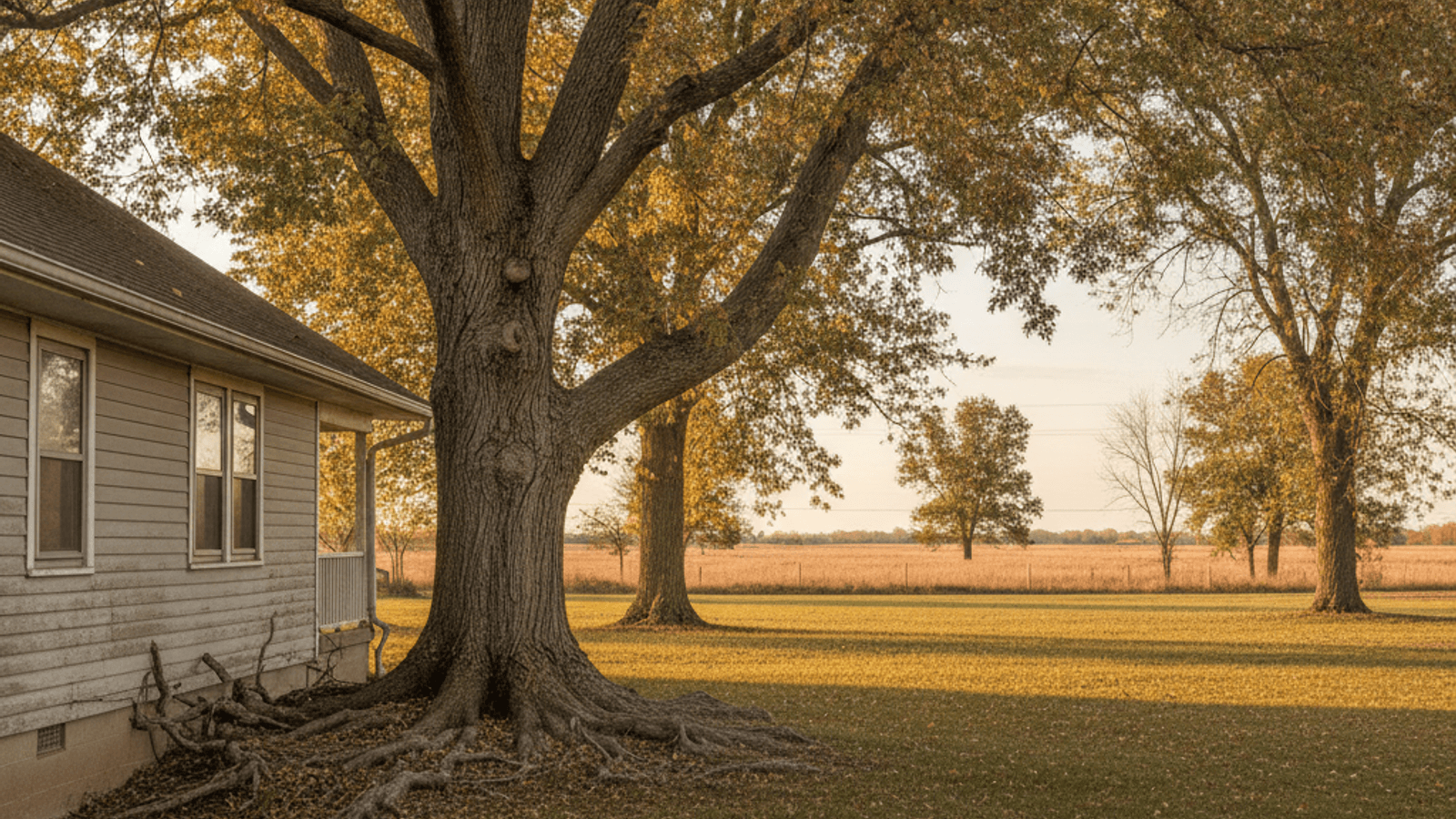
Nobody publishes the number people want here. No Kansas agency, no extension bulletin and no city rule we could find sets a minimum distance between a tree and a house, and distance on its own was never the thing causing the trouble anyway. A big old silver maple leaning over a Potwin roof and a young redbud the same distance from the same wall are two different conversations with two different answers.
Four things actually decide it, and all four are visible from the yard: what the limbs are doing to the roof, what the roots are doing under the drive and the footing, what the ground is made of here, and what species you are dealing with. This page walks through each one. For the tree itself, call (785) 333-4052 and we’ll get an insured provider out to look at it.
How close is too close for a tree to a house?
Close enough that the tree can reach the house is the honest threshold, and reach means three separate things. The canopy reaches the roof. The roots reach under the footing and the drive. And if the stem fails, the top reaches the bedroom. A tall tree standing well off the corner is still over the house in the only sense that counts, because a stem’s fall radius is its own height, in every direction.
That is why a tape measure answers less than a look at the tree does. What an on-site assessment weighs is the mature height against the distance, the direction the tree already leans, whether the stem splits into two codominant leaders with bark pinched in the union, whether there is decay at the base, and what is sitting underneath. Those are all conditions, not dimensions, and a tree with none of them beside a house is a different risk from a tree with three of them at twice the distance.
What the limbs over the roof are doing
They are sanding the shingles. Every gust moves a limb a few inches across the surface it rests on, and the granules that wash into the gutter are the roof’s wear layer leaving early. The same canopy keeps that slope shaded and slow to dry after an ice storm or a wet spring week, it drops the leaf load straight into the gutters instead of the yard, and it gives squirrels a bridge onto the fascia they would otherwise have to climb a wall to reach.
Clearing a roof is routine work and it is not a chainsaw-from-a-ladder job. A limb over a roof is removed in pieces, roped down, from a position the climber sets first, which is why a clearance trim is a trimming crew’s job and not a Saturday with a borrowed pole saw. On most deciduous trees here, routine pruning belongs in late February through April, before bud break, which K-State Research and Extension puts plainly: “Trees are pruned slightly earlier in the season, from late February through April.” Dead and damaged wood comes out any time of year, and the timing rules have real exceptions by species.
One hard stop. If any part of that canopy is touching or near a power line, nobody from your household goes near it and no crew touches it until the utility has looked. The span running pole to pole is Evergy’s to review on 888-471-5275, which is Evergy’s number and not ours, while the line from the pole to your meter is the customer’s responsibility. Which half of that you are looking at changes who you call first.
What the roots are doing under the house
Roots are shallower and wider than almost everyone pictures. Kenneth Tand, a Texas engineer who investigates foundations bearing in expansive clay, writes it this way: “The bulk of the root system for most trees, not all, is located within the upper 3 feet of the ground surface,” while “the depth of the roots is more often 10 to 15 feet.” His work is Houston case histories, not Kansas measurement, so take the shape of it rather than the numbers: a mature tree’s roots occupy a wide shallow plate that reaches well past the dripline, and under a Topeka lot that plate is sitting in clay.
That clay is the part people underestimate. K-State Research and Extension’s Johnson County office describes what it does: “Foundations of homes are affected by the pressure that is exerted as the clay shrinks and swells. This pressure is great enough to crack foundations and basement walls, and move concrete sidewalks.” A big tree in a dry August pulls moisture out of that soil faster than rain puts it back, the clay shrinks, and the ground under one corner of the house moves differently from the ground under another. Tand reports the same cycle running backwards after a removal, where desiccated clay rehydrates and heaves, and he is careful to add a limit on it: “These large magnitudes of foundation movement are exceptions, not common occurrences.”
So the tree does not push a foundation over. It changes the moisture in the soil the foundation sits on, in both directions, and whether that matters on your lot depends on what your lot is made of. We’ve laid out the Shawnee County soil data and what the damage pattern looks like in detail, and you can look up your own parcel on the USDA’s Web Soil Survey. The flatwork is a separate and far more common version of the same story, and a root-lifted sidewalk has its own set of fixes that range from gentle to fatal for the tree.
One piece of K-State’s advice travels with its warning, and both halves matter: water the soil a foot or two out from the house during drought to keep the clay from shrinking, and never add soil against the foundation to fill a gap. In that office’s own words, “Added soil will result in more pressure being placed on the foundation as the clay expands, resulting in increased damage.”
Which trees near a house actually cause trouble here
Species does more work than distance. The trees that generate these calls across Greater Topeka are the fast ones that were planted everywhere a generation or two ago: silver maples with surface roots and limbs that shed in ice, cottonwoods that get enormous on the river bottoms around North Topeka and NOTO, Bradford pears that split at the union once they hit size, and honey locusts that establish fast on the Southwest Topeka clay.
The mechanism behind most of those failures is the same one. A tree that forks into two equal stems with bark trapped in the crotch has a union that was never a true branch attachment, and freezing rain is what finds it. Ice loads a limb far past what wind does, and the split runs down the trunk rather than snapping a branch clean. A silver maple’s lifespan and failure pattern and why Bradford pears come apart are both worth reading if either is the tree standing over your garage. None of this says your particular tree is unsafe. It says what to have looked at.
Should you prune it or take it out?
Most trees near a house get pruned, not removed, and the split between the two is about structure rather than proximity.
| Pruning is usually the answer when | Removal gets honest consideration when | |
|---|---|---|
| The stem | is sound, with one dominant leader and no decay at the base or flare | has a split union, a cavity, a mushroom conk, or a lean that started recently |
| What is wrong | is reach: limbs on the roof, over the drive, into the line corridor | is the whole tree: the species outgrew the spot and the canopy cannot be reduced without wrecking it |
| The target | can be protected by taking weight off the long limbs over it | sits directly under a stem that has a known failure point |
| Afterward | the tree keeps its shape and comes back on a maintenance cycle | the problem is finished, and the stump and surface roots become the next decision |
Topping is not on that table on purpose. Cutting a mature crown back to stubs does not make a tree near a house safer, it forces a flush of weakly attached water sprouts on a decaying frame, and a few years later the tree is taller, denser and worse attached than it was. A real reduction cuts back to live lateral branches that can take over, which is skilled work and the kind of thing a written assessment should specify before anyone starts.
What about a tree you are about to plant
Pick the mature size first, then the spot. A tree that tops out at twenty-five feet and a tree that tops out at seventy are not the same decision near a wall, and the second one has no business within reach of a roof no matter how small the pot is now.
Then plant it correctly, because planting error is what creates the slow strangling problems that show up years later near houses and streets. Tim McDonnell of the Kansas Forest Service puts the fundamentals in Selecting and Planting a Tree: “Planting depth is determined by location of root flare,” dig the hole “2 to 3 times wider than root ball,” slice the circling roots at planting, and “Apply mulch 2 to 4 inches deep with no mulch against the tree trunk.” K-State’s MF3132 adds the tight-space version of the same error: “Trees planted along city streets are particularly prone to the development of girdling roots,” and that is a problem that can be corrected young and not old.
Frequently asked questions
Does a tree close to the house lower my home’s value or affect insurance?
We have no sourced figure on either, and anyone quoting you one about Topeka specifically is guessing. What is worth doing is documenting the tree’s condition in writing before anything happens to it, because a written assessment with photographs and dates is the record that exists afterward.
Can I cut the limbs over my own roof myself?
Ground-level hand pruning and raking are fine. A limb over a roof is not: it is overhead, it is under tension once you start the cut, and it lands on the most expensive surface on the property if it goes wrong. That one goes to an insured crew with rigging.
Will removing a big tree near my foundation fix the cracks?
Removal changes which way the ground moves. It does not switch the ground off. Tand’s Houston sites heaved after trees came out as dried clay took water back on, so a crack in a basement wall is a structural engineer’s question first and a tree question second.
How far should a new tree go from the house?
Far enough that its mature canopy clears the roof and its mature height clears the structure if it ever came down. That is a judgment about the species you picked, not a fixed number, and an arborist consultation is the cheap way to get it right before the hole is dug.
When to call us
A tree over a roof, over a drive, or beside a foundation is the kind of work where the equipment and the rigging decide the outcome, and where a mistake lands on the house. The tree-service providers we connect you with across Shawnee, Jefferson, Jackson, Osage and Wabaunsee counties are independent and insured, and you should confirm current proof of insurance with the provider before work begins.
Call us at (785) 333-4052.