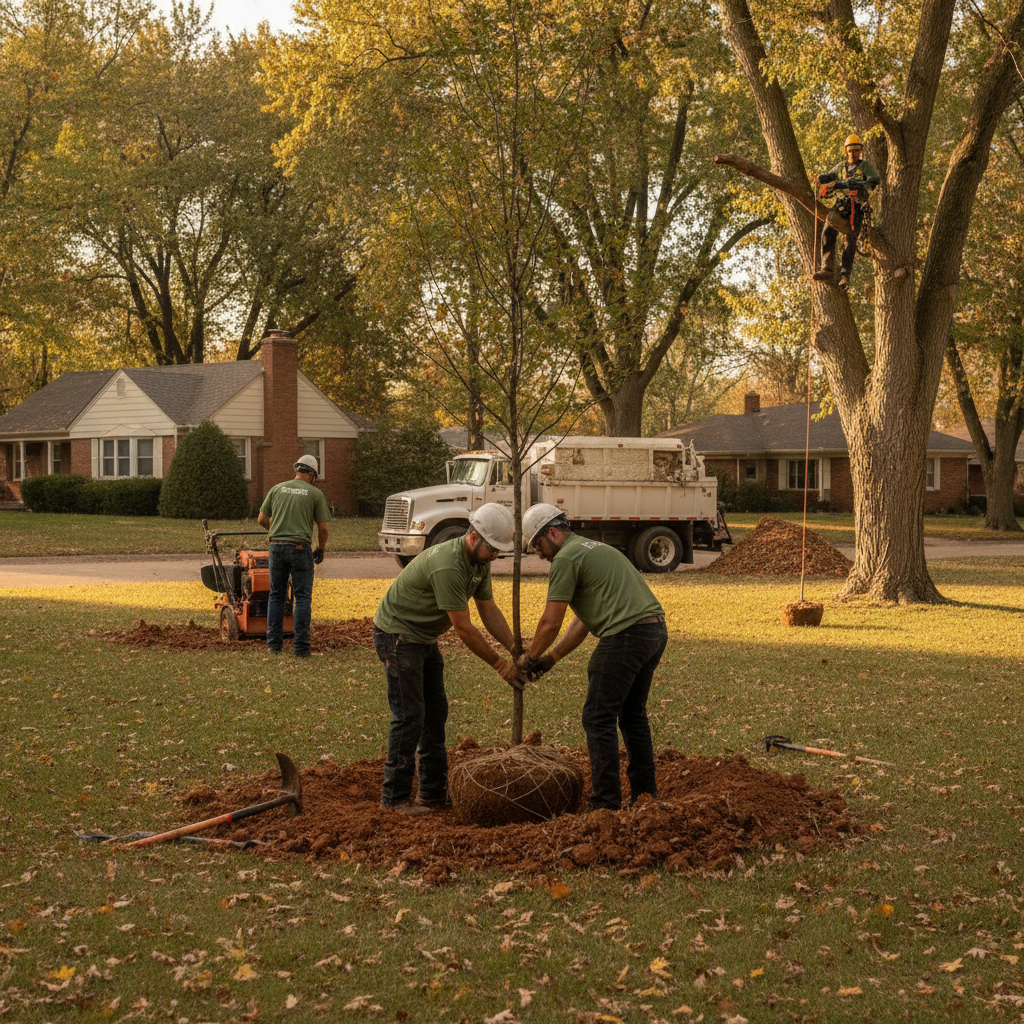
Fall is the window that works on northeast Kansas clay. After summer heat breaks, cooler air and still-warm ground let a new tree put energy into roots instead of leaves. Plant while a spade still sinks. Stop when the ground is frozen. A July hole on a Highland Park lot, or a frozen hole in January, fights this climate instead of using it.
Why fall beats a July install here
Greater Topeka has a real freeze season, hot humid summers, and expansive clay that swells and shrinks. July planting drops a small root ball into baked clay while the top of the tree tries to cool a full set of leaves. The tree spends that first season in drought mode before its roots have ever entered native soil.
Fall reverses the stress. Leaves drop. Top growth slows. Roots keep working in warm soil, and fall rain does part of the watering. By the time the next Kansas summer arrives, that tree has had a dormant season plus a spring of root growth. The extra cool season is the whole advantage.
Ice, not snow, is the winter event that wrecks established trees here. Freezing rain loads limbs until unions fail. A tree that shrugs off a blizzard can lose half its crown to an ice storm. A newly planted tree has a small crown, so it doesn’t catch ice the way a mature silver maple over a Potwin driveway does. Fall planting doesn’t kill a dormant tree. What kills it is planting so late the root ball sits against frozen clay with no contact, or buying stock that sat stressed on a nursery lot all summer and was already dead in the pot.
Spring still works, because this climate gets regular rain then too. The catch is what comes next. A spring tree walks into summer heat with one season of roots. A fall tree walks into the same heat with two. On a 1990s lot along the Wanamaker corridor, or out through Silver Lake and Rossville, access is open and either season is workable. On a tight Oakland or Highland Park yard, where clay has been compacted for a century and the new tree has to live under an old canopy, give it the fall head start.
| Window | What the tree is doing | What Topeka clay is doing |
|---|---|---|
| Fall | Crown slowing down, roots still growing | Still warm and usually workable |
| Spring | Buds pushing, roots restarting | Wet and open, then a fast slide into heat |
| Summer | Full leaves demanding water | Baked and hostile to a new root ball |
Check the National Weather Service Topeka office for the freeze and storm picture in the year you’re planting. Plant when the air has cooled, the clay is still workable, and the tree is heading into dormancy. Don’t plant by a slogan copied from another region.
Don’t plant under or toward a power line. If vegetation is on the lines that run from pole to pole, that span is Evergy’s to review. Call Evergy at 888-471-5275. Vegetation on the line from the pole to the meter is the customer’s responsibility. Ask Evergy what has to happen before anyone works near a service drop. Never touch a branch that is contacting a conductor, and never set a new tree where the mature crown will have to live in a line.
Species that handle Topeka winters and clay
The tree that survives here is the one that can take expansive clay, ice, wind, and the actual size of the lot. Central Topeka’s 1880s-to-1950s streets already carry big oaks and silver maples over small lots, with sidewalks and city right-of-way close enough that whose tree it is becomes a real question. Southwest Topeka has younger planted trees and room for a shovel, sometimes for a machine. South Shawnee and Osage County add acreage, volunteer timber, and Osage orange hedge rows. Jackson County mixes a county-seat canopy in Holton with farmland around it. Jefferson County adds Perry Lake shoreline, where who owns the tree is a different answer. Wabaunsee is Flint Hills edge: windbreaks, shelterbelts, and cedar creeping into pasture.
Bur oak belongs on this ground. It’s the native that already holds Highland Park and older neighborhoods together. Hackberry, honey locust, and Kentucky coffeetree take clay and wind. Linden and some maples do too. Silver maple is the caution inside that last group. It was over-planted a generation ago, and it drops limbs after ice. Putting another silver maple over a Potwin roof repeats a known failure. If you’re replacing one, read how silver maples age in this climate before you order the same tree.
Skip ash as a new shade tree. Emerald ash borer was confirmed in Jefferson County in 2015, Shawnee County in 2017, Jackson County in 2019, and Osage County in 2022, per the Kansas Forest Service county list. A county listing is not a diagnosis of any particular tree. It’s a reason not to plant a new ash as the next generation of shade. An existing ash that’s failing is a tree removal and replant question. More on ash in Topeka.
Bradford pear is the other species this metro already paid for. Co-dominant unions split in wind and ice. Don’t replace a split pear with another pear. A lot of those yards get emptied after storm damage cleanup. Plant a tree with a single leader and a form that can take ice.
On Osage County acreage, Osage orange already sits in the old fence lines. It was planted as living fence before barbed wire. It’s not a street tree for a tight Topeka lot. Out toward Alma, Eskridge, and Harveyville, eastern redcedar fills a pasture if you let it. A windbreak is a designed row, not a cedar thicket. Windbreak trees in this footprint are a different job from a front-yard shade tree.
Cottonwood belongs on the Kansas River bank at NOTO, not beside a Westboro garage. Some trees are slow to re-root after they’re dug. A nursery or a named ISA Certified Arborist can tell you whether the species in the pot is one that prefers a spring move. The credential belongs to a person. Ask for the name of the person who will look at the site, then check that name in the International Society of Arboriculture directory.
Diversity is the idea behind the 10/20/30 rule people search. It’s a guideline, not a Kansas law. The useful version here is local: don’t fill a block with one species, one genus, or one family. Topeka already did that with ash, silver maple, and Bradford pear. Ice, borers, and splitting then hit the whole street at once. Mix genera. Match mature size to the lot.
A tree in the city right-of-way is not the homeowner’s to plant or cut. The boundary between a private yard tree and a street strip is often not where it looks like it is from the porch. Confirm location with the City of Topeka Forestry Division before anyone schedules work on a street tree. Inside city limits, confirm a tree company’s city licence with the City of Topeka. Kansas has no statewide tree-service licence and no statewide general contractor licence. Most of the smaller towns and counties in this footprint license nothing at all.
Hole, mulch, and the first summer
Roots on a new tree run sideways. Clay in Greater Topeka glazes when a shovel cuts a deep, smooth-sided hole, and that glaze behaves like a pot. Dig wide. Keep the hole no deeper than the root ball. Set the root flare at or slightly above the surrounding grade. A tree planted too deep in clay slowly girdles itself. The flare should be visible. If the nursery ball is buried in extra soil, peel that soil off until you see where the trunk widens.
Call before you dig so you aren’t planting on a buried line. Utilities are not a guess.
Don’t build a compost bathtub in clay. A hole backfilled with fluffy mix, sitting in a tight clay yard, holds water like a bucket and then dries into a hard cup. Backfill with the soil you took out, broken up, so new roots have to enter native ground. Roughen the sides of the hole so they aren’t glazed.
Mulch is a moisture blanket and a mower bumper, not a volcano piled against the bark. Keep it off the trunk. A wet collar of mulch against clay invites rot and rodents. A wide, shallow ring is the point. Water right after planting, even in cool weather. Then water to the soil, not to a calendar. Clay around the ball can stay wet while the ball itself is dry, because the two soils haven’t knitted yet. That mismatch is why the first summer kills trees that looked fine in April. Stick a finger or a trowel into the root ball. If it’s moist, wait.
The first summer is the exam. Hot, humid air pulls water through leaves faster than a small root system can replace it. A fall-planted tree has a head start. It still needs watching. A spring-planted tree needs even more. Ground-level watering and raking are the DIY. Don’t climb. Don’t run a chainsaw above shoulder height. Don’t work from a ladder around the new tree or the old one you’re replacing.
Evergreens keep their needles, so they keep losing water in winter wind. If the ground is frozen, roots can’t replace that water, and the foliage browns. A fall-planted pine or spruce needs moisture in the root ball going into winter. It’s not the same job as a leafless bur oak.
Routine pruning on many deciduous trees belongs in late February through April, before bud break, according to K-State Research and Extension. Dead or damaged wood can come out any time. A brand-new tree doesn’t need a haircut the week it goes in. Let it spend energy on roots. If an existing tree over the planting site needs work first, that is tree trimming, not a weekend with a pole saw. Oak wilt spreads through fresh pruning wounds during the growing season, so ask a provider when it’s safe to prune an oak on your property this year.
If you’re replacing a tree that already failed, get the old stem out of the way so new roots aren’t fighting a stump and a tangle of decaying wood. Stump grinding is a separate scope from planting. There’s no single planting price worth quoting as a market rate. Size of the stock, how tight the lot is, whether clay has to be broken by machine, whether an old tree has to come down first, and how much first-year watering you’ll do yourself all move the number. Confirm estimate terms with the provider who will do the work. The tree-service providers we connect you with are independent and insured. Confirm current proof of insurance with the matched provider before work begins.
Common questions about when to plant
Most planting-time searches collapse to the same few points: fall on this clay, skip July, skip frozen ground, and skip the species this metro already lost.
What is the best month to plant trees?
Fall, once summer heat has broken and before the clay freezes solid. In Greater Topeka that is the stretch after leaves start to turn, through the weeks you can still sink a spade. Spring is the second-best window because rain is regular. July is the month to skip. There’s no single calendar day that fits Potwin, a Perry Lake lot, and a Wabaunsee windbreak in the same year. Watch the ground, not a slogan.
When should you not plant trees?
Don’t plant when the ground is frozen. Don’t plant into July and August heat on this clay. Don’t plant under a power line, in a city right-of-way you don’t control, or with a species that will outgrow a tight lot. Don’t plant ash as a new shade tree in this footprint. Don’t plant a tree that’s already dead in the pot. If the root ball is dry, circling, or the canopy is brittle, send it back.
What is the 10/20/30 rule for tree planting?
It’s a diversity guideline, not a Kansas statute and not a City of Topeka rule. The idea is to avoid filling a street with one species, one genus, or one family so a single borer, ice storm, or split-prone form can’t take the whole block. Greater Topeka already has that problem in neighborhoods heavy on ash, silver maple, and Bradford pear. Plant a mix that fits clay and ice, and size the tree to the lot.
Why do some people say not to plant trees?
Mass planting as a carbon offset is a different argument from putting one right tree on a Topeka lot. A poorly matched tree dies, lifts a sidewalk, or splits in ice. The job here is the right species, the right hole, and a season that lets roots work. Skip the offset slogan. Plant for the house, the clay, and the ice.
When to call us
Large stock, a failed tree that has to come out first, a tight lot between houses in Potwin or Oakland, or a planting site near a service line is not a Saturday with a shovel. We’ll connect you with an independent insured provider for the removal, the plant, or both, and you confirm current proof of insurance with that provider before work starts. Call us at (785) 333-4052.