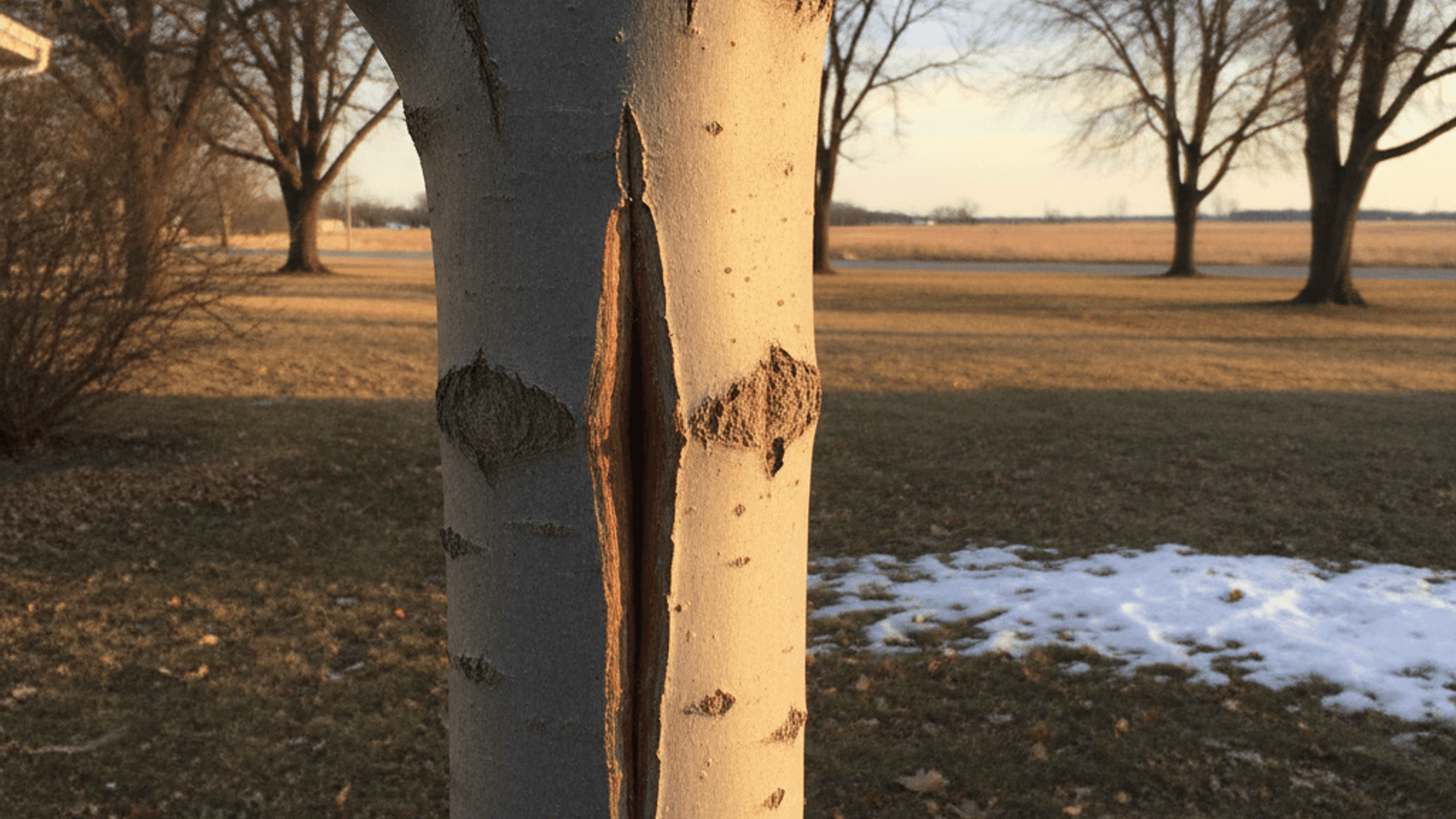
A long vertical split down the trunk of a young maple, almost always on the side that catches the afternoon sun, is the most common winter bark injury on a Topeka lot. Two separate things produce it and they look nearly identical from the driveway. Sunscald kills a strip of living tissue when bright winter sun warms that face of the trunk and the temperature drops after dark. A frost crack splits the wood itself when a hard cold snap moves the inner and outer trunk at different rates.
Neither one is an insect, and neither is a disease you can spray. Both are a Kansas winter doing what it does to a thin-barked tree with nothing shading its trunk. The good news is that the trees most at risk are the ones you can still protect this month, and the fix is cheap. If the split is already deep, or it is on a big stem over something you care about, call (785) 333-4052 and we’ll get an insured provider out to look at it.
What a Kansas winter does to thin bark
Bark is not a raincoat. The living layer just under it, the cambium, is what moves water and sugar up and down the stem, and it stays alive all winter in a slowed-down state. Cold on its own rarely kills it here. What kills it is the swing: a 60-degree Tuesday afternoon followed by a hard freeze eight hours later, repeated through February. K-State Research and Extension puts the principle plainly in its Kansas problem guide, Tree and Shrub Problems in Kansas: “Sudden drops of temperature are more damaging than steady declines, particularly if they occur before cold acclimation (fall/winter dormancy) or after de-acclimation.”
Topeka sits in the part of the country that specializes in that swing. Clear sky, low humidity, open prairie horizon, no coastal mass to smooth the curve. A trunk standing in full sun on a January afternoon with snow on the ground reflecting more light up at it is doing something very different from a trunk in the shade twenty feet away.
Which trunks are standing in that sun is mostly a question of where you live. Central Topeka neighborhoods like Potwin and Oakland sit under a closed canopy of old street trees, and a young tree planted there spends most of the winter in shade cast by something older. The newer stock out the Wanamaker corridor and through Westboro, Silver Lake and Rossville is the opposite: open lots, young planted trees, nothing between a smooth trunk and the southwest sky. That is where this damage shows up.
Sunscald, and why it is always the southwest face
The south and southwest side of the trunk gets the most direct sun at the lowest winter angle, for the longest stretch of the afternoon, and it is the last face to lose that heat at sunset. K-State’s horticulture fact sheet on the problem states the pattern without hedging: “Sunscald normally develops on the south or southwest side of the tree.”
The mechanism is warming followed by a drop. That same K-State sunscald sheet describes winter sunscald this way: “Sunny, warm winter days may heat the bark to relatively high temperatures.” It cites a measurement for scale: “Research done in Georgia has shown that the southwest side of the trunk of a peach tree can be 40 degrees warmer than shaded bark.” That is Georgia research on a peach tree, not a Kansas measurement on your maple, so treat it as an illustration of how big the gap can get rather than a number for your yard. The warming, the sheet continues, “can cause a loss of cold hardiness of the bark tissue resulting in cells becoming active.” Those active cells then die when night comes.
Here is the part that confuses people. You will not see it in February. The sheet is specific: “The damaged bark tissue becomes sunken and discolored in late spring. Damaged bark will eventually crack and slough off.” So the sunken, cracked, peeling patch you notice in May was made in January, and by the time it is visible the injury is months old. MF3132 describes the scale of the dead area the same way: “Large, irregular or elongated sections of the bark on the southwest side of the tree are killed.”
Frost cracks, and the sound people report
Frost cracking is the louder cousin. It happens during the cold itself rather than after it, and in a quiet neighborhood on a bitter night it is audible. Shad Hufnagel, Forest Health Coordinator at the Kansas Forest Service, wrote up the phenomenon after a round of cold snaps had people reporting what sounded like exploding trees: “These cracks occur when moisture and sap inside a tree rapidly freeze and expand during extremely cold weather.” The release, he writes, is “often compared to a gunshot or firework.”
Mechanically it is a tension failure between layers. MF3132 defines it as “longitudinal splits in the bark and wood, caused in part by old wounds and by differential contraction rates of the inner and outer wood in the trunk from exposure to temperature extremes.” The outside of the trunk shrinks faster than the inside, the two layers pull against each other, and something has to give. An old wound, a pruning scar, a previous split, gives first.
Severity varies a lot. Hufnagel notes that “Some are minor and cosmetic, while others may be deep, long, and wide.” The real worry is not the crack itself: “Frost cracks can weaken a tree and make it more vulnerable to future stressors like insects, disease, or decay.” A crack that opens every cold winter and closes every summer becomes a permanent seam in the stem, and a seam is where decay gets in and where an ice load eventually finds the weak point.
| Sunscald | Frost crack | |
|---|---|---|
| Where on the trunk | South or southwest face, the sunny side | Any face, often following an old wound or scar |
| What you see | A sunken, discolored patch that later cracks and sloughs off | A clean longitudinal split running up the stem, sometimes open |
| When you notice it | Late spring, months after the injury happened | During or right after a hard cold snap |
| What it damages | The living bark layer, killed in a defined area | Bark and the wood underneath, through multiple layers |
| What reduces it | Shading the trunk through winter on a young thin-barked tree | The same winter-injury practices, since exposure drives both |
Which trees on a Topeka lot are at risk
Thin, smooth bark and youth are the two qualifiers, and they stack. MF3132 names the shape of the risk directly: “Young trees or trees with thin, smooth bark, such as maple or linden, are susceptible to sunscald or southwest winter injury.” K-State’s fact sheet extends the species list and, usefully, names who is off the hook: “Honey locusts, fruit trees, ashes, oaks, maples, lindens and willows and other thin-barked trees are most commonly affected. Trees that have bark growth lower on the trunk are not susceptible.” The Kansas Forest Service list for frost cracking overlaps and adds a few: “Species such as maple, boxelder, linden, sycamore, cottonwood, and many fruit trees are particularly vulnerable.”
Put that against what actually gets planted around here and the picture gets practical. The red maples and lindens going into new subdivisions are squarely on the list. So is the little orchard tree in the back corner. So are the volunteer boxelders and cottonwoods along a creek line out toward Jefferson County. Silver maple earns its spot on both lists and brings its own structural problems besides.
What falls off the list is most of what is giving Topeka trouble elsewhere. A century-old bur oak in Highland Park with deeply furrowed plated bark is not getting sunscalded. Its bark is thick, rough, and it is standing under its own canopy. The injury here is a young-tree and open-lot problem, which is why it lines up so well with where new planting is happening and why it is worth thinking about before the tree goes in the ground rather than after.
Wrapping a young trunk, and the two mistakes
Wrapping works, and the recommendation is specific about the material and the reach. K-State’s sheet: “Applying light-colored plastic or paper tree wrap from the ground to the start of the first branches is recommended to protect recently planted, thin-barked trees.” Light-colored is doing real work in that sentence, because the point is reflecting sun off the trunk, not insulating it. A dark wrap can make the problem worse.
Mistake one is leaving it on. MF3132 is blunt: “The trunks of young, thin-barked trees and shrubs on exposed sites should be wrapped or otherwise protected from direct or reflected sunlight during the winter months. Remove the wrap in the spring.” Wrap left on through a growing season traps moisture against the bark, hides borer entry, and starts to bind as the stem puts on diameter.
Mistake two is doing it forever. The sheet sets the expectation: “Usually protecting the tree the year of planting is sufficient but some trees may need to be wrapped a second year. In such cases, check the wrap after the first year and replace if it deteriorates or becomes too tight on the trunk.” Once the tree has developed rougher, thicker bark and some low branching to shade its own stem, the wrap has done its job.
Three other things reduce winter injury generally, and all three are in MF3132’s winter guidance. Water matters going into the cold: “Trees and shrubs should be watered thoroughly, but not excessively, in the fall before freezing weather sets in.” The limit comes attached in the same passage: “Do not water when the ground is frozen.” Mulch helps, because “Mulching prevents frost from penetrating deep into the ground and can help reduce winter injury.” And late feeding hurts: “Do not fertilize trees in late summer or early fall because this could result in the production of succulent growth that is susceptible to winter injury.” A tree that went into fall already short on water is starting winter from behind.
Bark that is already split
The first question is depth, not length. A shallow surface crack on a young stem that is already callusing over is a tree managing an injury. Bark gone with the inner trunk showing through is a different conversation, and it is the one K-State Research and Extension’s Shawnee County office draws a hard line on in its storm-pruning guidance: “If the bark has been split and the cambium (inner trunk) is exposed or the main trunk has split, the tree will not survive long term and should be removed.”
Do not paint it, seal it, or fill it. The sunscald sheet addresses the instinct directly: “Do not cover the damaged area with wound dressings as these do not help and may delay the formation of callus tissue.” What the tree does instead is grow over the edges, and the sheet describes it: “Callus tissue will move in from both edges of the wound and will eventually cover the wound.” For a dead sunscald patch, MF3132’s own problem table calls the condition “Common in Kansas” and gives the response as “Prune affected sections back to healthy wood in the spring and provide adequate watering.” Spring, not now, and a cut back to live tissue is pruning work rather than scraping.
What an on-site look adds is everything a photo cannot settle: how far around the stem the dead tissue runs, whether decay has already started behind the seam, whether the stem has a second defect stacked on the first, and what is standing underneath if the stem eventually fails. That is the judgment inside a tree health assessment, and on a larger stem it rolls into a formal look at failure risk. A trunk injury does not mean a dead tree, and the signs that a tree has actually died are a separate and clearer list.
Frequently asked questions
Is split bark on a tree a sign of disease?
Usually not, when the split is vertical, on one face, and showed up over a winter. Sunscald and frost cracking are physical injuries from temperature, not infections. Disease can arrive afterward through the opening, which is exactly why the Kansas Forest Service frames the risk as a crack making a tree “more vulnerable to future stressors like insects, disease, or decay.” The sequence runs injury first, pathogen second.
When should I wrap a young tree in Topeka?
Before hard winter sun is a factor, so fall is the natural window, and the wrap comes off in the spring per MF3132. The trees worth wrapping are recently planted, thin-barked and standing where nothing shades the trunk. An established oak with rough plated bark does not need it.
Will a frost crack heal?
A tree seals, it does not heal. Callus tissue rolls in from both edges and eventually covers the wound, but the split stays inside the stem as a permanent feature. Cracks that reopen in following winters are common because the seam is now the weak line, and a stem with a long-running open crack over a house or a drive is worth having a provider evaluate for structure rather than watching for another year.
When to call us
Winter bark injury is mostly a small-tree problem with a small-tree fix, and wrapping a young trunk is genuinely a homeowner job. The call is worth making when the split is on a mature stem, when the inner trunk is showing through, when a crack has reopened over more than one winter, or when the tree in question is standing over a roof, a drive or a line. Nobody should be on a ladder with a saw working out the answer.
Call us at (785) 333-4052 and we’ll connect you with an insured tree-service provider who can look at the stem and tell you whether it is cosmetic or structural.