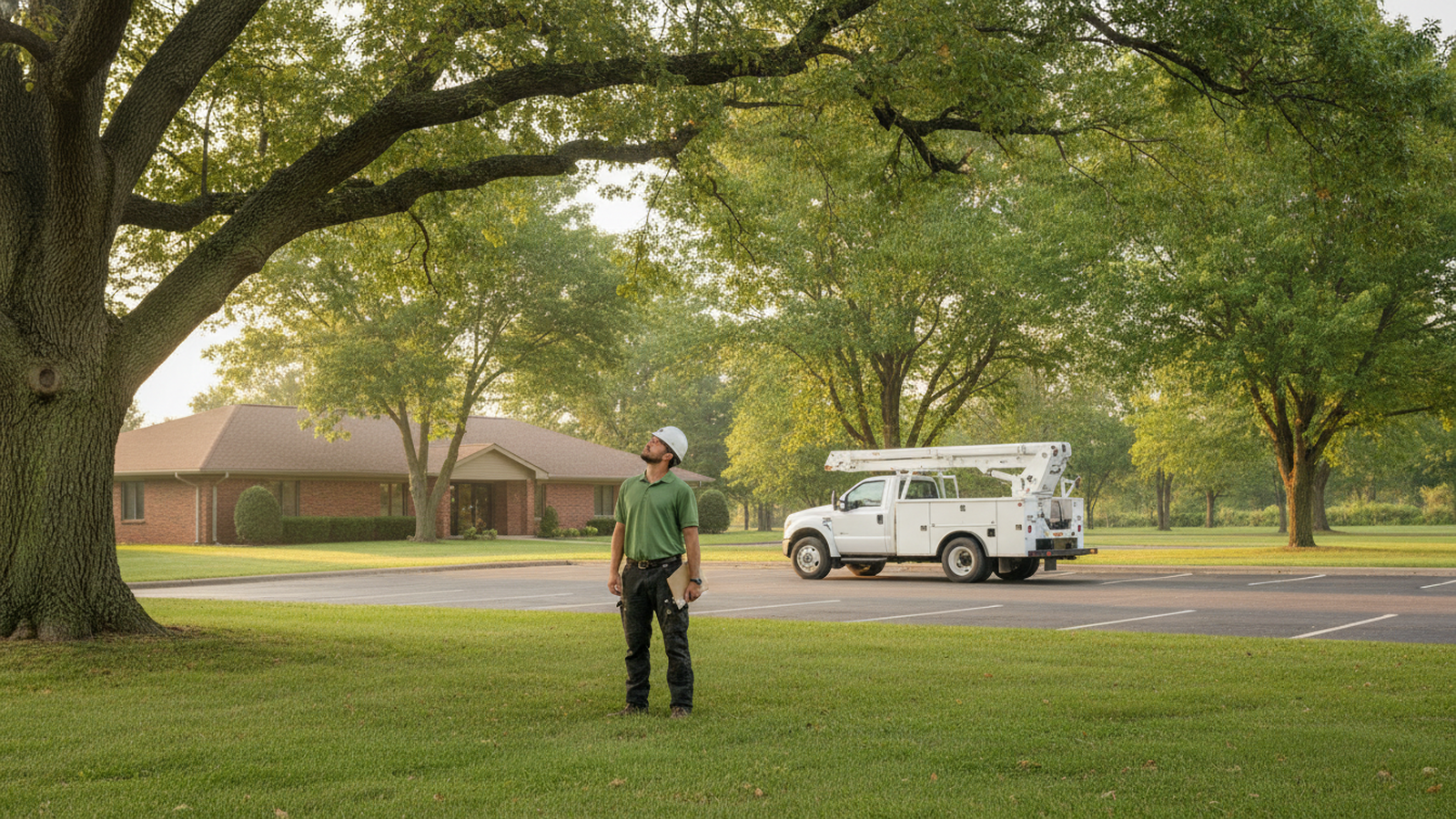
Commercial tree service in Topeka is easier to compare when every provider receives the same written scope. Identify the trees or zones, pruning objectives, access limits, debris handling, insurance documents, and desired result. Different bids may reflect different assumptions, so ask each provider to list exclusions and optional work.
ANSI A300 can help organize the pruning scope, but it doesn’t replace property-specific instructions. Both liability and workers’ compensation records may matter. Their relevance depends on the provider, the work, the property, and applicable law.
What makes commercial tree service in Topeka different from a homeowner call?
Commercial work often involves several decision-makers, defined property zones, access planning, and documentation. Some projects are recurring, while others respond to damage or a newly observed concern. The bid should reflect the actual task rather than an assumed maintenance cycle.
Occupancy and nearby targets still matter. A tree beside a shared parking area presents different planning questions than one beside an unused section of land. A tree risk assessment can evaluate the individual tree, target, site conditions, and inspection limits.
Why do three tree bids come back at three different prices?
Because “trim” doesn’t define the intended result. The current ANSI A300 framework supports objective-based pruning specifications and has been consolidated rather than maintained as a separate pruning part.
A reference to ANSI A300 isn’t a complete work order. The scope still needs to identify the trees, pruning objectives, measurable outcomes, access limits, and debris responsibilities. If the property lacks someone qualified to prepare that scope, consider an arborist consultation before requesting comparable bids.
What should a commercial tree care bid actually specify?
State the pruning objective for each tree or property zone, then add measurable limits. A practical scope can cover:
- Specified branch removal. Identify dead, broken, or selected branches included in the work.
- Clearance. Name the walkway, drive aisle, roof, sign, or other feature involved.
- Crown or branch reduction. Describe the area being reduced and the desired result.
- Structural improvement. Tie proposed cuts to documented findings from the tree assessment.
The scope should also identify access restrictions, protected property, debris handling, and excluded work. Ask whether hauling, chipping, stump work, traffic control, or restoration appears in the written quote. The tree-debris disposal guide explains questions to settle before work begins.
Because standards change, confirm terminology against the current ANSI A300 edition. Require the provider to document any proposed method that differs from the accepted scope.
Anything near an Evergy line changes the scope
If any tree on the property has grown into an overhead distribution line, that portion of the work is not an ordinary pruning line item. Utility clearance runs on its own rules and its own qualified personnel, and on a managed property it often means part of the canopy is already being handled by someone other than your contractor. Our breakdown of Evergy line-clearance trimming versus hiring your own crew covers where that boundary falls, and it’s worth resolving before you pay a contractor to quote work that isn’t theirs to do.
Which practices should a commercial bid rule out in writing?
Two, by name, because the standard already calls both unacceptable and quoting them out protects the trees you’re paying to keep.
Topping. Define topping in the bid as an unacceptable result and require the provider to explain any proposed crown reduction. The current ANSI A300 framework focuses on pruning objectives and measurable outcomes. A low price doesn’t justify an undefined or damaging method.
Lion’s tailing. Defined as removing an excessive number of inner, lateral branches from parent branches, and likewise called not an acceptable pruning practice. It looks tidy from the parking lot and it moves weight to the ends of limbs, which is the opposite of what you want before a wind event.
Require the provider to inspect each tree before work and document conditions that could change the scope. If climbing is expected, ask which access method is proposed and how retained trees will be protected.
The scope should require compliance with applicable safety rules. Ask how the provider will manage public access, traffic, electrical hazards, and work near occupied areas. Utility involvement is necessary when electrical hazards are present.
Does a tree crew in Kansas have to carry workers’ compensation?
Not always, and this is the gap most commercial buyers never check.
K.S.A. 44-505 generally applies the Kansas Workers Compensation Act to employment in the state. It includes a payroll-based exception when the preceding year’s total gross payroll was not more than $20,000 and the employer reasonably expects the current year not to exceed that amount. Other statutory conditions can matter.
A city license doesn’t establish that a provider carries workers’ compensation coverage. Request current documentation and verify what it covers rather than assuming.
How should workers’ compensation and liability documents be reviewed?
Both documents matter, and neither should be treated as a substitute for the other.
K.S.A. 44-503(a) can create principal liability when its statutory conditions apply, including work that is part of the principal’s trade or business. Whether the section applies to a particular property and contract is fact-specific.
Subsection (g) addresses situations where a covered or electing contractor has secured payment of compensation. Evidence can include a current workers’ compensation certificate, self-insurer certification, or qualified group-funded pool certification, as specified by the statute.
Request current liability and workers’ compensation evidence before work begins. Ask your insurer or counsel what the property and contract require. Don’t rely on a general summary to decide legal exposure.
What licensing and liability limits should a commercial property require?
Inside Topeka city limits, verify the provider’s city license and insurance. TMC 5.165.030 requires a City Clerk license for covered tree, shrub, and vine services. TMC 5.165.070 also establishes public-liability requirements for that license.
The city requirement doesn’t decide what coverage your property or contract needs. Request a current certificate and discuss limits or additional-insured language with your insurer or counsel. Our guide to Topeka’s tree removal permit and licensing rules provides more context.
Certification and city licensing answer different questions. Ask who will assess the trees, what credential that person holds, and which business will perform the work. For property outside Topeka, including Burlingame, verify the rules for that jurisdiction directly.
How should a Topeka property schedule tree work across the year?
Set the schedule by species, condition, site, occupancy, and work objective. K-State says many deciduous trees are generally pruned before bud break, while evergreens and flowering plants can require different timing. Its Kansas guidance also says to avoid wounding or pruning oaks during April, May, and June.
Dead, broken, or hazardous branches require separate decisions. Arrange a tree health assessment when conditions change or a concern appears. After storm damage, stay clear of downed lines, hanging branches, unstable trees, and branches under tension. Electrical hazards belong with the utility.
For planned or emergency tree service, verify availability directly. Ask what the written quote includes, how access will be controlled, and who handles debris. Our tornado season tree prep guide and insurance explainer cover related planning questions.
Frequently asked questions
What is commercial tree service in Topeka?
Commercial tree service in Topeka covers planned or responsive tree work for managed properties. The written scope should identify the trees or zones, intended result, access, debris handling, documentation, and insurance records required by the property.
What should a commercial tree service contract include?
At minimum: the trees or zones covered, the ANSI A300 pruning type for each (cleaning, thinning, raising, or reduction), clearance heights over drive aisles and walkways, limb size ranges, debris handling, visit frequency, what documentation you get after each visit, and current certificates for both liability and workers compensation insurance.
Does a commercial tree crew in Kansas need workers’ compensation insurance?
Not always. K.S.A. 44-505 includes a payroll-based exception when its stated conditions are met. A city license doesn’t prove that workers’ compensation coverage exists, so request current documentation and verify its scope.
Can a property owner be liable for an injured worker of an uninsured tree contractor?
Potentially, when the conditions in K.S.A. 44-503 apply. The analysis depends on the work, the relationship, and whether compensation was properly secured. Ask an insurer or counsel to evaluate the specific contract rather than relying on a general rule.
Is tree topping ever acceptable on a commercial property?
No. ANSI A300 treats topping as an unacceptable pruning practice. Require a defined pruning objective and ask the provider to explain the proposed cuts and finished result. Don’t accept an undefined method simply because its bid is lower.
Do tree companies need a license to work on commercial property in Topeka?
Yes, for covered work inside city limits. TMC 5.165.030 requires a City Clerk license for businesses performing listed tree, shrub, or vine services. Verify the provider’s current license and insurance directly before work begins.
What’s the difference between crown thinning and crown reduction?
They describe different intended outcomes. Density management addresses selected live growth, while reduction changes selected branch or crown dimensions. Define the objective and measurable result in writing so providers quote the same scope.
How often should a commercial property have its trees inspected?
There isn’t one inspection schedule for every commercial property. Set the next review from the trees’ condition, species, site changes, occupancy, and previous findings. New damage or a significant site change can justify an earlier assessment.
The scope is the whole job
A clear scope helps property decision-makers compare the same work. Identify the trees, pruning objectives, access limits, debris handling, exclusions, and required documentation. Rule out unacceptable practices by name and ask each provider to explain any proposed alternative.
Topeka Tree Pro connects Greater Topeka property owners with independent insured tree-service providers. Request an estimate for commercial tree service, tree trimming, or storm damage cleanup. Verify availability, qualifications, insurance, permissions, and the written scope directly with the provider. Call (785) 333-4052.
Standards and statutes change. ANSI A300 is revised periodically and the Kansas statutes cited here were current when this was written. For a specific contract, confirm the current standard language with the Tree Care Industry Association, the statutes with the Kansas Office of Revisor of Statutes, and your own exposure with your insurer or counsel rather than relying on any summary, including this one.