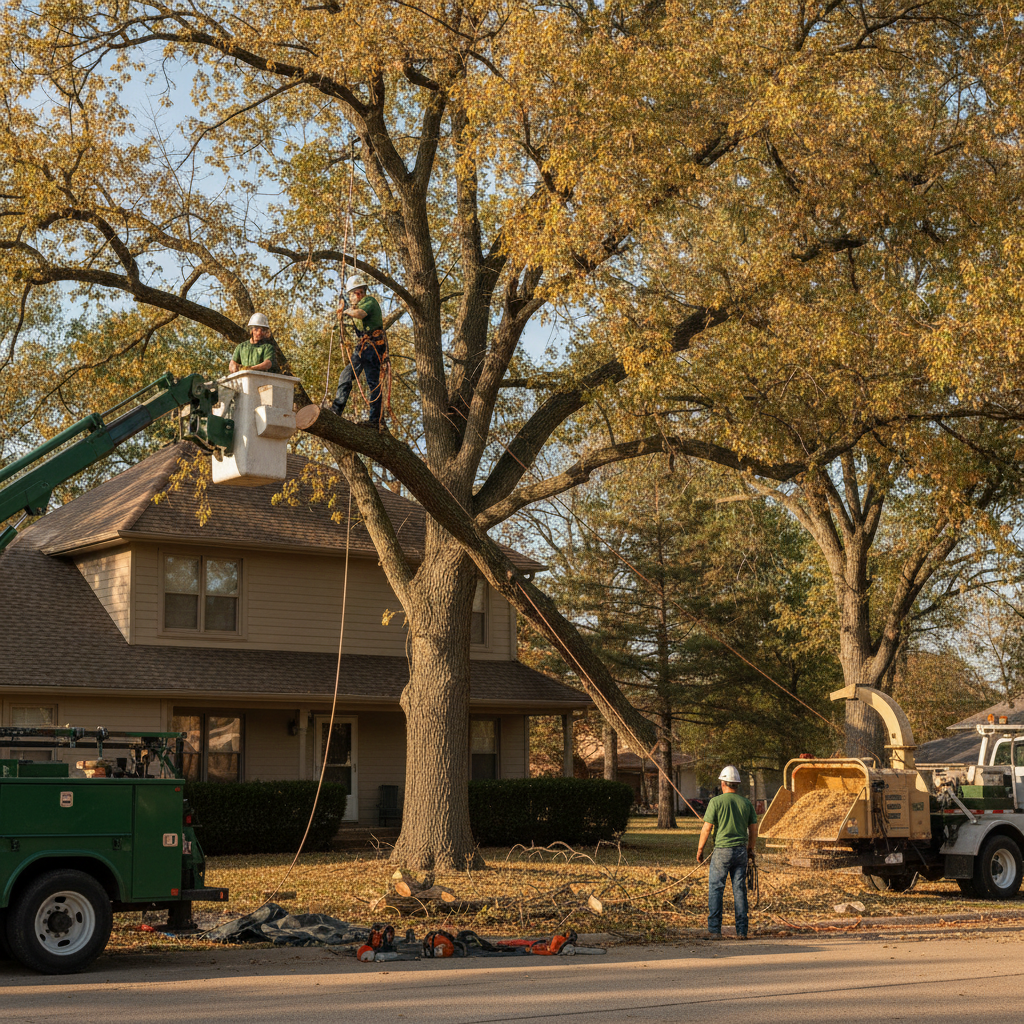
The pin oak on a Topeka parkway is the oak with the telltale silhouette: upper limbs reaching up, middle limbs stuck out level, lower limbs hanging toward the sidewalk. It is also the oak that most often turns a thin, sickly yellow on our high-pH clay, even though the iron those leaves need is already in the ground. Pin oak, Quercus palustris, was planted here because it moved well from the nursery and made shade fast. The soil under a lot of those parkways was never the soil it evolved for.
Why pin oaks were planted on Topeka parkways
Pin oak became a Topeka street tree because it was easy to move, quick to make shade, and sold in quantity. Unlike many oaks that send a stubborn taproot, pin oak grows a shallow, fibrous root system that re-establishes after the tree is dug, balled, and set on a parkway. Nurseries liked that. Cities liked the tight pyramidal form on a young tree. Homeowners liked a red oak that filled in faster than a bur oak.
The Latin name tells the other half of the story. Palustris means of marshes. In the wild, pin oak is a bottomland and flatwoods tree: wet clay, winter water, then a growing season that is not a swamp. Eastern Kansas is on the western edge of that range. A cottonwood on the Kansas River bank at NOTO is in something closer to pin oak country than a narrow grass strip between curb and sidewalk in Potwin.
That is the mismatch that still shows up on Greater Topeka lots. Mid-century and later planting waves put pin oak on parkways in Oakland and Highland Park, then again in the 1990s-and-newer stock along the Wanamaker corridor, Westboro, Wakarusa, and out US-24 through Silver Lake and Rossville. The form looked right on paper. The clay under those lawns is alkaline, not the acidic bottomland the species wants. On acreage in Auburn, Berryton, and Overbrook, pin oak was never the fence tree anyway. That job belonged to Osage orange. Out toward Alma and Harveyville the windbreak is cedar, not a drooping red oak.
The branching pattern is the other reason pin oak was popular, and the reason it stays in the work mix. Young trees hold a pyramid: top limbs up, middle limbs horizontal, lower limbs hanging. Those hanging limbs are graceful in a wide yard and a nuisance over a walk, a drive, or a parked car. Dead lower twigs also hang on for years, which is one story behind the common name. They look like pins. They also catch ice.
Ice, not snow, is the winter event that breaks trees here. Freezing rain loads a union until it fails, and a pin oak that shrugged off a blizzard can shed a lot of that hanging lower wood in one night. Spring is no quieter. Straight-line wind and hail are routine from roughly March into June in this corridor, and a chlorotic canopy with a lot of dead laterals is extra sail. After a storm, storm-damage cleanup is often less about the trunk and more about those persistent, hanging pieces.
Young pin oaks also keep dead leaves into winter, a habit called marcescence. From the street it can look like the tree never went dormant. The leaves are dead. They drop when the new flush pushes them off. That is not a disease. The yellow flush in July is a different problem.
Iron chlorosis on high-pH clay
Iron chlorosis is why so many pin oaks here look yellow by midsummer even though the iron is already in the clay. High-pH soil locks iron in a form the roots cannot take up. Without iron, the leaf cannot make enough chlorophyll. The blade turns yellow while the veins stay green, a pattern called interveinal chlorosis. Photosynthesis falls off. The tree makes less sugar. New leaves come in smaller and paler. Twigs die back. Over a run of seasons the crown thins from the outside in.
That is not a mystery unique to Topeka, and it is not a diagnosis of any one tree from a photo. It is the usual collision between this species and alkaline urban clay. Lime in lawn programs, limestone in the parent material, and fill around newer foundations all push the same direction. A pin oak on a true wet, acidic bottomland site can be a dark, glossy green. The same genotype on a West Topeka parkway strip often is not.
Iron chlorosis on trees in this metro follows the same chemistry on other sensitive species. Pin oak is simply the oak that shows it first and worst. People sometimes read yellow summer leaves as drought or as the same decline they have watched on ash since emerald ash borer was confirmed in Shawnee County. Drought scorches from the edges. Borer work leaves D-shaped holes and galleries under the bark of ash, not oak. Chlorosis on pin oak is a soil-to-leaf transport failure. The tree is hungry for a nutrient that is present and unavailable.
Treatment tries to get usable iron into the tree, or to change the chemistry right around the roots, so chlorophyll can form again. It does not rewrite the clay. Whatever is applied wears off as the soil returns to its old pH, so a green year is not a cured tree. Product names, rates, mixes, and timing belong to the person doing the application. Shawnee County Extension is the place for a soil test if you want a number on paper before anyone budgets a treatment. A provider looking at the live crown can tell you whether there is enough leaf area left to respond, or whether you would be feeding a tree that has already lost the factory.
Do not read yellow leaves as a permit to start cutting. A chlorotic pin oak is still an oak. Fresh pruning wounds on oak are how oak wilt can move during the growing season, so the timing of any cut on this species is not the same as on a maple. Ask the person on the property when it is safe to prune this oak this year, and treat that answer as part of the job, not as an extra.
Pruning, treatment, or a species change
A pin oak on a Topeka lot usually needs one of three things: the lower limbs lifted, the chlorosis treated as a repeating job, or the tree taken out and replaced with a species that can live in this soil.
| Path | What it changes | What it leaves alone |
|---|---|---|
| Lift or thin the crown | Clearance over a walk, drive, or roof, plus dead wood that ice will finish | The soil chemistry starving the leaves |
| Treat the chlorosis | Leaf color and vigor for a stretch of time, if enough live crown is left to respond | The high-pH clay. The yellowing tends to return |
| Remove it and plant something else | The mismatch between a marsh oak and an alkaline parkway strip | Nothing, if the replacement is another pin oak |
K-State Research and Extension puts routine pruning of many deciduous trees in late February through April, before bud break, and dead or damaged wood can come out any time. That window is the starting point, not a free pass on oaks. Oak wilt spreads through fresh wounds in the growing season, so a pin oak is not a summer topping project and it is not a ladder-and-chainsaw Saturday. Tree trimming on this species is mostly about those hanging lower limbs, storm-damaged laterals, and dead pins that never self-pruned. Raising a skirt over a sidewalk is not the same as topping the tree. Topping forces weakly attached water sprouts and leaves you with a worse structure than you started with.
Anything near a power line is a different job. The pole-to-pole span is Evergy’s to review. The line from the pole to the meter is the customer’s responsibility. Call Evergy’s vegetation line at 888-471-5275 before anyone works near a conductor, and never try to move a branch that is touching a line. Evergy’s own page on who trims what is the rule to follow, not a clearance guess in feet.
Treatment makes sense when the tree still has a usable crown, the target is worth the repeating cost, and someone will keep after it. It does not make sense when the canopy is already a rack of deadwood over a roof in Highland Park, or when every July is paler than the last. Removal cost, when you get there, moves with trunk diameter, lean, what sits under the drop zone, whether a bucket or a crane can even reach the stem between houses, and how much wood has to leave the property. Stump grinding is a separate scope from the felling. There is no Topeka Tree Pro price on any of that. Confirm the number with the provider who would do the work.
If the honest call is a species change, tree removal is the first half and the second half is not another pin oak. The native upland oak already doing real work on older Topeka lots is bur oak. It evolved on this prairie edge, not in a swamp. A replacement still has to match the space: tight lots in Potwin are not acreage in Osage County, and a tree that will throw hanging lower limbs over a city sidewalk will keep doing that no matter what you name it.
Kansas has no statewide tree-service licence and no statewide general contractor licence. Licensing here is local. The City of Topeka licenses contractors who work inside city limits. Most of the smaller towns and counties in this footprint license nothing at all. Ask who will actually be on the property. Ask whether that person holds the ISA Certified Arborist credential, then check the name in the International Society of Arboriculture’s directory. Confirm current proof of insurance with the matched provider before work begins. If the tree is inside Topeka, confirm the company’s city licence with the City of Topeka. A tree in the city right-of-way is not yours to cut. Forestry is the authority on which side of that line you are standing.
Common pin oak questions
Most of the pin oak questions we hear in Greater Topeka are about the name, the yellow leaves, and how fast the tree will get over a roof.
Why is it called pin oak?
The name is usually traced to those stiff, pin-like twigs, the same tough branchlets that were used as wooden pins in timber framing, and to the way dead lower twigs hang on the tree for years. The other common names, swamp oak and swamp Spanish oak, point at the wet ground the species actually wants. The street-tree form people planted in Topeka is the same plant. The parkway is not a swamp.
What are the downsides of a pin oak in Topeka?
The downsides that actually show up here are iron chlorosis on high-pH clay, hanging lower limbs over walks and drives, dead twigs that never drop, and ice loading on that same descending wood. Pin oak is also an oak, so pruning wounds in the growing season are an oak wilt problem, not just a cleanup problem. Fast shade was the sales pitch. The maintenance is the rest of the life of the tree.
How fast does a pin oak grow?
Pin oak is fast for an oak on a site it likes: full sun, moisture, and soil acidic enough that the leaves can make chlorophyll. A young tree in those conditions puts on height quickly and holds that tight pyramid. A pin oak yellowing on alkaline clay does not keep that pace, because a leaf that cannot make food cannot build wood. Age alone does not set the height. Site, water, and whether the crown is green in July do.
When to call us
A pin oak with hanging wood over a roof, a limb near a line, or a canopy that has gone from yellow to thin is not a weekend chainsaw job. We will connect you with an independent insured tree-service provider for pruning, treatment, or removal, and you confirm current proof of insurance with that provider before work starts. Call us at (785) 333-4052.