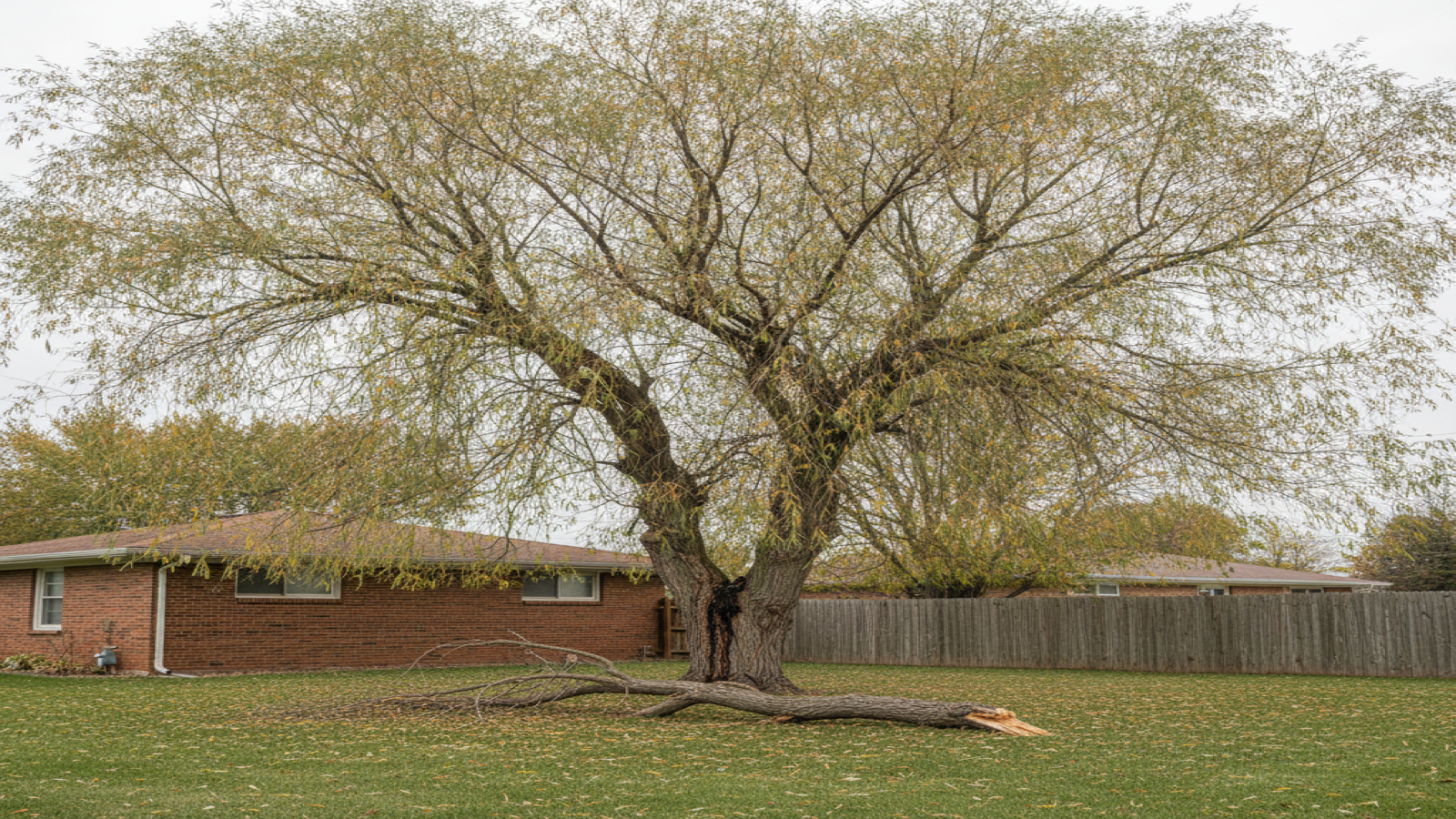
A willow in a Topeka back yard is usually growing in the wrong place, and the reason is in the rainfall. The USDA-NRCS plant guide for black willow says the species “grows best where the average annual rainfall is 51 inches, of which 20 inches falls during the growing season, April through August.” Topeka’s 1991 to 2020 precipitation normal is 36.53 inches a year.
That is not a death sentence for every willow in Shawnee County. It does explain the limb drop, the dieback, and the short useful life that bring most people to this page.
Whether a specific willow should come down is an onsite call, not a species rule. Call (785) 333-4052 to be matched with an independent insured provider who can look at the actual tree.
Where does the 51-inch figure come from?
The Plant Guide for black willow (Salix nigra) was contributed by the USDA-NRCS Plant Materials Center in Manhattan, Kansas, together with Kansas State University Forestry Research. It is a federal document written in Kansas about a tree that grows in Kansas, which is rarer than it sounds for tree advice you find online.
The guide describes the species habitat plainly. Black willow “is usually found on moist or wet soils along banks of streams, lakes, swamps around farm ponds, and pasture sloughs.” It calls the tree “a small to medium-sized tree 30 to 60 ft high and about 14 inches in diameter” with “a broad, irregular crown and a superficial root system.”
On dry ground the guide is not absolute. Black willow “will tolerate dry soils with reduced vigor.” Reduced vigor is the phrase that matters. The tree lives, and it lives badly.
Is Topeka actually too dry for a willow?
Split the number and the answer gets more interesting.
National Centers for Environmental Information normals for the Topeka Municipal Airport station, period 1991 to 2020, put the annual precipitation normal at 36.53 inches. The April through August monthly normals are 3.81, 5.17, 4.92, 3.99 and 4.55 inches, which adds to 22.44 inches.
So Topeka clears the plant guide’s growing-season benchmark of 20 inches. It falls about 14 inches short on the annual total. The shortfall sits in the cool months, which is when a water table recharges rather than when a tree is drinking.
That is the mechanism worth understanding, because the plant guide names the failure directly: “Droughts that lower the water table can cause serious mortality where willow tends to be shallow-rooted as on clay-capped alluvial soils.” A shallow-rooted tree on clay does not have a deep reserve to reach for in a hot dry Kansas August. See drought-stressed trees in Topeka for what that stress looks like across other species.
Do Shawnee County yards have the wet sites willows want?
Mostly not. The Kansas Forest Service publication “Trees and Shrubs for Difficult Sites” lists black willow only under Trees for Wet Locations, with a plant range of east, central and west Kansas, a height of 35 to 50 feet, and the remark “Excellent for bank stabilization and shore protection; rapid grower; shade intolerant.” It does not appear on the dry-locations table.
That is the intended job: a creek bank, a pond edge, a shoreline. Not a lawn.
The soil data lines up. Querying the USDA Soil Data Access service on 2026-09-30 for SSURGO survey area KS177, which is Shawnee County, the major soil components sort by drainage class like this: moderately well drained 147,214 acres, well drained 64,377 acres, somewhat poorly drained 39,348 acres, somewhat excessively drained 32,650 acres, poorly drained 4,245 acres, and excessively drained 1,583 acres.
Poorly drained ground is roughly one and a half percent of that mapped acreage. Add the somewhat poorly drained class and you are still near fifteen percent. The wet site a willow was built for is the exception in this county, not the rule, and a soil survey map unit is a county-scale generalization rather than a reading of your particular back corner.
Why do willow limbs keep coming down?
Speed. The K-State Research and Extension Johnson County office publishes a tree-selection article for the Kansas City area that states the general rule: “As a rule, fast growing trees are weak wooded, tend to break under wind and ice, easily develop defects including rot and decay, and, in the scheme of life, tend to live for a shorter period of time.”
That same article puts willows on its avoid list by name. “Fast growing trees to avoid for the suburban home landscape include all species of willows.” It adds, in the author’s own first-person voice, “Yes, I realize weeping willows are pretty but they just don’t make it in a backyard.”
Read that at the right altitude. It is an unsigned first-person column from one county extension office, written about the Kansas City metro, and it is a planting recommendation. It is not a statewide publication and it is not an instruction to cut down a tree you already have. What it does tell you is that experienced Kansas horticulture staff would not plant this tree in a yard again.
If a willow has already dropped a limb on something, fallen limb roof and fence damage in Topeka covers the cleanup and claim side, and ice storm tree damage covers the winter loading that takes these trees apart.
What is actually wrong with my willow?
Several willow complaints in Kansas are documented, and they do not all mean the same thing.
Oozing, stained bark. K-State publication MF3132, “Tree and Shrub Problems in Kansas,” says “Wetwood is common in elm, cottonwood, maple, mulberry, oak, willow, and sycamore,” and then gives the reassuring half: “In general, wetwood does not pose any significant threat to landscape trees.” The same publication says “Alcoholic flux is common on sweetgum, willow, elm, and oak, especially when trees are stressed.” Stress is the signal there, not the ooze itself.
Sunken cankers on branches. MF3132 routes willow to its poplar entry, where canker shows as “Brown sunken cankers on twigs and branches. Cankers may enlarge and girdle the branch.” The publication notes canker is “Most common in trees with stress or injuries” and that cankers “Frequently follow ice storms or freeze damage.” Its management line is to maintain plant health with proper pruning, fertilization and watering, and to prune out and remove affected wood if cankers develop.
Canker that kills. The black willow plant guide names two. “Cytospora chrysosperma causes canker in poplar and willow. Under forest conditions, cytospora canker is of little consequence but when trees become weakened by drought, competition, or neglect, losses can be heavy.” Keep that whole sentence together. The severity is conditional on a weakened tree, which is the condition a dry-site Topeka willow is already in. The guide also describes Phytophthora cactorum bleeding canker, “lesions on the lower trunk that discharge a dark-colored, often slimy liquid,” which is “Confined to the phloem and cambium area” and “can result in death if the canker girdles the trunk.”
Borers. MF3132 states that the cottonwood borer “attacks cottonwood, poplar, and willow,” with larvae inside infested trees and adults seen tunneling in at the soil line.
Telling these apart on a photo is guesswork. A tree health assessment puts someone at the trunk who can check the cambium, the root collar and the branch unions instead of the canopy alone.
Does the root system threaten pipes or paving?
The plant guide’s own description is “a superficial root system,” and it credits willows generally as “a soil-binder” whose “fibrous roots help to prevent the soil from being washed away.” Shallow and fibrous is a combination that shows up at the surface.
Neither the Kansas-authored plant guide nor MF3132 makes a willow-specific claim about buried pipe, so this page won’t invent one. If you already have a blockage, tree roots in a sewer in Topeka handles the diagnosis path, and tree roots lifting a sidewalk covers the paving version. Both are decided by camera and excavation, not by species.
What happens after a willow comes out?
Two things to settle in writing before work starts.
First, the stump. Black willow, per the plant guide, “is easily established from cuttings,” and the guide notes it “will sprout at the base following fire.” A species that roots from a stick is one to ask about directly. Get the stump treatment written into the scope rather than assumed, the same way cottonwood stump sprouting in Topeka plays out.
Second, the debris. Willow makes a lot of light, wet, bulky wood in a hurry. Ask whether hauling is in the price or billed separately, and check tree debris disposal in Topeka for what the options are here.
For what a job like this generally involves, tree removal cost in Topeka walks through the factors that move a quote. Ask every provider for the same written scope so the numbers compare.
What should you do next?
Don’t take a verdict on a willow from a web page, including this one. A tree that is structurally sound over open lawn is a different decision from the same tree over a driveway, and tree risk assessment in Topeka explains why the target matters as much as the defect.
If a limb is hanging, cracked, or over a structure, treat it as a hazard and stay clear. Emergency tree service and storm damage cleanup are the matching service pages, and tree removal is the planned version.
Topeka Tree Pro is a referral service serving Shawnee, Jefferson, Jackson, Osage and Wabaunsee counties. It connects homeowners with independent insured providers and does not perform the work itself. Verify a provider’s credentials, insurance and written scope directly before hiring. Call (785) 333-4052 to get matched.