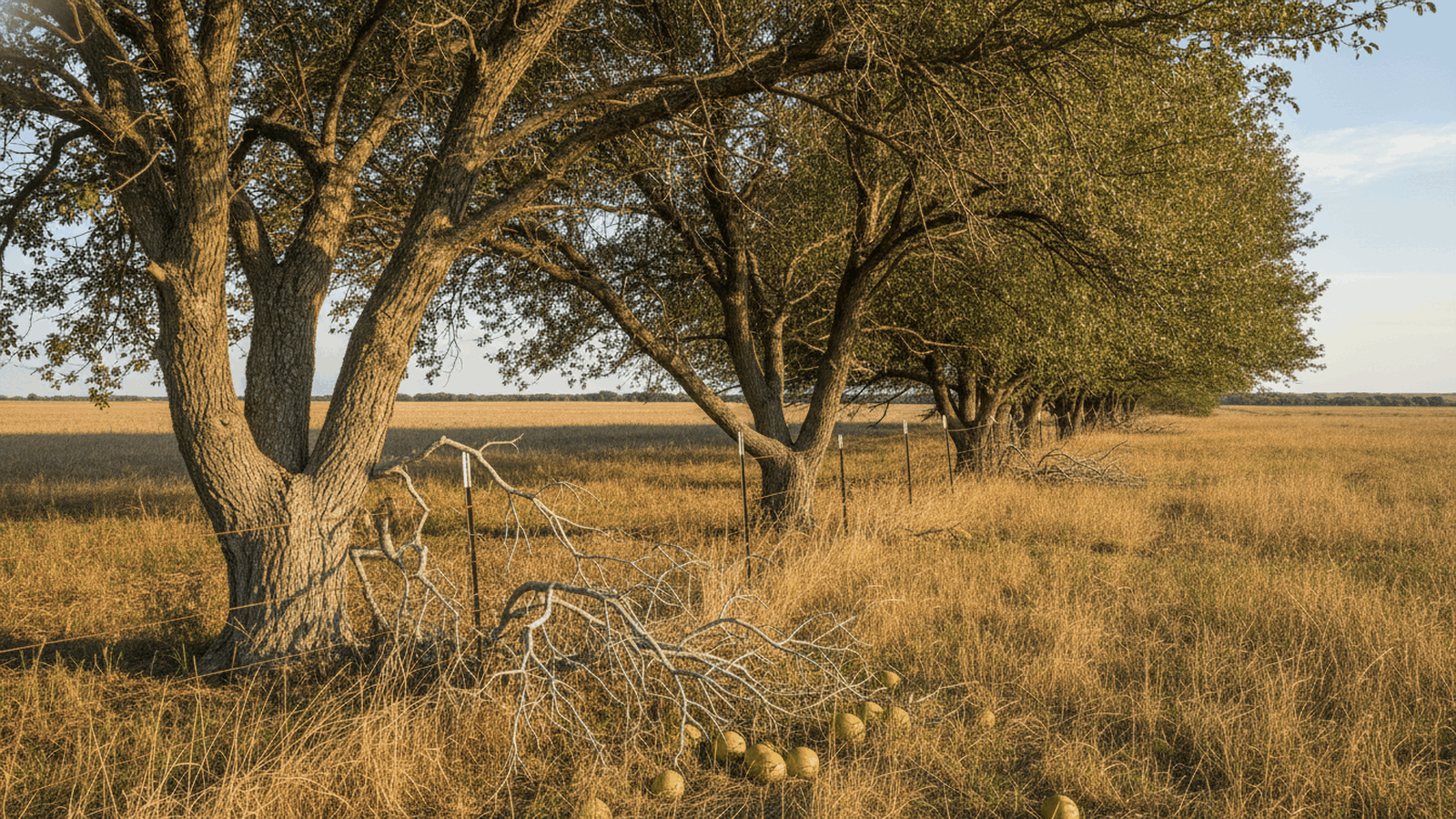
To get rid of Osage orange trees, you have to finish the stump. Cutting the trunks is not the job. Cynthia Domenghini, a K-State horticulture expert quoted in a December 2024 K-State Research and Extension article, puts Osage orange on a list of trees that come back after you cut them. Those trees “will either need to be dug out or the cut stump treated with herbicide after cutting.” Leave the stump and the row grows back.
That is the whole decision. The rest is why an old hedge row fights a saw, what of it is actually worth keeping, and what those yellow-green balls on the lawn this month do not do.
What is actually growing in that fence line?
Around Topeka, callers usually say hedge, not Osage orange. USDA-NRCS lists the other names as “bodark, hedge apple, horse-apple, naranjo chino, hedge, and Bois d’Arc.” That guide was written at the Manhattan Plant Materials Center in Manhattan, Kansas. Hedge here means this tree, Maclura pomifera. It does not mean a trimmed ornamental shrub screen.
The rows are old living fences. USDA-NRCS attributes the 1850s idea to John A. Wright, editor of the Prairie Farmer, and professor Jonathan B. Turner. Then the guide says: “By 1855 Osage orange made fencing entire prairie farms practical, and the practice had spread rapidly throughout the prairie states to most of the eastern states.” After that, “the invention of woven and barb wire caused the hedge row to be used less from 1875 forward.” Used less, not wiped out. That is why a sunny fence line south or west of town, including acreage around Wakarusa or Auburn, can still hold a row that nobody has touched in a generation.
The tree itself is “a small to medium sized tree 12 to 20 meters (m) tall, with deeply furrowed bark and thorny branches.” That height is roughly 40 to 65 feet. It “does require full sun to be productive, no shade tolerance.” USDA-NRCS also notes it “is not a constituent of any mature forest association.” A sunny fence line fits. A shaded woods interior does not.
It will also show up as a volunteer. The guide calls Osage orange “a pioneering species forever invading exposed mineral soils, particularly overgrazed pastures and abandoned crop fields.” Those are the settings the guide names: tired pasture and ground that has been let go, not a mown yard.
How far it spreads depends on how the ground is managed, and USDA-NRCS is careful about that. Osage orange “has the potential to invade areas abused by poor management and the over grazing of range or pasture land,” and it “may become weedy or invasive in some regions or habitats and may displace desirable vegetation if not properly managed.” Read that as a reason to watch a tired pasture, not as a verdict on hedge everywhere in Kansas.
Some of these trees get old. The same guide says Osage orange “has the potential to be fairly long lived tree with reports of specimens reaching 150 years old (McCurdy et al., 1972).” That is a reported maximum, from a 1972 citation, rather than a typical age for a row along a Kansas field.
Why doesn’t cutting it down get rid of it?
Because hedge grows back from the cut.
The December 2024 K-State article lists trees that resprout: “Siberian Elm. Hackberry. Osage Orange. Oak. Ash. Aspen. Cottonwood. Maple. Sycamore. Willow.” Domenghini’s two real options sit right after that list. Dig them out, or treat the cut stump with herbicide after cutting. A chainsaw by itself is not on the list. Cottonwood owners run into the same pattern on stumps that keep sending up shoots. Hedge is on that Kansas list too.
If herbicide is part of the plan, the same article names the chemistry: triclopyr and glyphosate. “Roundup is a common name for an herbicide that contains glyphosate, while triclopyr is found in many brush killers.” Read the label before you buy. Domenghini’s next sentence is the rule that has to travel with those names: “Read the label before purchasing to make sure that a stump treatment is listed. Most often the undiluted or lightly diluted product is applied to the stump immediately after cutting.” Treatment should happen “immediately or within five minutes of cutting.” Miss that window and you did the cutting half of a two-step job.
Timing matters, and the article is specific about it. That piece ran in December, and it says “this time of year is a very good time to treat as long as applications are made when the temperature is about freezing.” So the window it describes is cold weather, near freezing, not a September afternoon. In September the fruit is dropping and that window is still ahead of you, which makes now a good month to plan the work and line up who will do it.
USDA-NRCS does not name a product at all. Its whole Control section is: “Please contact your local agricultural extension specialist or county weed specialist to learn what works best in your area and how to use it safely. Always read label and safety instructions for each control method.” Take that route before you pick a mix: the extension specialist or the county weed specialist for the ground you are standing on.
Topeka Tree Pro connects you with independent insured providers. Herbicide application is a separate, regulated activity. If a provider will treat stumps, ask what credentials they hold and where you can verify them. Do not assume the person who cuts the row is the person who can treat it.
Why is an old hedge row such slow work?
Three facts from the Manhattan USDA-NRCS guide, taken together, explain the mess in the fence line.
The branches are thorny. “The trunk is usually short and divides into several prominent limbs with upward arching branches.” And “lower branches that have died remain on the tree for years, indicating that Osage orange does not self prune.” Dead wood stays up. The row is full of it.
Then the roots. “The root system is diffuse and covers large areas with its lateral spread.” Spread out and sideways, rather than one deep anchor, which is what the grinder meets under an old row.
That is why this is not a line of easy trunks. The saw hits low forks, thorns, and dead wood that never dropped. The ground under it is a mat of laterals. A single volunteer is a tree removal. A long fence row is closer to lot clearing. If cedar is mixed into the same line, that is a different stump problem. Eastern redcedar is the land-clearing story. Hedge comes back from the cut.
Nobody should rule on your row from a photo. A matched provider has to see the access, the wire, the thorns, and what you want the strip to be when they leave.
What of it is worth keeping?
The posts are the honest keep. USDA-NRCS says Osage orange trees “are used for fence posts, due to their unusual ability to resist decay from soil born organisms, to provide livestock enclosures.” The claim is specific: resistance to decay from organisms in the soil, which is the part of a post that sits buried. It is not a claim that the wood is fireproof or immune to insects, and no source puts a price or a service life on a hedge post.
The firewood is real, with a hard limit. A Johnson County Extension agent article from K-State Research and Extension says: “Osage Orange is plentiful near Kansas City, which should be a blessing since it is one of the hottest-burning, most dense woods that exist, but you would never want to burn it in an open fireplace.” That last clause is the part people skip. The same office ties the danger to resin pockets that explode and throw sparks, and notes honeylocust will spark too. So hedge belongs in a closed stove, not an open hearth, and the prevalence half of that sentence is written about the Kansas City area rather than Topeka.
If you are keeping wood, sort posts from burn pile before the chipper shows up. Tree debris disposal around Topeka is the hauling and stacking side of that choice.
A standing tree you might keep is an onsite call. Not a species verdict. If you want one inspected instead of a row removed, that is an arborist consultation.
What do hedge apples actually do?
USDA-NRCS dates the fruit to September. That is why this is in your grass right now. The “Hedge ball” is “a multiple fruit consisting of many 1-seeded druplets fused into a globose, yellow-green structure approximately 8 to 12 cm in diameter.” Roughly 3 to 5 inches. “Fruits average 450 grams (g) in weight, but range from 150 to 700g.” Roughly a pound on average, from about 0.3 to 1.5 pounds. “The average Osage orange fruit contains from 200 to 300 seeds per fruit.”
The trees are dioecious. USDA-NRCS: “Osage orange are dioecious and wind pollinated with flowers appearing in mid-May to June after leaves.” “Female trees may start to bear fruit at about ten years of age.” Male trees do not carry the balls. Female trees may.
The basement trick is the myth, and Iowa State University is the place that actually tested it. Its research “has demonstrated that chemicals extracted from the fruit can be repellant to tested insects.” The tested insects were German cockroaches, mosquitoes, and houseflies. Spiders were never among them, so the spider claim has no study behind it at all.
What did work was narrow. “Sliced hedge apples placed in enclosed, small spaces did repel insects. However, there is still no evidence that putting whole fruit around the house or in the basement will have any effect.” In open rooms, “there is so much air movement that whatever small amount of repellant chemical may be present will quickly dissipate.” Whole fruit along a baseboard is doing nothing for you.
Two warnings from that same Iowa State page are practical on acreage. “The milky juice present in the stems and fruit of the Osage-orange may cause irritation to the skin.” Wear gloves when you handle balls or fresh cuts. And “the fruit may cause death in ruminants by lodging in the esophagus and preventing eructation or release of ruminal gases.” That covers cattle, sheep, and goats, and the mechanism is a physical blockage rather than poisoning. The warning is written about ruminants specifically.
If you run ruminants, a dropping hedge row is a livestock hazard until the fruit is off the ground.
What changes the price of clearing a row?
The quote follows the actual strip, which is why this site publishes scope instead of a number.
Lot clearing is “quoted after the provider assesses acreage, vegetation, access, obstacles, debris handling, and the intended result.” A single tree “requires an on-site quote based on tree condition, access, obstacles, and requested cleanup.” Stump grinding is “quoted after the provider assesses the stump, access, obstacles, root area, and requested finish.”
What moves those quotes is the row you actually have. Length and density. How close the wire, the outbuilding, and the drive sit. Whether the laterals have to come out or the stumps get treated and left. Where the thorny brush goes. Whether the strip needs to be pasture, a new fence line, or just passable. Compare written scopes, not a number shouted over the hood.
If the row sits on a property line, do not guess who may cut it. Kansas line-fence questions belong in a conversation with the other owner and, if needed, a Kansas attorney. Our page on a neighbor cutting a tree is the sourced place for that line. This page does not rule on it.
Frequently asked questions
Does hedge grow back after you cut it?
Yes. A December 2024 K-State Research and Extension article quoting Cynthia Domenghini lists Osage orange with other trees that resprout. Those trees “will either need to be dug out or the cut stump treated with herbicide after cutting.” Cutting alone is not one of the two options.
Do hedge apples keep spiders away?
Not on the evidence Iowa State published. Iowa State tested chemicals extracted from the fruit against German cockroaches, mosquitoes, and houseflies. Spiders were not on the tested list. Sliced fruit in a small enclosed space did repel those tested insects. Whole fruit around a house or in a basement has no evidence of effect, because the compound dissipates in open air.
Is hedge good firewood?
A Johnson County Extension agent article calls it “one of the hottest-burning, most dense woods that exist, but you would never want to burn it in an open fireplace.” Resin pockets explode and throw sparks, so a closed stove, not an open hearth. Posts are the other use USDA-NRCS names, for resistance to decay from soil-borne organisms.
Are hedge apples dangerous to cattle?
Iowa State reports that the fruit “may cause death in ruminants by lodging in the esophagus and preventing eructation or release of ruminal gases.” That covers cattle, sheep, and goats, and it is a blockage risk rather than a poisoning one. The warning is written about ruminants specifically. Separately, the milky sap “may cause irritation to the skin,” so wear gloves.
What happens if I leave the stumps?
They are still Osage orange, and Domenghini’s two options are dig them out or treat the cut stump, with the label check and the five-minute window. Stump grinding is a separate finish, for the collar and the ground you want back. Ask the provider to put stump work, follow-up on sprouts, and debris handling in the written scope.
Can I cut a hedge row that sits on the property line?
Do not take that as a yes from this page. Ownership and who may cut are per-deed questions. Read what Kansas caselaw says about a neighbor and a tree, then get the line settled before anyone starts a saw.
How do you get this row off the property?
Decide the end result first. Pasture. A new fence. One specimen left. Then have someone walk the strip. The thorns, the low forks, the dead wood that never self-pruned, and the lateral roots are the job. The stump is the part that decides whether you actually got rid of the trees.
Call (785) 333-4052. We’ll connect you with insured local crews. They inspect. We match. Shawnee, Jefferson, Jackson, Osage, and Wabaunsee.