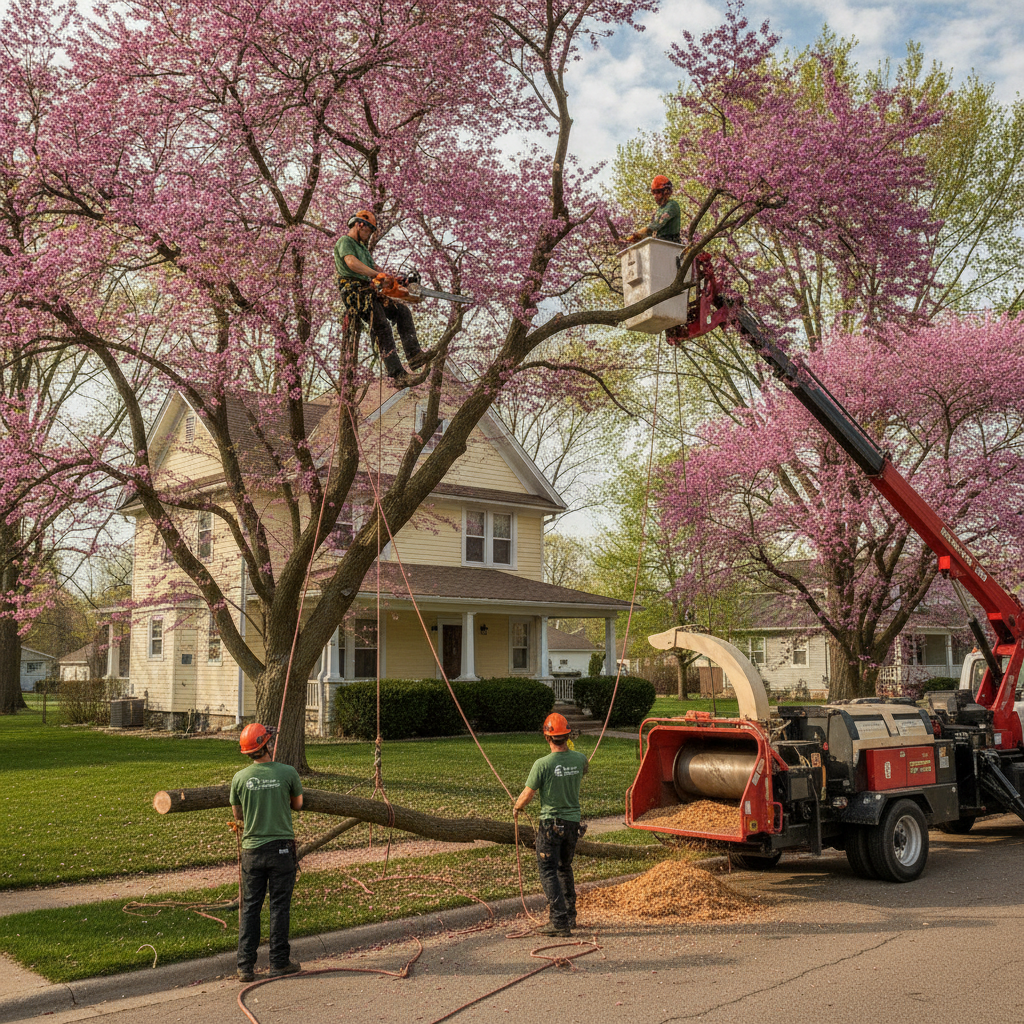
The magenta haze on bare twigs in early spring is eastern redbud, Cercis canadensis, the small native tree that flowers before it has leaves. Clusters open on last year’s wood, and often right on the trunk, while the oaks and silver maples in Potwin and Oakland are still gray. It belongs on Kansas limestone edges and in front yards that want a short, bright season, not a century of shade. If you are naming the tree in your yard, deciding whether to plant one, or watching a stem die back, that mix of color and a short useful life is the whole picture.
Why redbuds thrive on Kansas limestone edges
Eastern redbud is an understory and woodland-edge tree of the eastern half of Kansas, not a prairie giant and not a river-bottom cottonwood. In the wild it leans toward light at the timber margin, often with several trunks and a low, spreading crown. The flowers look like tiny sweet peas because the tree is in the pea family. Heart-shaped leaves follow the bloom. Flattened seed pods hang into winter.
Limestone and alkaline ground suit it better than they suit a pin oak or a river birch. That is why volunteers show up in fence lines south of Auburn, along draws toward Carbondale, and in the gaps of old Osage orange hedge rows in Osage County. The Flint Hills edge around Alma, Eskridge, and Harveyville is closer to that native niche than a compacted, irrigated parking strip. A planted tree on a Westboro or Wanamaker lot can settle in if the hole actually drains.
What it does not like is a wet bowl. Expansive clay and freeze-thaw are the ground story in Greater Topeka. Water that sits against the root flare after a spring rain, or lawn irrigation aimed at the trunk, keeps the crown looking fine for a while and the roots in trouble. A redbud at the high edge of a yard, with mulch kept off the bark, matches the species. One in a low, soggy corner of a new subdivision does not.
Sun is a trade. Full sun on an open 1990s lot along the Wanamaker corridor, or out through Silver Lake and Rossville, pushes more bloom and a fuller crown. Some afternoon shade under a bur oak or silver maple on a tight Potwin, Highland Park, or North Topeka lot is closer to how the tree grows in the timber. Deep shade makes it leggy and stingy with flowers. Purple-leaf nursery forms scorch more easily on a treeless west wall. Green-leaf wild-type trees take the heat better.
It will not replace a street ash. Emerald ash borer has been confirmed in Shawnee, Jefferson, Jackson, and Osage counties, but a redbud does not make the height or the summer shade of the tree it would be asked to stand in for. Put it at a house corner, along a drive, or at the edge of a windbreak. Do not put it in the middle of a Wabaunsee pasture and expect a canopy. A nursery container tree establishes more reliably than a volunteer dug from the timber, because this species puts down a deep taproot early. For timing on a new planting, start with when to plant trees in Topeka.
On the Holton and Oskaloosa squares you see them as yard trees under older canopy. Around Perry Lake they belong in town lots and timbered draws, not as shoreline trees the way cottonwood does on Corps ground. The Kansas River bank at NOTO is cottonwood country. Redbud wants the drier shoulder above it.
Canker, borers, and a short useful life
The bloom is front-loaded. A redbud gives you a run of loud springs and then starts losing leaders while the bur oak over a Highland Park garage is still adding wood. Nursery talk often treats two decades as the expected run. On Topeka clay, canker and ice are what actually end the tree, and that can arrive earlier or later than any round number. A species and an age do not make a diagnosis of your tree. No living tree can be certified safe. The useful thing to know is the failure pattern.
Canker is the disease that takes most of them. A sunken, dark depression in the bark on a main stem or a large limb is the mark. The fungus enters through wounds, freeze cracks, and old stubs. The tree tries to close over it. On a small ornamental, that race often ends with a dead leader and a flush of sprouts below the kill. Verticillium wilt is the other serious one: a whole branch flags on one side because the fungus is in the vascular system. Wet soil invites root rot. Borers follow stress. They are usually secondary, moving into a tree that is already fighting canker or a bark split.
The structural problem is older than the insects. Redbuds often grow with co-dominant stems and included bark, the same weak union you see on a Bradford pear, just on a smaller frame. Freezing rain loads those crotches past what a dry snow would do. This is a four-season climate, and ice, not snow, is the winter event that wrecks ornamentals here. The National Weather Service office in Topeka is where you check a winter warning. After ice, a redbud that shrugged off ordinary wind can drop half its crown. Hanging wood and debris after that kind of event are storm-damage cleanup for an insured provider, not a weekend with a pole saw. Never cut a limb that is hanging or under tension, and never work from a ladder with a chainsaw.
Downsides that actually show up in this metro:
- Canker opens in wounds and freeze cracks and slowly kills leaders from the top down.
- Tight, co-dominant unions split when ice loads the crown.
- Flattened seed pods hang into winter and drop, some years in a heavy carpet.
- The useful landscape life is short next to an oak, a hackberry, or a honey locust.
If a stem is dead, hollow, or hanging toward a roof, a drive, or the service drop from pole to meter, the tree has left the postcard category. The pole-to-pole span is Evergy’s to review. Vegetation on that span is theirs to look at, and Evergy’s vegetation line is 888-471-5275. The line from the pole to the meter is the customer’s responsibility. Never touch a branch that is on a conductor. Ask Evergy what has to happen before anyone works near the service line. Once the utility question is settled, tree removal of a private-yard redbud is still rigging work when the drop zone is a garage, a fence, or a tight Oakland side yard. A small tree over a structure takes more time in pieces than the same stem with a clear fall.
Pruning after bloom
Redbud sets next spring’s flowers on wood that is already there. Cut those twigs in late winter and you cut the show. K-State Research and Extension puts routine pruning of many deciduous trees in late February through April, before bud break, and says dead or damaged wood can come out any time. Redbud is the spring-flowering exception inside that window. Wait until the pink is gone, then thin.
The cut is taking out dead wood, crossing limbs, and the tight rubbing pairs that will split later. It is not topping. Topping forces weakly attached water sprouts and ruins the vase. A clean cut to the branch collar, on a small number of stems, is the work. Raising lower limbs over a walk is reasonable. Stripping a young trunk too hard turns a naturally low, spreading crown into a stick with a tuft on top.
On a West Topeka lot with room, a single-trunk form is a training choice while the tree is young. In timber-edge plantings toward Overbrook, Lyndon, or Berryton, the multi-stem look is closer to wild form. Either way, included bark in a tight crotch is a known failure point. An on-site look tells you whether that union is one to reduce or to live with. We do not diagnose from a species name, a photo, or a street.
Hand-pruning of small twigs from the ground is fair DIY. Once the wood is over your head, on a ladder, or hanging after a storm, that is tree trimming for an independent insured provider. Confirm current proof of insurance with the matched provider before work begins. If the work is inside Topeka city limits, confirm the company’s city licence with the City of Topeka. Kansas has no statewide tree-service licence and no statewide general contractor licence. Most of the smaller towns and counties in this footprint license nothing at all. Ask for the name of the person who will actually make the cuts, then check that name in the International Society of Arboriculture’s directory.
A redbud in a Topeka front yard
A redbud is a good front-yard tree when you want early color, a small silhouette, and a native plant, and you are willing to outlive it. It will not screen a two-story house. It will not replace a silver maple for summer shade on a North Topeka lot. On a 1990s Wanamaker-corridor yard it sits in scale with the house. On a tiny Potwin or Oakland setback, watch the mature spread against the sidewalk and the neighbor’s drive.
Whose tree it is matters on those old lots. A stem in the city right-of-way or on other city property is not the homeowner’s to cut. The boundary is often not where a fence or a sidewalk makes it look. Confirm location with the City of Topeka Forestry Division before anything is scheduled on a street tree.
Weeping and dwarf nursery forms stay smaller than the wild-type eastern redbud and fit a courtyard or a tight side yard. The species itself stays in the small ornamental class, well below a street oak, a cottonwood, or a mature silver maple. That is why people plant it near a house. That is also why it ends up next to service drops and eaves, where a split union is no longer a woodland problem.
What are the downsides of redbud trees?
Short useful life, canker, weak unions in ice, and a crop of seed pods. The tree is not a messy giant, but it is not a plant-it-and-forget-it oak either. On wet clay it declines faster. On a well-drained limestone edge it looks like the native it is, then still fades while longer-lived neighbors are hitting their stride.
How big will a redbud tree get?
It stays a small ornamental, about the height of a single-story eave in the open, with a spreading, often multi-stem crown. Weeping nursery forms stay lower still. It will not become a shade tree for a Holton farmhouse or a Highland Park double lot. If you need height, you need a different species.
Is a redbud a good front yard tree in Topeka?
Yes, if the point is early color and a tree that fits the house, and if you accept that you may take it down in your own lifetime. It is a poor pick if you want a long-lived canopy, a screen, or a tree you can ignore through ice season. Plant it where a falling stem has a place to go that is not the roof.
When to call us
When a redbud is dropping large wood, sitting on a split union, or dying back over a roof or a drive, that is insured tree-service work, not a Saturday on a ladder. We match Greater Topeka property owners with independent insured providers for pruning, takedown, and storm cleanup, from Silver Lake to Overbrook and from Holton to Alma. Call us at (785) 333-4052.